
P0420 code: what it means and what to rule out first

P0420 on some 2021–2023 F-150 2.7L trucks may be a software fault. Ford bulletin 26-2067 fixes it with a 0.3-hour PCM reprogram and no parts.
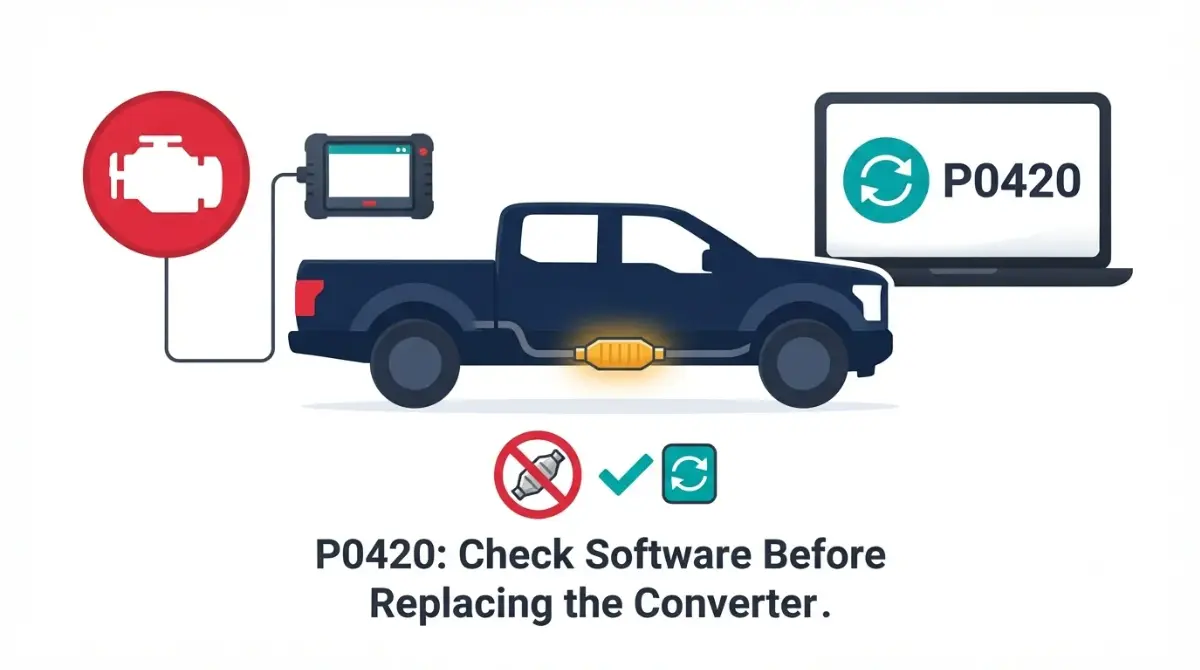
Table of Contents
Recall and bulletin status checked on November 21, 2026.
P0420 means your engine computer has judged the bank 1 catalytic converter to be working below the efficiency threshold it’s programmed to expect. It doesn’t prove the converter has failed, and several automakers have published bulletins in which the documented fix for this code is a software update.
Before anyone prices a converter, settle three things in order: what other codes are stored with P0420, whether a bulletin covers your vehicle, and whether the converter is within its federal emissions warranty. If the light is steady and the car drives normally, you have time to work through them.
Safety note: If the check engine light is flashing, or the engine shakes or loses power, have a qualified technician inspect the car before you drive it further. A flashing light usually signals an active misfire, and unburned fuel from a misfiring cylinder can overheat and damage the catalytic converter.
What the catalyst monitor compares
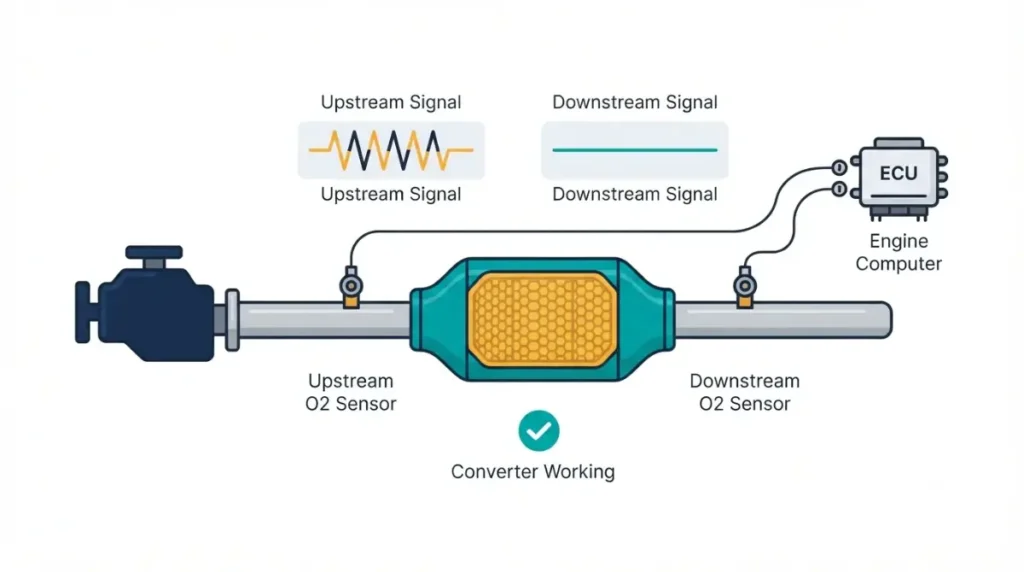
Two oxygen sensors bracket the converter. The upstream one reads exhaust straight from the engine (on many newer engines it’s a wide-range air-fuel ratio sensor), and the downstream one reads what leaves the converter. A working converter stores and releases oxygen, so the downstream signal stays fairly flat while the front sensor’s reading swings between rich and lean. When the downstream signal starts mirroring the front one, the computer decides the converter has lost efficiency and stores P0420.
Bank 1 is the side of the engine that holds cylinder 1. A four-cylinder has a single bank, so P0420 is the only catalyst-efficiency code it sets. On a V6 or V8, P0430 is the same fault on the opposite bank, and two of the software bulletins below cover both codes together.
OBD II, and this self-test with it, has been required on cars and light trucks since the 1996 model year. The test doesn’t run on every drive, only when the computer’s set conditions are met, so a fault can take several trips to show up again after the code is erased.
Misfire, leak or sensor: the cheaper causes to check
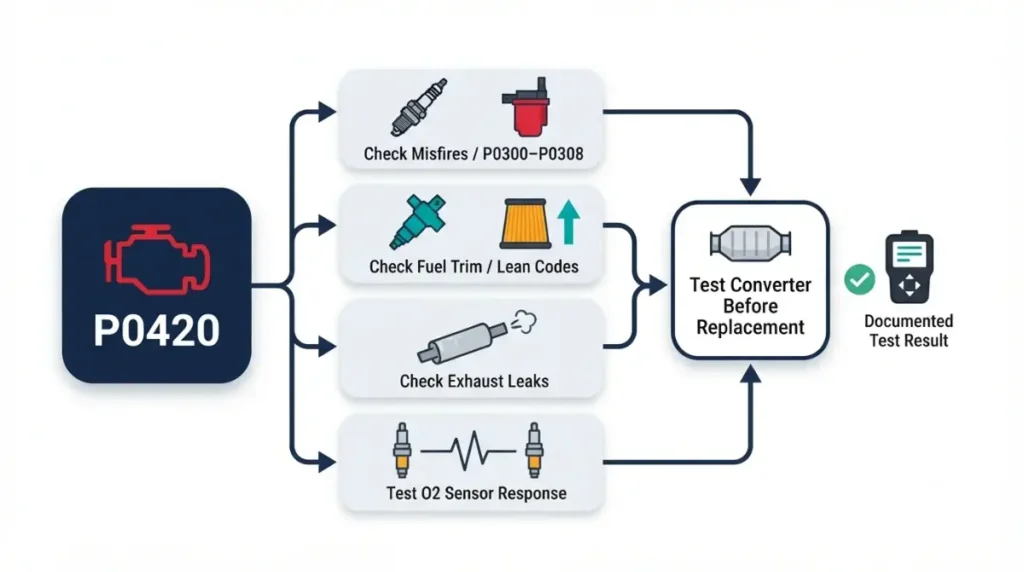
A second code stored alongside P0420 usually tells the shop where to start. Misfire codes (P0300 through P0308, where the last digit names the cylinder) point at the engine, and the converter can’t be judged fairly until the misfire is gone. A fuel-trim code such as P0171, system too lean on bank 1, does the same.
Hyundai’s bulletin 16-FL-005, for certain 2011–2014 Sonatas with the 2.4L GDI engine, shows how closely the two can be linked. Its software update stops catalyst temperatures from climbing, which on those cars could set either P0171 or P0420, and it tells technicians not to replace the catalyst when P0171 is the only code stored.
Misfires get checked first. Fuel from a cylinder that isn’t firing reaches the converter unburned and burns there instead, and that extra heat can damage the converter. Spark plugs and ignition coils are the first parts a shop looks at when a cylinder misfires.
With no other code stored, the shop’s next job is testing rather than replacing. That means checking the exhaust between the engine and the downstream sensor, and checking how both oxygen sensors respond, before anyone condemns the converter.
Bulletins where the fix was a software update
Ford bulletin 26-2067, issued February 24, 2026, carries the title “Incorrectly Illuminated MIL With DTCs P0420 And/Or P0430.” It’s one of several manufacturer bulletins on file with NHTSA in which the repair for a catalyst code is reprogramming the engine computer.
| Bulletin and issue date | Vehicles and engine | Documented repair | Labor allowed |
|---|---|---|---|
| Ford 26-2067, Feb 24, 2026 | 2021–2023 F-150, 2.7L EcoBoost (P0420, P0430) | PCM reprogram | 0.3 h |
| Ford 25-2549, Nov 5, 2025 | 2021–2022 Super Duty, 7.3L (P0420, P0430) | PCM reprogram, drive cycle and self-test; normal diagnosis only if the code returns | 0.8 h |
| Ford 25-2407, Aug 29, 2025 | 2023–2024 Maverick and Bronco Sport, 2.0L EcoBoost | PCM reprogram | 0.3 h |
| Ford 25-2188, May 7, 2025 | 2022–2024 Explorer, 2.3L EcoBoost, built on or after Jan 3, 2022 | PCM reprogram | 0.4 h |
| GM 19-NA-057, March 2019 | 2013–2015 Buick Encore and Chevrolet Trax, all engines | Engine and transmission modules reprogrammed together | Not stated in the bulletin |
| Hyundai 16-FL-005, September 2016 | Certain 2011–2014 Sonata, 2.4L GDI | ECM update, plus catalyst replacement when P0420 is stored | 0.8 h or 1.6 h, depending on the catalyst replaced |
Source: manufacturer service bulletins 26-2067, 25-2549, 25-2407, 25-2188, 19-NA-057 and 16-FL-005, as filed with NHTSA.
In five of the six, the documented repair is software. The Super Duty bulletin adds a drive cycle and a self-test, and only sends the truck to normal diagnosis if the code comes back. Hyundai’s is the exception: that update exists to keep catalyst temperatures down, so a catalyst that had already set P0420 gets replaced along with it.
A bulletin doesn’t add coverage by itself. Ford’s bulletins state that coverage follows the causal part, and the 2025 ones list the emissions warranty among the coverages that can pay. How that differs from a recall is set out in who pays for a Ford bulletin versus a recall.
2021–2023 F-150 2.7L trucks have their own bulletin
2021, 2022 and 2023 F-150s with the 2.7L EcoBoost fall under Ford TSB 26-2067. Ford says the light may be on in error because of PCM software, and that “this condition does not affect vehicle drivability or durability.” The repair is reprogramming the PCM, with 0.3 hour of labor and no parts listed.
Ford also tells dealers to warn owners that the transmission relearns its shift strategy after the reprogram, so upshifts and downshifts can feel firmer for several days.
The bulletin gives no build-date range. On any 2021–2023 2.7L showing P0420 or P0430, the reprogram comes before converter work, and other documented faults for these trucks are listed in F-150 problems by model year.
Is the converter still inside its 8-year, 80,000-mile warranty?
80,000 miles or 8 years, whichever comes first, is the federal warranty on a catalytic converter in cars and light trucks, including medium-duty passenger vehicles (40 CFR 85.2103). Most other emission-related parts get 2 years or 24,000 miles. Larger medium-duty trucks get 5 years or 50,000 miles on those other parts, with the same eight-year term on the converter.
That warranty can pay out on a converter in two ways. The defect warranty applies when the converter fails because of a defect in materials or workmanship. A manufacturer can turn a claim down when the evidence shows skipped maintenance or misuse caused the failure, so service records matter, and oil changes done at any shop or at home count as long as you can prove them.
The performance warranty starts at the inspection station. If your vehicle fails an EPA-approved emissions test and the failure would leave you facing a penalty or sanction under local, state or federal law, the manufacturer must fix the cause at no cost to you. That warranty runs 2 years or 24,000 miles, extended to 8 years or 80,000 miles when a failed converter is the cause, and the claim can be made as soon as the vehicle fails the test.
These terms come from the current regulation, which applies to 1981 and later vehicles, but its list of long-term parts has been revised over the years. The emissions warranty section of your warranty booklet is the document that settles which parts carry the longer coverage for your model year.
Coverage note: If the vehicle is inside 8 years and 80,000 miles, take the P0420 to a dealer for the brand before paying any shop for a converter. Emissions warranty claims go through the manufacturer’s dealers.
How a shop should prove the converter failed
A converter replaced while the cause is still present can set P0420 again, and nothing about the new part stops that. A diagnosis worth paying for answers these questions in writing:
- Which codes are stored besides P0420, and are they current or from an earlier drive?
- Is there a manufacturer bulletin for this code on my VIN, and is the engine computer’s software up to date?
- Were misfires, fuel trim, the exhaust ahead of the downstream sensor and both oxygen sensors checked?
- Which test showed the converter itself has failed?
- Is the converter still inside its 8-year, 80,000-mile coverage on my vehicle?
A shop that answers the fourth question with a named test result has done the diagnosis you’re paying for.
Repair cost once the cause is known
A software fix costs a small slice of a converter’s price. Ford allows 0.3 hour for the 2.7L F-150 reprogram, about 18 minutes of labor with no parts, while RepairPal’s estimate for replacing the converter on a Ford F-150 runs $1,591 to $1,656 across model years. Its year-by-year figures range from $879 to $947 on a 2015 truck up to $2,039 to $2,113 on a 2026.
| Repair | Labor or estimate | What’s included |
|---|---|---|
| PCM reprogram, Ford 26-2067 (F-150 2.7L) | 0.3 h | Labor only, no parts |
| PCM reprogram and drive cycle, Ford 25-2549 (2021–2022 Super Duty 7.3L) | 0.8 h | Labor only, no parts |
| Converter replacement, F-150 | $1,591–$1,656 across all years; $879–$947 for a 2015 up to $2,039–$2,113 for a 2026 | Estimated shop total |
Sources: Ford bulletins 26-2067 and 25-2549; RepairPal F-150 converter estimate, updated September 3, 2026.
Treat these as typical ranges: labor rates swing by region and from one shop to the next, and the written quote from the shop doing the job is the figure to plan around.
Inside coverage, bulletin labor costs you nothing. Outside it, the dealer bills the reprogram at its own hourly rate, which still leaves the software route far below any converter figure in the table.
Erasing the code resets your inspection readiness
Erasing P0420 with a scan tool turns the light off, but it also sets the car’s readiness monitors back to “not ready,” and an inspection reads that as a car that hasn’t finished its self-tests. New York’s DMV lists cleared codes as a cause of a not-ready result and notes that EPA guidelines allow only one monitor to be not ready on 2001 and newer vehicles. Other states set their own readiness rules, and some allow fewer exceptions.
Each monitor completes on its own drive cycle, which depends on the make and model. If the converter is weak, the catalyst monitor fails again once it runs and P0420 returns, so erasing the code doesn’t get a car through an emissions test. On a vehicle young enough to qualify, the failed test is better used as the start of a performance-warranty claim.
Replacement converters that are legal to install
In California, an aftermarket converter is legal to sell and install only with a California Air Resources Board Executive Order exempting it from the state’s anti-tampering law (CARB). Some other states have adopted California’s converter rule, so a converter sold as 49-state legal may not be legal where your car is registered. Check with your state’s environmental agency before ordering one.
Elsewhere, the choice is an original-equipment converter or an aftermarket unit built to EPA’s long-standing policy on replacement converters. Removing a converter, or disabling any emissions control, is tampering under the federal Clean Air Act in every state.
While the vehicle is under its eight-year converter coverage, the replacement part is the manufacturer’s to supply through its dealer, so the choice of brand only comes up once that coverage has ended.
Should you replace the converter for a P0420 alone?
No. A converter is the repair once a named test shows it has failed, with misfire and fuel codes fixed, the engine software current and any bulletin for your VIN applied. Inside the eight-year, 80,000-mile window, that replacement is a warranty claim at the dealer. Outside it, decide on the test result and a written quote for a converter that’s legal in your state; on an older car where that quote comes close to what the car is worth, compare the two before committing. Your first call is to a dealer for the brand, with the VIN ready, to ask whether a P0420 bulletin applies to your vehicle.
Found this helpful? See more of our guides on Google.
Want to see our guides first on Google?
