F-150 Problems by Year, 2011–2026, and What Ford Covers

Five recalls for one first-gear downshift on 2011–2014 trucks: F-150 problems by year, matched to the recalls and programs Ford still honors.
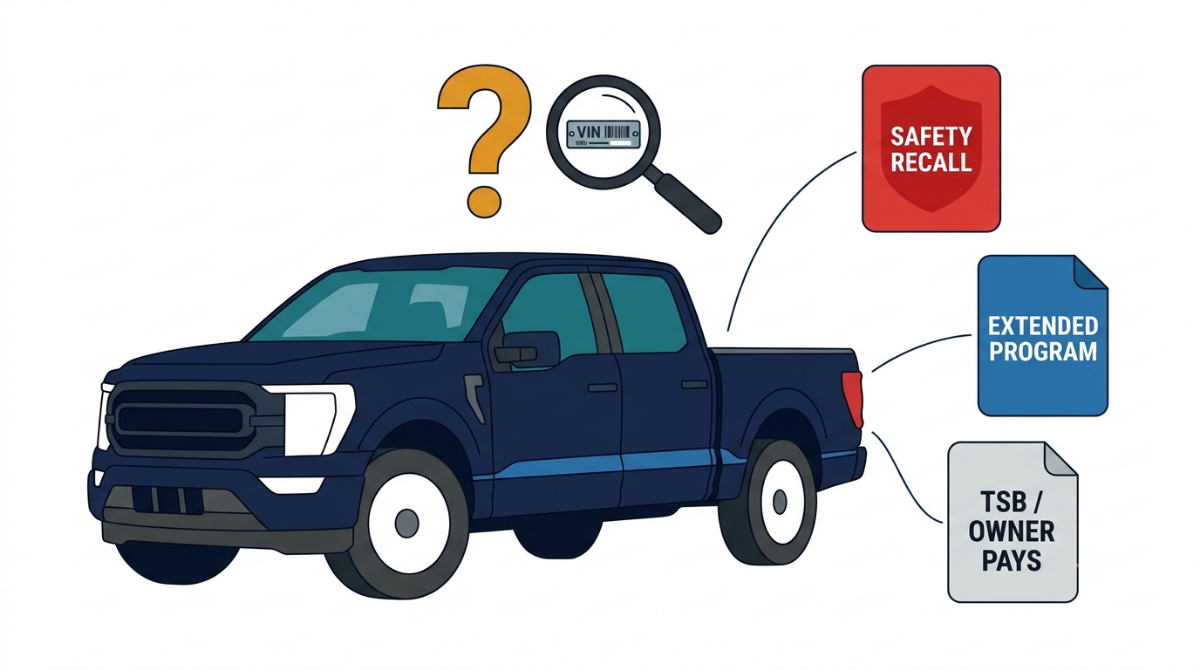
Table of Contents
Recall and bulletin status checked on November 7, 2026.
Ford’s software fix for the 2015–2017 F-150 six-speed downshift, recall 26S28, has been at dealers since July 9, 2026, and it costs owners nothing. The cam phaser program for 2017–2020 trucks fitted with the 3.5L EcoBoost went the other way: it ended January 1, 2023, so a cold-start rattle on one of those trucks today is your bill.
Who pays for an F-150 problem comes down to the model year and engine, and often to the build date range Ford lists for each assembly plant. Each problem on 2011–2026 trucks, including the PowerBoost hybrid, is matched below to the document Ford filed for it, with the date that coverage ends. The F-150 Lightning has its own campaigns and isn’t covered here.
Safety note: A sudden downshift with the rear tires skidding, a brake pedal that suddenly sinks farther, a 2021 truck that moves after you select Park, a Max Duty truck that loses drive, or a parking brake that grabs while you’re moving are all subjects of F-150 recalls. If your truck does any of these, have a Ford dealer inspect it before you keep driving, and call Ford’s recall line at 1-866-436-7332 with the VIN.
Which F-150 problems Ford still pays for
Fifteen years or 150,000 miles is the longest coverage Ford currently offers on any problem in this article, and it applies to two parts: the 2015–2017 six-speed lead frame (the circuit board inside the transmission that carries sensor signals) and the PowerBoost exhaust heat recovery unit.
| Model years and build | Problem | Ford document | Status | Coverage limit |
|---|---|---|---|---|
| 2011–2014, 6R80 six-speed | Sudden downshift into 1st gear | Recalls 16S19, 19S07, 19S19, 24S37, 26S45 | Open or closed by VIN | Free repair |
| 2011–2013, 6R80 six-speed | Lead frame failure | Programs 16N02, 19N01 | Past the limit on nearly all trucks | 10 yrs/150,000 mi |
| 2015–2017, built Mar 12, 2014–Aug 18, 2017 | Downshift toward 2nd gear, rear wheel lock-up | Recall 26S28 | Remedy available | No charge; lead frame 15 yrs/150,000 mi |
| 2013–2018, 3.5L | Brake fluid leaks into the brake booster | Recalls 16S24, 20S31, 22S11, 25S37 | Remedies out | No charge |
| 2015–2018, built through Nov 5, 2018 | Tailgate unlatches on its own | Program 20N03 | Active | Apr 3, 2030 or 150,000 mi |
| 2017–2020, 3.5L | Cam phaser rattle | Program 21N03 | Ended | Ended Jan 1, 2023 |
| 2.7L built May 1–Oct 31, 2021 | Cracked intake valve | Recall 24S55, program 24N12 | Active | 10 yrs/150,000 mi |
| 2021–2023 hybrid, built Jan 10, 2020–Sep 8, 2023 | Heat recovery valve failure or coolant leak | Program 24N04 | Active | 15 yrs/150,000 mi |
| 2021, 10-speed with park-by-wire | Park system may not hold | Recall 26S48 | Remedy not yet available | No charge once released |
| 2021–2025 Trailer Tow Max Duty | Rear axle hub bolt can break | Recalls 23S65, 25S82 | Repairs under way | No charge |
| 2021–2023 | Electric parking brake applies while driving | Recall 23S35 | Open or closed by VIN | Free repair |
Sources: Ford recall reports and program letters filed with NHTSA, including the 21N03 cam phaser program letter. Time limits count from the warranty start date, and each program ends at its time or mileage limit, whichever comes first.
Each program pays only for the failure it names. Program 24N12, for example, replaces the long block once if an intake valve fails on a 2.7L truck that has already had the 24S55 inspection, and 20N03 applies when the tailgate actually opens on its own because water got into its wiring. A truck with an unrelated engine or tailgate fault gets no help from either one.
Ford’s programs stay with the truck when it’s sold, and a dealer checks them by VIN.
2011–2014 trucks and the first-gear downshift
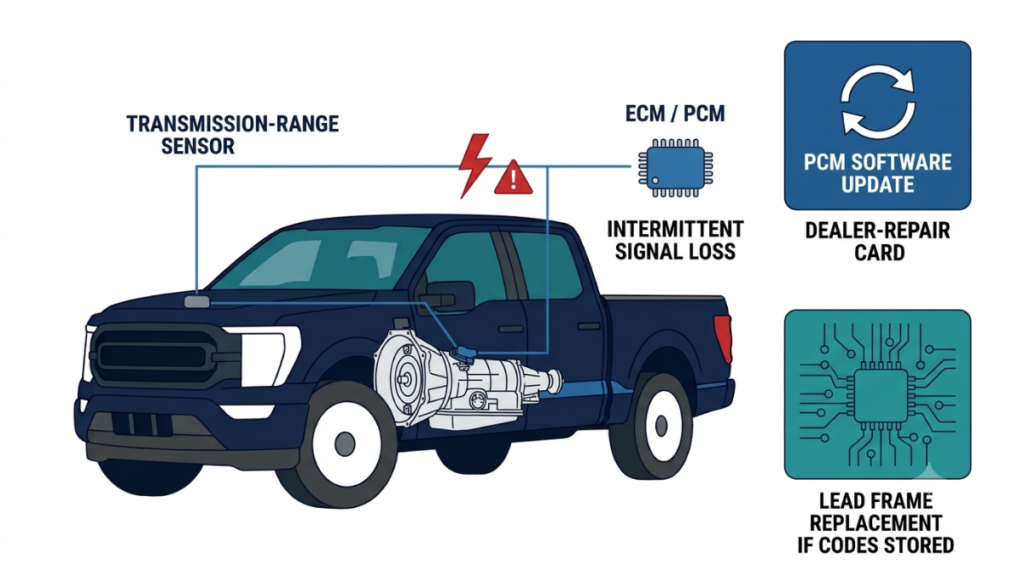
Recall 16S19, issued in 2016, traced a sudden drop into first gear on 2011–2012 F-150s fitted with the 6R80 six-speed automatic to an intermittent loss of the output speed sensor signal. The fault sits in sensor signals and software, so each remedy since has been a computer reprogram, sometimes with a new lead frame.
Five campaigns for one downshift
Recall 19S07 widened the fix to 1,263,051 trucks across the 2011–2013 model years, built from April 28, 2010 to November 18, 2013, and it closed NHTSA’s query RQ17-010. A few months later, recall 19S19 went back to 107,857 of the 2013 trucks with the 5.0L or 6.2L V8 because the 19S07 software didn’t carry the updates those engines needed.
The 2014 model year followed in 2024. NHTSA opened recall query RQ24-005 that March to look at whether the earlier recalls should have included 2014 trucks, and Ford answered with recall 24S37 for 552,188 of them. That remedy reprograms the engine computer and swaps in a replacement lead frame if the truck has stored codes P0720, P0722, P0731 or P1500. In 2026, Ford added recall 26S45 for about 45,000 of those 2014 trucks because they didn’t receive the correct software during their 24S37 repair.
If any of these recalls is still open on your truck, it’s a free repair. The separate lead frame programs are a different story: 16N02 and 19N01 ran a decade or 150,000 miles from first sale, so a 2013 truck sold new in 2013 aged out in 2023. You can find each 2011–2014 downshift campaign with its build dates on a separate page.
3.5L EcoBoost timing chain wear
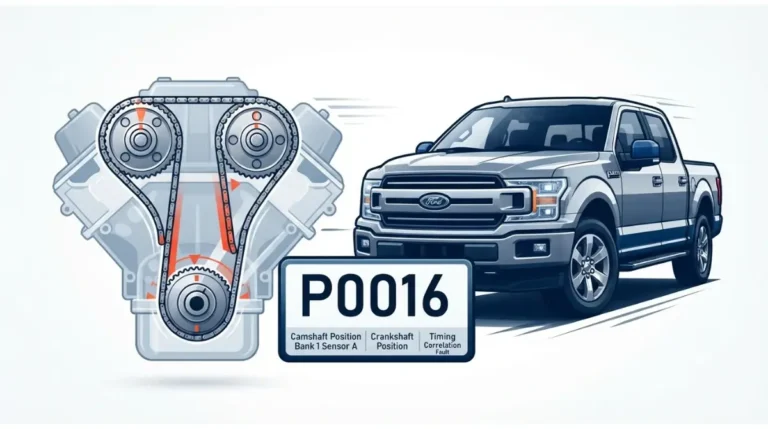
Bulletin 17-0026 applies to 2011–2014 3.5L trucks built through October 10, 2014 that set code P0016 from primary timing chain wear. Ford’s fix is a new primary chain. There’s no recall or extended program behind it, so outside the original powertrain warranty the owner pays. The sound itself is covered in how early EcoBoost timing chain rattle shows up on a cold start.
2013–2014 3.5L brake fluid leak
Recall 16S24 covers 225,012 EcoBoost 3.5L trucks made from August 1, 2013 to August 31, 2014. A rear seal in the master cylinder can roll and let fluid leak into the brake booster, which reduces front braking. Dealers replace the master cylinder and, if it’s leaking, the booster too. It was the first of four recalls on that part.
Six-speed downshifts, phaser rattle and oil use, 2015–2020
A drop from sixth gear toward second at highway speed, sometimes with the rear tires skidding for a moment, is the complaint behind recall 26S28.
2015–2017 six-speed downshift (26S28)
It covers 1,392,935 six-speed trucks built from March 12, 2014 to August 18, 2017. In Ford’s recall report to NHTSA, the cause is an intermittent transmission range sensor signal to the engine computer, and the worst case is a downshift from 6th to 2nd. As of April 2, 2026, Ford counted 444 warranty claims, 316 owner complaints to NHTSA and 891 separate trucks, with two injuries and one crash possibly related.
NHTSA opened preliminary evaluation PE25-002 on March 21, 2025 and upgraded it to an engineering analysis on January 30, 2026. NHTSA’s engineering analysis opening document says 43% of owners in its review reported at least one wheel lock-up, and cites Ford’s view that electrical connections inside the lead frame degrade from heat cycling and vibration. Its testing also found that losing the signal while reversing uphill may let the truck roll forward, one more reason to get the update done.
Dealers install a revised calibration at no charge. If the truck stored certain codes before the update, the dealer replaces the lead frame as well, and Ford backs that part with a 15-year, 150,000-mile extended warranty. Ford’s first owner letters went out before the remedy was ready, so an early letter that says no fix is available is out of date. Book it now, and ask the dealer to confirm both the calibration and any lead frame work on the repair order. Which codes qualify a 2015–2017 truck for a new lead frame has its own page.
2017–2020 3.5L phaser rattle
Program 21N03 paid for all four cam phasers (the units that adjust camshaft timing) on 2017–2020 3.5L trucks built from March 10, 2016 at Dearborn or April 15, 2016 at Kansas City, through November 30, 2019. Ford paid the full cost under 70,000 miles, 66% from 70,000 to 79,999, 33% from 80,000 to 89,999, and nothing above that, and only if the 21B10 software update was done by February 28, 2022. The program letter states that a noisy phaser doesn’t affect safety, performance or emissions.
It ended January 1, 2023, and the refund window for earlier owner-paid repairs closed with the 21B10 deadline. Bulletin 20-2191 still describes the repair for 2017–2018 trucks built on or before July 10, 2018: four new phasers plus new software. A bulletin gives the shop a procedure. It doesn’t make the work free.
Oil consumption bulletins for the 3.5L and 5.0L
Bulletin 19-2365 covers 2018–2020 5.0L V8 trucks burning more than 1 quart in 3,000 miles. Ford traced it to high intake vacuum during deceleration pulling oil into the cylinders; the fix is updated software, an oil change and, on trucks made by October 4, 2019, a new dipstick. Bulletin 20-2132 covers 2017–2019 3.5L trucks (not the 2018–2019 Raptor or 2019 Limited) built up to April 1, 2019, with the same 1-quart-in-3,000-miles threshold, and replaces both valve covers to cure a crankcase ventilation fault.
10-speed shift complaints and the lawsuit
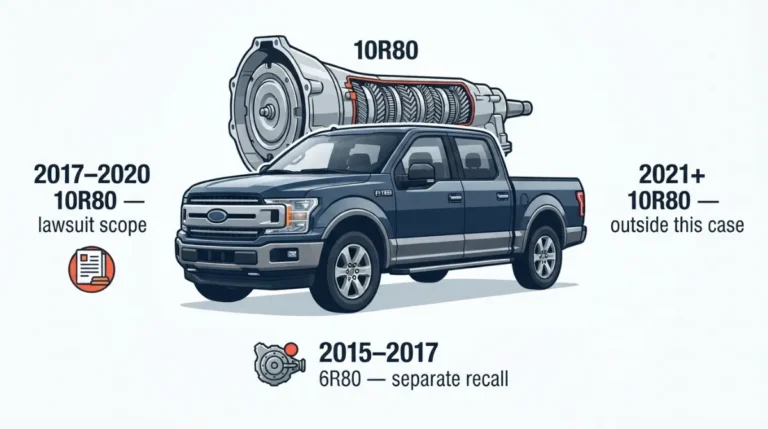
Bulletin 18-2079 reprograms 2017 F-150s built through August 1, 2017 that shift harshly or late, sometimes with code P0711 and the check engine light. A class action over the 10R80 in 2017–2020 trucks, O’Connor v. Ford Motor Co. in the Northern District of Illinois, survived Ford’s motion for partial judgment in February 2026, and the case continues. Symptoms are compared in the 10-speed shift complaints and what Ford’s bulletins change.
Can a finished F-150 recall come back?
A truck whose recall shows as completed can still get a new letter for the same part, and on the F-150 that has happened with at least four separate problems since 2016.
| Problem | First campaign | Later campaigns | Why it came back |
|---|---|---|---|
| 6R80 first-gear downshift | 16S19, 2011–2012 | 19S07, 19S19, 24S37, 26S45 | Scope widened to 2013 and 2014; 2013 V8 software lacked updates; some 2014 trucks got the wrong software |
| 3.5L master cylinder leak | 16S24, 2013–2014 | 20S31, 22S11, 25S37 | Field reports kept arriving from later build dates |
| Max Duty rear hub bolt | 23S65, 2021–2023 | 25S82, 2023–2025 | Expanded to later builds with a redesigned axle shaft |
| Daytime running lamps stay on | 20C03, 2018–2020 | 26C28 | A new body control module software update for 91,198 trucks |
Sources: Ford recall reports filed with NHTSA and Ford’s 22S11 chronology.
The brake chain is the clearest case. Ford wrote that its 2016 decision on 16S24 was made when the “root cause was unknown,” based on failure rates at the time. Recall 20S31 then extended the replacement to 292,311 EcoBoost trucks from the 2014–2017 model years, built through August 1, 2016, when the supplier added a silicone lubricant to the seal. Two more expansions followed, the latest, 25S37, for trucks built between February 1 and June 30, 2017.
If your truck had one of these repairs, a newer campaign may still list it, and only a fresh VIN check shows that. Keep the old repair order, which records the campaign number and the date the work was done. Owners with brake symptoms can match their truck to the four master cylinder recalls by build date.
2021–2026 trucks with recalls still open
Trucks built between January 8, 2020 and October 8, 2021 at Dearborn, or February 12, 2020 and September 28, 2021 at Kansas City, fall inside recall 26S48.
2021 Park system (26S48)
The recall covers 82,570 trucks from the 2021 model year with the 10-speed and electronic park-by-wire. While the truck is still moving, its park pawl can engage, which damages the park system so it may not hold the truck later. The remedy is not yet available: Ford expects it in April 2027, when dealers will update the powertrain software and inspect and replace damaged transmission parts as needed. Until then, follow the interim instructions in Ford’s owner letter, and see what 2021 owners can do until the 26S48 fix arrives.
Rear axle hub bolts on Max Duty trucks
Recall 23S65 covers 112,965 trucks from 2021–2023 that have the Trailer Tow Max Duty package and 9.75-inch heavy-duty rear axle, built between January 28, 2020 and December 25, 2022. A hub bolt can break from fatigue, and the truck can lose drive or roll away in Park. Ford’s dealer notices through 2024 described an interim repair that replaces both rear axle shafts and hub assemblies, and as of April 13, 2026, 47,196 trucks had been repaired, about 42%. Recall 25S82 adds 103,174 trucks from 2023–2025 built from January 2, 2023 to May 21, 2025, with redesigned shafts and fasteners. The hub bolt recall page explains what each repair replaces.
2.7L intake valves and engine coverage
Recall 24S55 inspects 47,719 2.7L trucks made May 1 to October 31, 2021 for intake valves that can crack and break. It closed NHTSA’s engineering analysis EA23-002. Program 24N12 backs it up: if a valve fails after the inspection, Ford replaces the long block once, within 10 years or 150,000 miles of first sale. On those build dates, a valve failure is covered.
PowerBoost exhaust heat recovery leaks
Program 24N04 covers 2021–2023 F-150 hybrids built January 10, 2020 through September 8, 2023. Water can get into the actuator and stick its valve, turning on the check engine light, and on the F-150 the unit’s coolant inlet port can break and leak coolant. That coverage runs 15 years or 150,000 miles. A follow-up, 25M04, covers only 301 trucks that got a weaker coolant spigot in an earlier repair. Other PowerBoost problems and hybrid campaigns have a page of their own.
Parking brake and trailer module recalls
Recall 23S35 covers 870,701 2021–2023 trucks whose rear axle wiring harness can chafe and apply the electric parking brake while driving; dealers inspect the harness and replace or protect it. Recall 26C10 covers 4,380,609 vehicles, including 2021–2026 F-150s, whose built-in trailer module can lose communication and drop trailer brakes or lights.
What you pay once the warranty and programs end
Five years or 60,000 miles, whichever occurs first, is where Ford’s Powertrain Limited Warranty ends. It can cover defects in engine internal lubricated parts, the cylinder block and engine computer, transmission internal parts and torque converter, and axle shafts and driveshafts. The New Vehicle Limited Warranty ends at 3 years or 36,000 miles, and Ford lists hybrid unique components at 8 years or 100,000 miles. Like any factory warranty, these pay for defects in materials or workmanship; Ford can refuse damage from skipped maintenance or misuse.
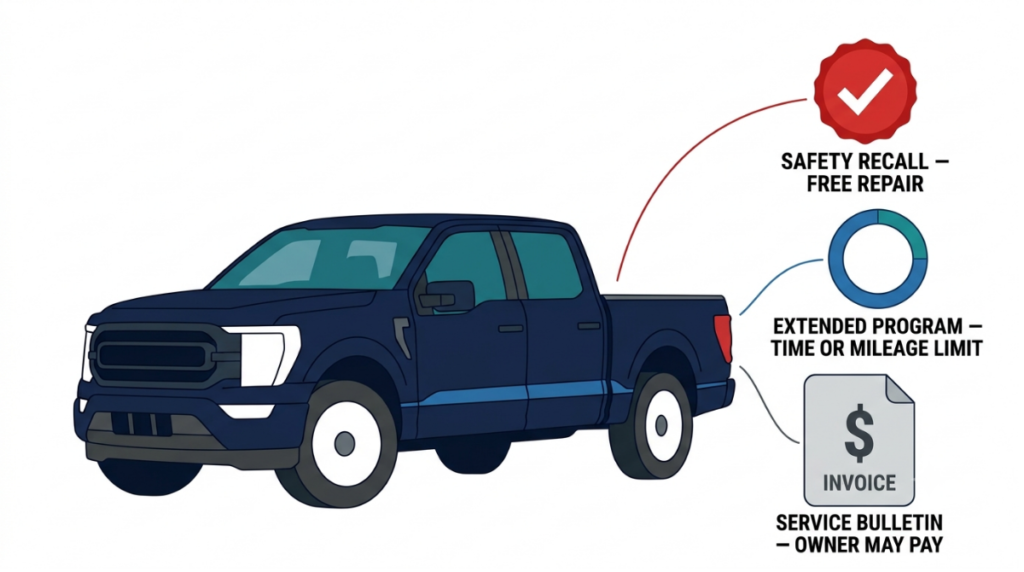
Coverage note: A service bulletin isn’t coverage. Ford pays for bulletin 20-2191, 19-2365 or 20-2132 work only while a warranty or program still applies to that truck and that part.
Federal law sets a longer limit for emission parts. Specified major components (the catalytic converter, the electronic emissions control unit and the onboard diagnostic computer) carry 8 years or 80,000 miles. Trucks certified to California emissions rules, or registered in California, also get 7 years or 70,000 miles on high-priced emission parts listed in the owner’s manual; other states set their own rules. Separately, federal recall law makes a safety recall free unless the truck was first sold more than 15 calendar years before the recall notice, so a 2011 F-150 sold new in 2010 is past that line for any recall issued after 2025.
If you paid for a repair before Ford’s recall letter on the same problem went out, Ford offers a refund through one of its dealers with your original receipts, processed after the dealer completes the recall work. Some recalls set a cutoff: 24S37 refunds only cover repairs done before July 19, 2024. For phaser work with no coverage left, see what a 3.5L cam phaser job costs at a dealer and an independent shop.
Does your VIN lookup show every open campaign?
A clean result on NHTSA’s recall search can still leave an open Ford program on the truck. That search shows unrepaired safety recalls only. It leaves out manufacturer customer service campaigns like 20N03 or 24N04, recalls more than 15 years old, and recent recalls whose VINs haven’t been loaded yet. Ford’s programs are listed against the VIN in the dealer’s system, so put four questions to the service desk:
- Which recalls and programs show open or completed on this VIN?
- Has a newer campaign replaced one already marked complete, as 26S45 did for some 24S37 trucks?
- Are any codes stored that a campaign names, such as P0720, P0722, P0731 or P1500 on a 2014 truck?
- Will this repair be billed to a recall, a program or a warranty, and under what number?
The answer to the last question belongs on the repair order before work starts.
Fix your F-150 or sell it with the fault disclosed
Get every free campaign done first. Recall and program work costs you nothing, and a buyer’s VIN search will show an open safety recall anyway.
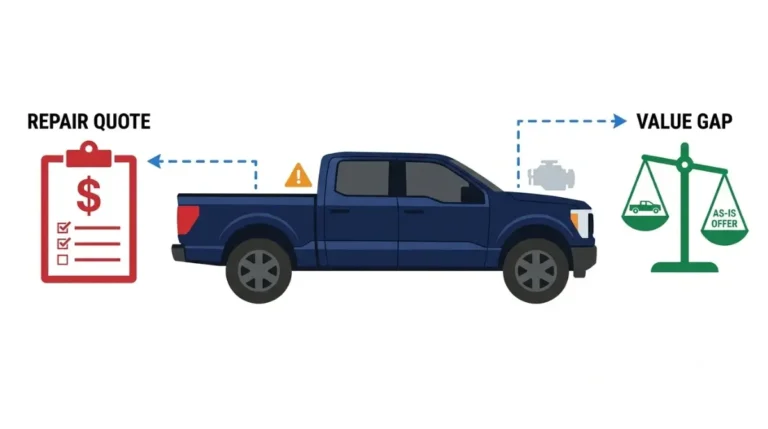
On a 2017–2020 3.5L with phaser rattle and no coverage left, the decision comes down to the noise and the price. Get a written quote, then compare it with what the truck is worth with the noise disclosed. A 2021 truck waiting on 26S48 is one to keep and drive under Ford’s interim instructions until April 2027. If you sell any F-150 with a known fault, put it in writing for the buyer with the quote attached, and never clear codes to hide it.
For trucks where a transmission or phaser bill is larger than the truck’s value, the trade-offs are laid out in when a phaser or transmission repair is worth paying for. Today, run the VIN through NHTSA’s search, then ask a Ford dealer to pull the program list on the same VIN.
Found this helpful? See more of our guides on Google.
Want to see our guides first on Google?