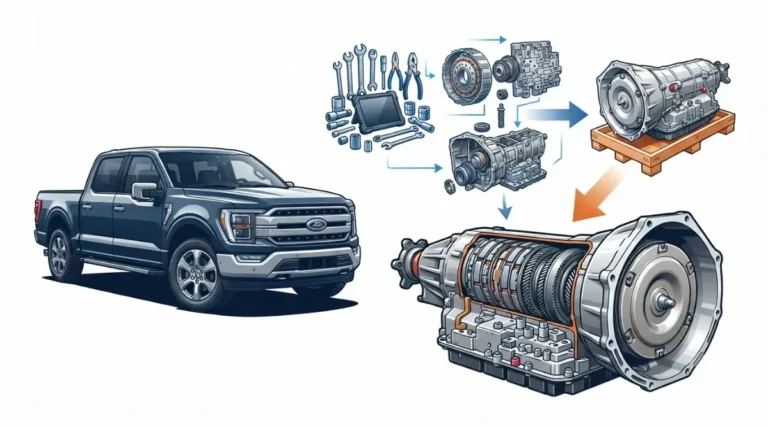
Ford Protect extended warranty for an F-150: when it pays off

Ford Protect PremiumCARE is the only tier that lists the F-150 cam phasers and hybrid parts, and signing after 12 months or 12,000 miles adds a $100 fee.
Table of Contents
Plan terms and bulletin status checked on November 26, 2026.
A Ford Protect extended warranty pays off on an F-150 you’ll keep past 60,000 miles, bought as PremiumCARE within the first 12 months, because PremiumCARE is the one tier that lists both the cam phasers and the hybrid drive parts. Trade the truck sooner and the factory warranties already cover most of what you’d be buying, and on a PowerBoost no tier covers the high-voltage battery.
Who comes out ahead on Ford Protect, and who doesn’t
Owners of a 3.5L EcoBoost or any 10-speed truck who drive beyond Ford’s 5-year/60,000-mile powertrain warranty are the ones who get their money back. Both carry repairs that cost thousands once Ford stops paying, which shows up year by year in the F-150 problems Ford still covers and the ones it doesn’t.
Skip the plan if you’ll sell before 60,000 miles or if the truck runs a lift kit or a tune.
PowertrainCARE is the weakest buy on a new truck. Its 29 parts are drivetrain parts, the same kind the powertrain warranty already covers, so most of what it adds starts only when that warranty ends.
Which F-150 parts each Ford Protect tier lists
PremiumCARE lists more than 1,000 components, against 113 for ExtraCARE, 84 for BaseCARE and 29 for PowertrainCARE. The rows below are the F-150 parts that separate them.
| F-150 part | PremiumCARE | ExtraCARE | BaseCARE | PowertrainCARE |
|---|---|---|---|---|
| Cam phasers (variable camshaft timing units) | Listed | Not listed | Not listed | Not listed |
| Timing chain and factory turbocharger | Listed | Listed | Listed | Listed |
| Transmission case, internal parts and torque converter | Listed | Listed | Listed | Listed |
| Transmission module | Listed | Listed (external module) | Not listed | Not listed |
| Gas fuel injectors | Listed | Listed | Not listed | Not listed |
| Trailer brake module | Listed | Not listed | Not listed | Not listed |
| Blind spot, lane departure and reverse sensing | Listed | Adaptive cruise control only | Not listed | Not listed |
| Hybrid-unique parts | Listed, except high-voltage battery and cables | Not listed | Not listed | Not listed |
| Catalytic converter, exhaust, brakes and shocks | Not covered | Not covered | Not covered | Not covered |
Source: Ford Protect’s October 2023 tier brochures, linked from Ford’s plan comparison page.

On a 3.5L EcoBoost the phaser row decides it: only PremiumCARE names the camshaft timing units. On a 10-speed truck the middle tiers aren’t interchangeable either, since ExtraCARE keeps the gas injectors and the transmission module that BaseCARE drops.
PowerBoost owners should read the hybrid row twice. Ford’s PremiumCARE brochure lists the truck’s unique hybrid parts “excluding high-voltage battery and cables,” and the other three tiers don’t list hybrid parts at all. The battery stays under Ford’s factory hybrid warranty, 8 years or 100,000 miles from the Warranty Start Date, whichever comes first, for defects in materials or workmanship.
Seven years of PremiumCARE buys about four new years
A 7-year plan doesn’t add 7 years, because its clock starts at the Warranty Start Date and zero miles (Ford Protect FAQ) and its first 3 years overlap the factory bumper-to-bumper warranty. ConsumerAffairs priced a 7-year/100,000-mile plan for a new F-150 XLT with a $100 deductible and got three quotes from $2,000 to $4,000, one of them Ford Protect PremiumCARE. Spread over the years the plan actually adds, the price looks like this.
| Miles a year | Plan ends | Bumper-to-bumper ends | New years of coverage | Cost per new year |
|---|---|---|---|---|
| 12,000 | Year 7, at 84,000 miles | Year 3 | 4 | $500–$1,000 |
| 15,000 | About year 6.7, at 100,000 miles | About year 2.4 | About 4.3 | About $470–$940 |
| 20,000 | Year 5, at 100,000 miles | About year 1.8 | About 3.2 | $625–$1,250 |
Cost per new year divides the quote range by the new years of coverage.

Those are one outlet’s quotes rather than a price list: Ford prices plans by vehicle and coverage, and the number on the contract you sign is the one to run through this math.
Engine and transmission parts overlap for longer, because Ford’s powertrain warranty runs 5 years or 60,000 miles on gas F-150s, the 2026 model included. At 12,000 miles a year, a 7-year plan is the only coverage on those parts for years 6 and 7 only.
2017–2026 F-150 repairs that could cover the plan’s price
Ford’s own bulletin labor times show what a failure costs once nobody else is paying. For 2017–2020 3.5L EcoBoost trucks built on or before November 30, 2019, TSB 23-2143 books 9.6 labor hours for the phaser job, and with Ford’s listed parts that comes to about $1,930 to $2,440 at posted shop rates of $120 to $159 an hour, before seals, fluids, fees and tax (cam phaser replacement cost on a 2017–2020 3.5L). Those trucks are past the New-plan window, so their only route to phaser coverage now is a Used plan.
The 10-speed costs more. Labor alone on Ford’s 10-speed bulletin repairs for 2017–2026 trucks runs $912 to $2,401 at the same rates, before parts, and a full dealer replacement on a 2022 SuperCrew was estimated at more than $8,600 (what a 10-speed repair costs after warranty).
Transmission internals and the torque converter are on all four tiers, but a plan pays for them only after the powertrain warranty ends. One replacement after 60,000 miles covers a $4,000 plan twice over. A phaser job on its own lands near the low end of the quotes, and each repair visit costs the $100 deductible whether the dealer fixes one failure or three.
Before any teardown, ask the dealer to match the failed part to your tier’s component list and file the claim with Ford Protect first.
Buy in year one or pay a surcharge later
The cutoff for a New plan is the end of the factory bumper-to-bumper warranty: 3 years or 36,000 miles, whichever comes first (Ford Protect FAQ). Section 11 of Ford Protect contract FPLP 8251 adds a $100 fee to New coverage bought after 12 months or 12,000 miles, so the first year is the cheaper time to sign.
Several Ford dealers sell plans online, and any Ford or Lincoln dealer in the US, Canada and Mexico honors them. Ford also offers interest-free installments for up to 30 months. Choose the disappearing deductible only if you’ll use the selling dealer for repairs, because it drops to $0 only when that dealer does the repair.
Cancel within 30 days of signing, with no claim filed, and the full price comes back. After that the refund is pro rata minus a $75 fee, paid within 45 days. Arkansas is one of several states that set a lower fee, so the figure depends on where you live. A sale moves the plan to the next owner for $75 if the transfer starts within 180 days, with Florida and Nevada charging less.
Past 36,000 miles? Used plans and the Continued Service Plan
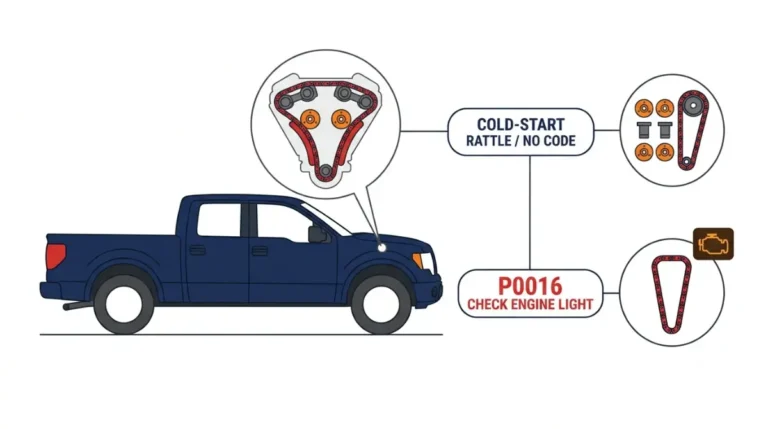
A 2019 3.5L EcoBoost that already rattles on a cold start can still get a Used PremiumCARE plan, just not for that rattle. Ford sells Used plans for 2010 and newer vehicles with no factory warranty left, and their coverage starts at the signing date and current mileage. Terms run from 6 months/6,000 miles on PowertrainCARE and BaseCARE, or 1 year/10,000 miles on ExtraCARE and PremiumCARE, up to 6 years or 75,000 miles, with coverage ending at the earlier limit. The standard deductible is $100, and the $0 option isn’t offered.
Coverage note: Section 7(f) of the Ford Protect contract excludes “all repairs that are required due to a condition that existed prior to the Signature Date.” Have any noise or warning light diagnosed before you sign, because a fault that existed before that date stays yours to pay. Arizona narrows the exclusion to faults that were known or detectable, and other states set their own rules.
When a Ford Protect plan or the factory warranty is about to expire, Ford’s follow-on product is the Continued Service Plan. A truck can enroll at up to 12 model years and 140,000 miles and stay covered until 14 model years and 160,000 miles (Ford’s buyer guide for the plan). It isn’t sold in California.
Lift kits, tunes and the maintenance log
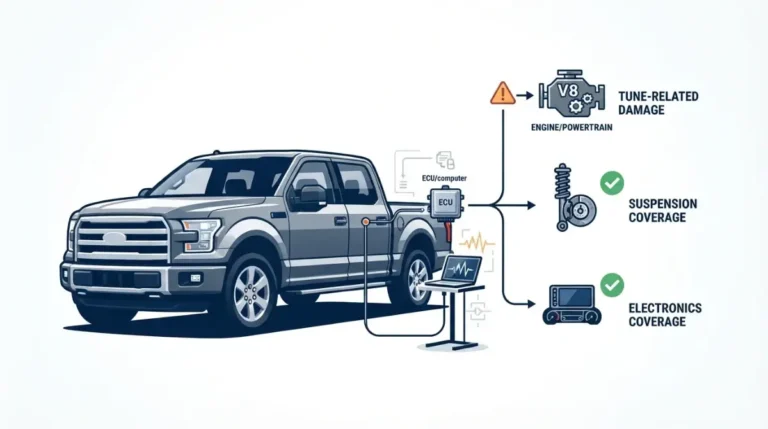
Off-road parts Ford didn’t install, such as lift kits and oversized tires, are excluded under Section 7 of the contract, and so are failures from non-factory PCM reprogramming, which is what a tune is. Tampering with emissions controls is excluded too, and it violates the federal Clean Air Act; in states that require it, aftermarket street parts need a CARB Executive Order number.
A claim also needs proof of scheduled maintenance showing the date, mileage, VIN and work done. Doing your own oil changes is fine with a written log and the receipts for parts and fluids. Repairs belong at a Ford dealer, and an independent shop is paid only as an emergency repair when every Ford or Lincoln dealer within 25 miles is closed. Business or farm use adds a surcharge to the price.
Get three PremiumCARE quotes before you sign
Ask three Ford dealers to price the same PremiumCARE term and deductible in writing, so the quotes compare line for line. Then put these questions to whichever one you choose:
- Is this a New or a Used plan, and on what date and at what mileage does it end?
- Does this tier list the cam phasers and the trailer brake module by name?
- Is the deductible charged per repair visit, and does the disappearing option work only at your dealership?
- Has the 12-month/12,000-mile surcharge been added to this price?
- What would my refund be in this state after the first 30 days?
If the lowest 7-year/100,000-mile quote falls inside the $2,000 to $4,000 range above and you’ll keep the truck past 60,000 miles, sign before the 12-month mark. If you’ll trade sooner, or every quote sits above that range, keep the money and let the factory warranties run their course.
Found this helpful? See more of our guides on Google.
Want to see our guides first on Google?