F-150 Grinding Noise in 2WD That Stops in 4WD? Read the TSBs
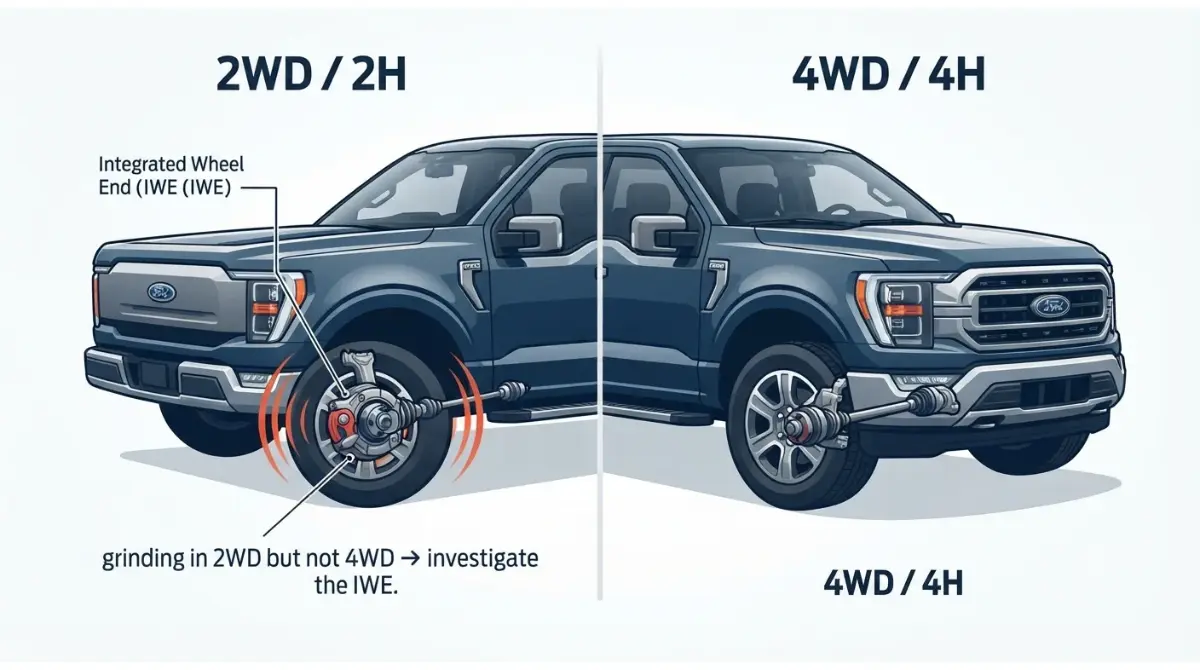
Table of Contents
F-150 grinding in 2WD: is it the IWE?
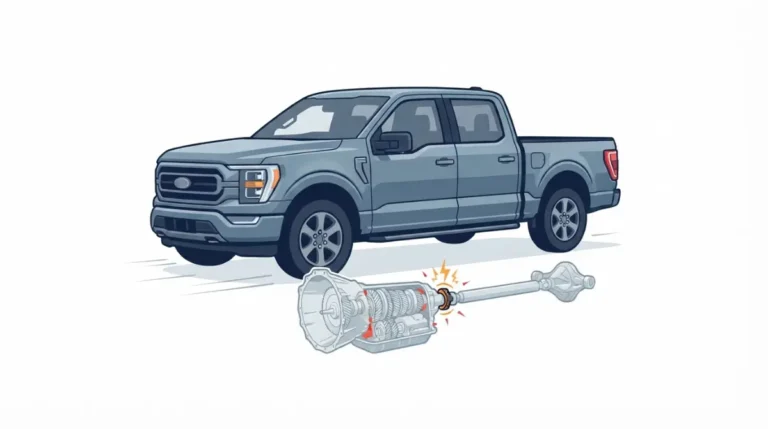
An F-150 grinding noise in 2WD that stops in 4WD points to the front integrated wheel ends (IWE) on a 4×4 truck. Ford has published service bulletins for it covering 2013–2018 and 2021–2025 trucks.
Only 4×4 trucks have this system
Every bulletin here covers trucks equipped with 4WD, so a 2WD-only F-150 isn’t in scope. It’s one of the issues in our F-150 problems by model year guide.
Where to start
- Hearing it, no quote yet: confirm it stops in 4WD, then match your year below.
- Holding a quote: see the bulletin table and cost section.
- Still under warranty: see how Ford decides coverage.
ℹ️ Safety Note: The front wheel end sits inside the steering, suspension and brake assembly, and repairs involve lifting the truck and removing safety-critical fasteners. This article explains symptoms and what Ford’s bulletins say; have any suspected fault inspected by a qualified technician.
Grinding only in 2WD? What the pattern looks like
Ford describes intermittent grinding from the front wheel area of 2013–2018 trucks, most often under acceleration in 2WD.
The 2H versus 4H test
Ford’s 2015–2018 and 2021–2025 bulletins share one clue: the noise stops in 4WD. If it continues there, it’s outside their pattern. Follow your owner’s manual on shifting.
“It sounds like the turbo”
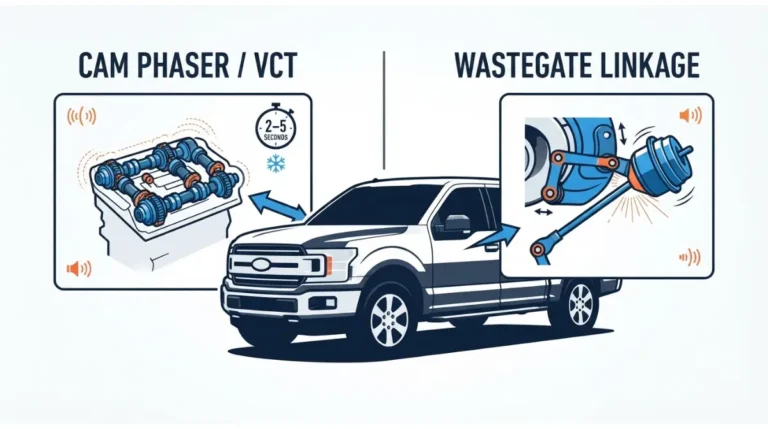
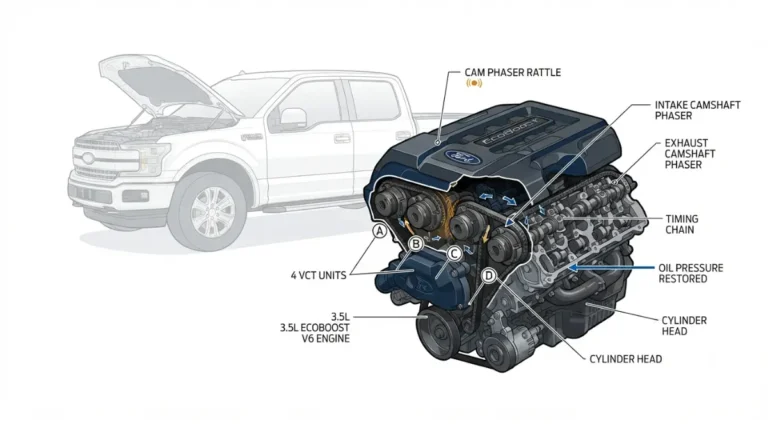
On 3.5L and 2.7L EcoBoost 4x4s, SSM 48082 says the noise could seem turbo-related, but returned turbos showed no concerns. Its text says 2015–2018; its heading says 2015–2019, so 2019 is unconfirmed. For rattles, see wastegate rattle versus cam phaser noise.
No warning light or code
For 2021–2025 trucks, Ford says no DTCs are stored in the transfer case control module, so a scan won’t flag it.
What the IWE does and why it grinds
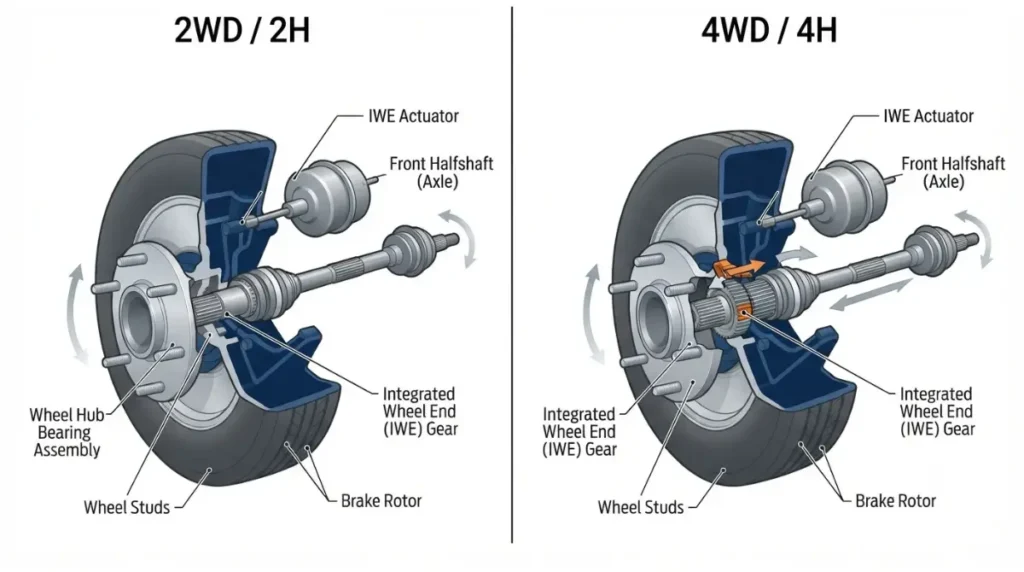
An integrated wheel end lets the front wheels spin freely in 2WD and locks them to the front axle in 4WD.
What Ford says causes it
The grinding happens when an IWE doesn’t fully disconnect in 2WD. Ford attributes it to vacuum loss or component wear on 2013–2018 trucks, and to possible incomplete actuator disengagement on 2021–2025 trucks.
🔍 Why It Happens: Ford’s 2021–2025 test checks whether the front halfshafts turn with the wheels in 2WD. If they do, the IWE hasn’t released.
What Ford doesn’t say
For 2021–2025 trucks, Ford’s bulletin doesn’t state how the IWE is actuated, so this guide doesn’t either.
Which F-150 years have Ford bulletins for this?
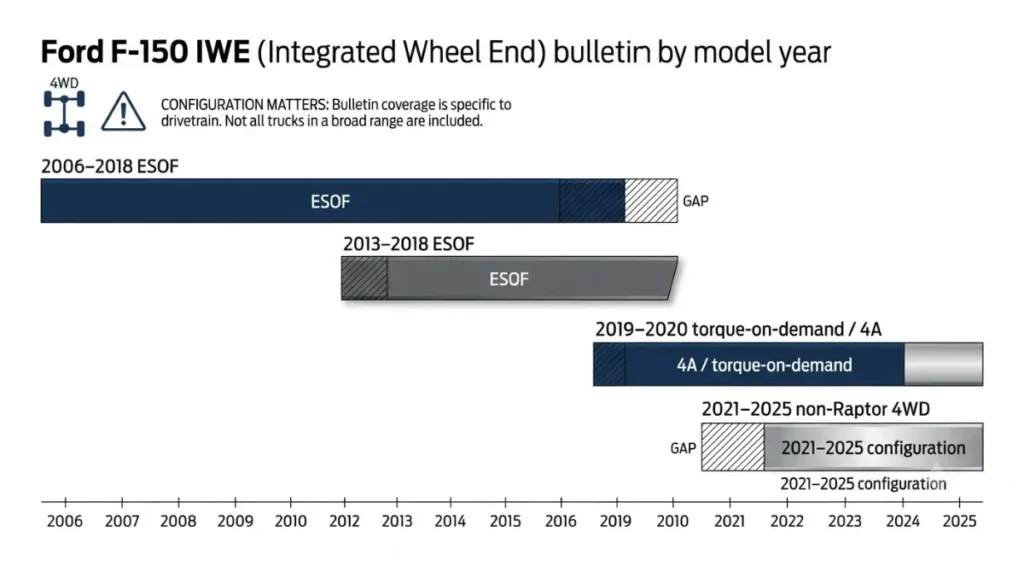
Ford has IWE bulletins for 4WD trucks from 2006–2025, with gaps; find yours below.
| Applies To | Bulletin | Ford’s Fix | Status |
|---|---|---|---|
| 2021–2025 non-Raptor 4WD, ESOF (code FMLAS) | TSB 25-2612, 18 Dec 2025 | Check halfshafts, clean splines, new IWE actuator(s) | Newest found |
| 2019–2020 non-Raptor, torque-on-demand (4A) | TSB 24-2188, 23 Jul 2024 | Cap IWE vacuum supply line | Newest found |
| 2006–2018 non-Raptor 4WD, ESOF | TSB 24-2188 | Vacuum check; 2017–2018 reprogram | Newest found |
| 2013–2018 ESOF | TSB 20-2278, 15 Oct 2020 | Check valve, vacuum tests, parts by result | Newest found |
2013–2018 (ESOF)
ESOF trucks have a switch with only 2H, 4H and 4L.
2019–2020 (torque-on-demand)
A 4A position on the mode switch means torque-on-demand.
2021–2025 (FMLAS)
Ask a dealer to check your minor feature code.
Years with no bulletin found
We found no bulletin for 2019–2020 ESOF, 2021–2025 non-FMLAS, or 2026 trucks; that doesn’t mean they’re unaffected.
What Ford’s bulletins tell shops to do
Ford’s fix differs by generation; ask which bulletin fits.
2013–2018: check valve, vacuum tests, parts by result
TSB 20-2278 has the shop replace the check valve, test the vacuum system, then replace the IWE or clutch ring, plus the wheel bearing if splines are damaged. 2017–2018 trucks also get a reprogram that keeps IWEs engaged for about 0.5 miles at startup above 32°F.
2019–2020: cap the vacuum line
For 2019–2020 torque-on-demand trucks, TSB 24-2188 has the shop remove the IWE vacuum supply line and cap the open ports. Ford’s text doesn’t describe the effect on 2WD operation, so ask before approving.
2021–2025: check halfshafts, clean splines, new actuators
The shop checks whether the front halfshafts turn with the wheels in 2WD, cleans the splines, and installs new IWE actuators on the affected side or both, a refinement of the original 2024 bulletin. Ford says its procedures aren’t meant for do-it-yourselfers.
Is the repair covered, and what will it cost?
A TSB describes a repair; it doesn’t decide who pays.
Coverage follows the causal part
Ford says warranty limits aren’t altered by a TSB; coverage follows the causal part, here 3C247, checked in Ford’s OASIS tool. The New Vehicle Limited Warranty runs 3 years or 36,000 miles from delivery.
Bulletin labor hours
| Applies To | What It Includes | Ford Hours |
|---|---|---|
| 2021–2025, TSB 25-2612 | Diagnose, clean splines, replace: left / right / both IWE | 2.3 / 2.1 / 3.4 |
| 2013–2018, TSB 20-2278 | Check valve and vacuum test only / both IWEs, bearings, clutch rings | 0.8 / 2.6 |
💵 What It Costs: Ford publishes hours, not dollars, and these are warranty labor times, not retail quotes. Multiply hours by your shop’s posted rate and add parts; dealer versus independent and regional rates vary widely (compare with our Repair Cost Estimator). We have no sourced parts prices, and 2013–2018 repairs can add 0.2–0.5 hours.
What to do next, and when to stop driving
Ford’s bulletins don’t say whether driving with the noise is safe or that waiting causes damage, so ask the dealer.
What to tell the shop
✅ Do This: Bring your model year, whether the noise stops in 4WD, and the bulletin number from the table. Ask whether part 3C247 is covered before authorizing work.
Noise that doesn’t fit the pattern
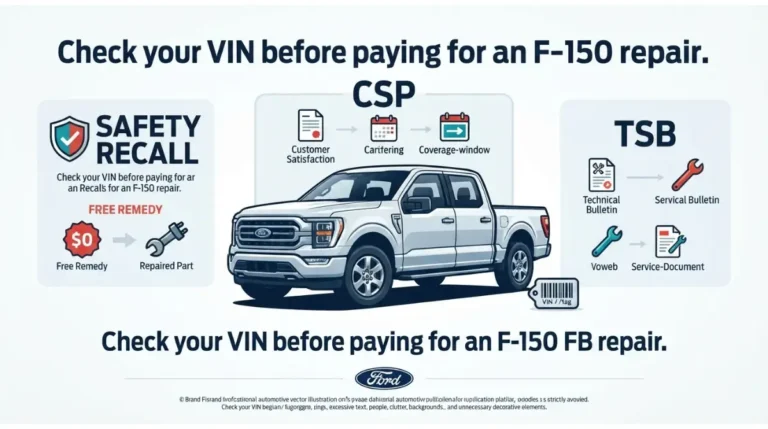
If it continues in 4WD, or you feel steering vibration or a locking wheel, have the truck inspected before driving on. Our rear axle hub-bolt recall guide covers a separate axle recall. We found no IWE recall or investigation on 30 September 2026; check your VIN with our Recall & VIN Lookup Helper.
FAQ
1. Why does my F-150 grind in 2WD but not 4WD?
Ford attributes F-150 grinding in 2WD to an IWE that doesn’t fully disconnect; the noise stops once you select 4WD.
2. Does a 2WD-only F-150 get this grinding noise?
Every bulletin covered here applies to 4WD-equipped trucks, so a 2WD-only F-150 isn’t covered for this grinding noise.
3. Which F-150 years have IWE bulletins?
TSBs cover 2013–2018, 2021–2025 ESOF trucks, and 2006–2020 under TSB 24-2188 (2019–2020 only with torque-on-demand).
4. Is my F-150 grinding noise the turbo?
On 3.5L/2.7L EcoBoost 4x4s, SSM 48082 says returned turbos showed no concerns; the grinding may trace to the IWE instead.
5. Will an F-150 grinding noise in 2WD set a code?
For 2021–2025 trucks under Ford’s bulletin, no diagnostic trouble codes are stored in the transfer case control module.
6. Is the IWE repair covered by warranty?
Coverage follows the causal part (3C247) checked in Ford’s OASIS tool; a TSB doesn’t change warranty limits.
7. How long does the IWE repair take?
Under TSB 25-2612, Ford lists 2.3 hours (left), 2.1 (right), and 3.4 (both); these are bulletin times, not quotes.
8. Can I fix the IWE grinding noise myself?
Ford says its bulletin procedures aren’t meant for do-it-yourselfers, and the repair involves the front wheel end. Have a qualified technician do it.
9. What is the 2019–2020 torque-on-demand fix?
TSB 24-2188 has the shop remove the IWE vacuum supply line and cap the open ports; Ford doesn’t describe the 2WD effect.
10. Does waiting make the grinding worse?
Ford doesn’t say delay causes damage, but its 2013–2018 procedure adds wheel bearing replacement when spline damage is found.
The short version
Confirm your truck has 4WD and the noise stops when you select it. Match your year to the bulletin table, then ask the shop which bulletin applies and whether part 3C247 is covered before you authorize anything. A quote that cites no bulletin number is worth questioning. Check your VIN for open recalls first.