F-150 Clunk When Stopping? The Right 2017–2022 Ford Bulletin
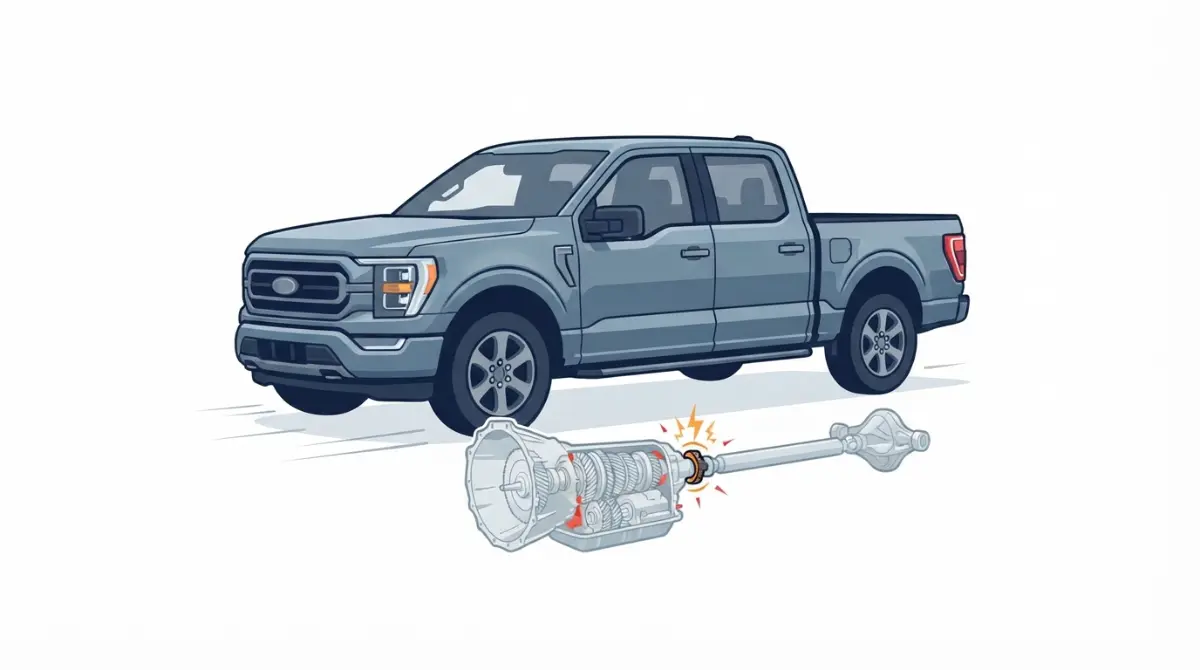
Table of Contents
Why your 10-speed F-150 clunks when you stop
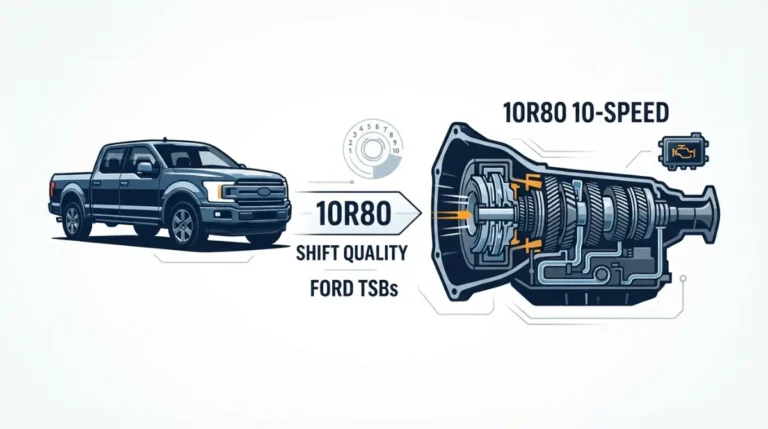
A clunk as your F-150 rolls to a stop or drops into Drive usually traces to one of two places: the 10R80 10-speed automatic or the rear driveshaft slip yoke. Ford has published service bulletins on the first, and the second has a long paper trail on older F-150s.
Transmission or driveline?
Start with your situation:
- Clunk while slowing or selecting Drive, check-engine light on: likely transmission. Go to the bulletin table.
- Thump pulling away or stopping downhill, no warning light: possibly driveline. See the slip-yoke section.
- Under 5 years/60,000 miles: check coverage before paying anything.
- Holding a quote: jump to the shop checklist.
Which trucks this covers
This covers 2017–2026 F-150s with the 10-speed. 2017 owners should confirm their transmission first, because MY2017 F-150s were built with either the 6R80 or the 10R80. For every other known issue by year, see our F-150 problems by model year guide.
ℹ️ Safety Note: The transmission and driveshaft transmit all of your truck’s drive torque, and a failure can affect vehicle control. The information here is for general understanding; have any clunk inspected by a qualified technician. This article gives no under-vehicle procedure.
When the clunk happens tells you where it lives
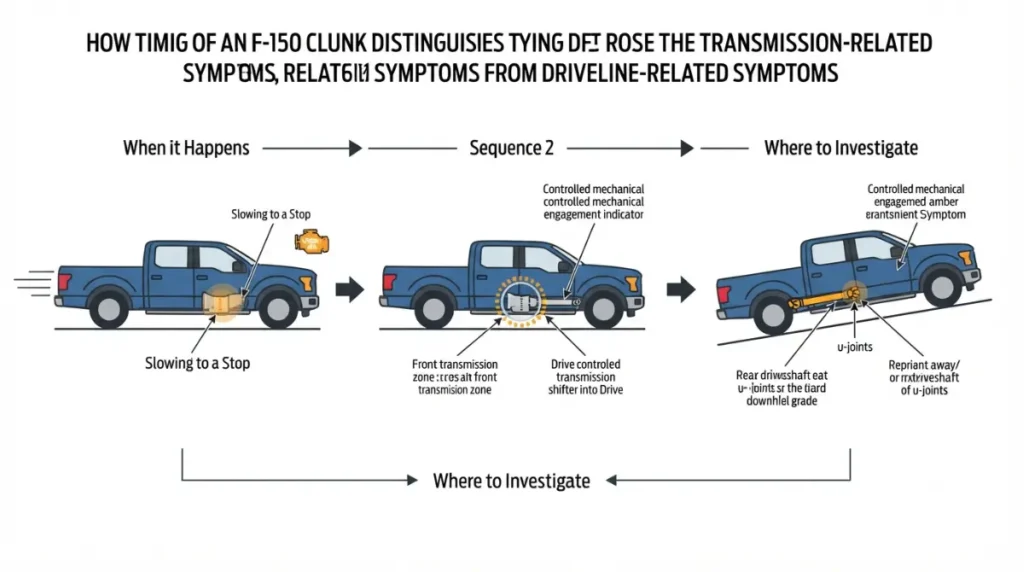
The timing of the clunk is the most useful clue you have.
Rolling to a stop or tapping into Drive
Ford’s bulletins for 2017–2020 trucks list harsh engagement, delayed engagement, harsh shift, delayed shift, and an illuminated MIL with DTCs such as P0751 and P2700. A clunk on the coast-down or the instant you select Drive, especially with a warning light, points to the transmission.
Pulling away or stopping downhill
Owner forums for 2021-and-newer trucks repeatedly describe a rear thump that shows up mostly when coming to a stop, almost always on a downhill grade, sometimes after a transmission reprogram failed to help. Ford treated these as separate problems. Its 2009–2010 slip-yoke bulletin says other driveline noise conditions, including engagement clunk, will not be corrected with this procedure.
What Ford says causes the 10R80 clunk
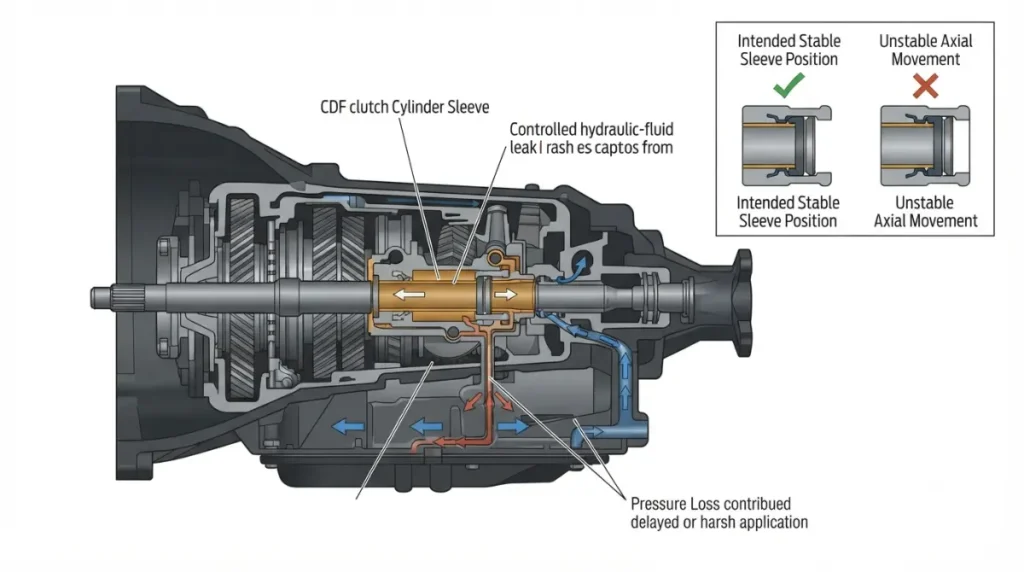
Ford’s bulletins name three causes, and the slip yoke is a fourth suspect outside them.
The CDF clutch cylinder sleeve
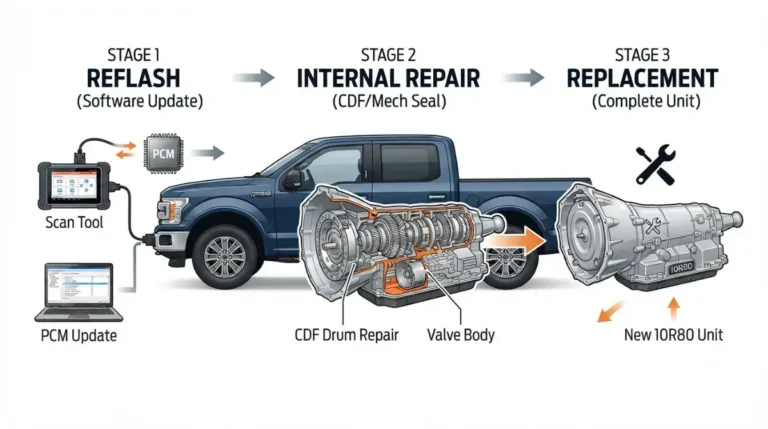
For 2017–2020 F-150s, Ford attributes the condition to axial movement of the CDF clutch cylinder sleeve causing hydraulic circuit leaks.
🔍 Why It Happens: Each gear change applies clutches with pressurized fluid. If that pressure leaks away, the clutch can apply late and then abruptly. That is the “harsh/delayed” engagement you feel as a clunk.
Sticking valves and software
Earlier 2017–2020 bulletins also cited the transmission solenoid ID strategy, sticking valves in the main control valve body and/or axial movement of the CDF clutch cylinder sleeve. More on known 10R80 behaviour is in our F-150 10-speed transmission problems guide.
The dry slip yoke
The slip yoke’s splines let the driveshaft change length as the suspension moves; if they bind, they can release with a thump. On 2009–2010 trucks, Ford’s fix was to clean and lubricate the splines of the driveshaft slip yoke using Motorcraft XG-8 PTFE lubricant. We found no Ford bulletin covering slip-yoke clunk on 2017-and-newer F-150s, so treat this as a suspect to inspect, not a documented 10-speed-era fix.
Which Ford bulletin matches your F-150’s build date
The build date is printed on the driver’s door-jamb label. Match it to the table below.
| Model year | Build window / applies to | Bulletin | Ford’s stated cause |
|---|---|---|---|
| 2017 (10R80) | Built on or before 1-Aug-2017 | TSB 18-2079 | Harsh/delayed shift, DTC P0711; PCM reprogram |
| 2017–2020 | 10R80 trucks | TSB 25-2126 (Mar 2025) | CDF clutch cylinder sleeve leak |
| 2021–2022 | Built on or before 15-Aug-2022; excludes hybrid | TSB 24-2254 (Aug 2024) | CDF clutch cylinder sleeve leak |
| 2023–2026 | — | None found in our 26-Sep-2026 check | — |
Sources:
- TSB 18-2079: 2017 F-150/Raptor with a 10R80 built on or before 1-Aug-2017; harsh or delayed shifts and/or MIL with DTC P0711; PCM reprogram.
- TSB 25-2126: dated 31 March 2025, superseding 25-2018, for 2017–2020 F-150 10R80.
- TSB 24-2254: 2021–2022 F-150 built on or before 15-Aug-2022, 10R80 excluding MHT, hybrids excluded.
How to use the table:
- Bulletins get revised often. Ford issued a further revision in September 2024 that superseded TSB 24-2176, so ask your dealer to confirm the current number against your VIN.
- Read the originals: Ford TSB 25-2126 for 2017–2020 trucks and Ford TSB 24-2254 for 2021–2022 trucks.
Is the clunk covered, and is it the recall in the news?
A bulletin tells a dealer how to fix a problem; it doesn’t pay for the fix.
TSBs don’t extend warranty
Ford’s 10R80 bulletins state that limits/policies/prior approvals are not altered by a TSB. Ford’s powertrain warranty coverage page says it covers the transmission and lasts 5 years or 60,000 miles, whichever occurs first.
Why the 1.4M-truck recall skips the 10-speed
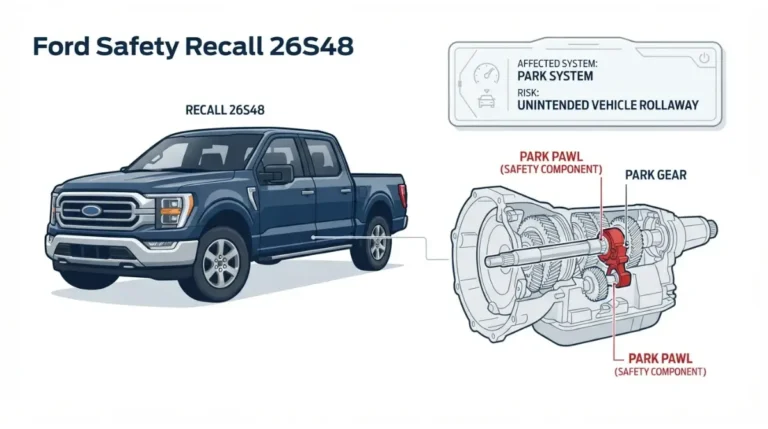
Recall 26S28 (NHTSA 26V-237) covers 2015, 2016, and 2017 F-150s with the 6-speed 6R80. NHTSA’s engineering analysis EA26001 was limited to MY 2015-2017 Ford F-150 with the 6R80 transmission. Ford says a remedy was made available on July 9, 2026; the status was open when we checked on 26 September 2026. For details, see our 26S28 downshift recall explainer.
Check your VIN anyway
A separate recall covers 34,481 Ford 10R80 remanufactured transmissions that may not shift into Park. That matters if your truck received a replacement unit.
✅ Do This: Run your VIN through NHTSA’s recall lookup before authorizing work. An open recall is repaired free.
What the shop should check before quoting a rebuild
Ask for the diagnosis to follow Ford’s documented sequence before anyone quotes internal work.
Tests to ask for
- Scan for stored codes. Ask whether any of the codes listed in the bulletin are present.
- Run the TSB leak check. For 2021–2022 trucks, Ford’s procedure is to verify hydraulic circuit leakage and replace the CDF clutch cylinder if necessary. Ask for the result in writing.
- Inspect the driveline. Ask for the slip yoke and U-joints to be checked for binding before any transmission teardown.
What diagnosis and repair cost
💵 On these numbers: Costs shown are typical ranges, not quotes. Labour rates vary sharply by region and between dealer and independent shops, and parts pricing moves. Use these to judge whether a quote is in the right neighbourhood, not to predict your invoice.
💵 What It Costs:
- Diagnosis: RepairPal lists F-150 powertrain control system diagnosis at $61–$90 and vibration diagnosis at $122–$179. These are its labour-and-parts estimates, not dealer quotes.
- Reprogram: Ford’s warranty labour time for the 2017 reprogram is 0.3 hours.
- Valve body: replacing the main control valve body under a related bulletin was 2.1 hours on a 2017 and 2.9 hours on a 2018 F-150. Multiply by your shop’s posted hourly rate, then add parts.
Can you keep driving with the clunk?
A single clunk at a stop is a nuisance, but some signs need prompt attention.
Signs to stop and get it inspected
Get the truck inspected soon if any of these appear:
- a lit MIL;
- harsh shifts that are getting worse;
- a new vibration.
What a clunk is not
The 6R80 recall describes an unintended downshift to second gear that may cause the rear tires to slide, which is a different event from a thump at a stop.
✅ Do This: If a 10-speed truck ever downshifts suddenly at speed, stop driving it. Have it inspected, and ask the shop to reference your build-date bulletin.
FAQ
1. Is a clunk when stopping normal on a 10-speed F-150?
Ford has published bulletins for harsh or delayed engagement on 2017–2022 10R80 trucks, so it is a documented condition. It isn’t something to accept. Have it inspected.
2. Can a slip yoke cause a clunk when stopping?
It can. Ford fixed slip-yoke clunk on 2009–2010 F-150s, but we found no such bulletin for 2017-and-newer trucks.
3. Which TSB covers 2017–2020 F-150 harsh engagement?
TSB 25-2126, dated March 2025, covers 2017–2020 F-150s with the 10R80 and cites CDF clutch cylinder sleeve leaks.
4. Which TSB covers 2021–2022 trucks?
TSB 24-2254 covers 2021–2022 F-150s with the 10R80 built on or before 15-Aug-2022, excluding hybrids.
5. Does the 26S28 recall cover my 10-speed F-150?
No. Recall 26S28 covers 2015–2017 F-150s with the 6R80 six-speed only. That was confirmed on 26 September 2026.
6. Is the 10R80 clunk covered by warranty?
A TSB doesn’t extend coverage. Ford’s powertrain warranty covers the transmission for 5 years or 60,000 miles, whichever comes first.
7. Will a software update fix the clunk?
Sometimes. Ford’s 2017 bulletin 18-2079 used a PCM reprogram, but its later bulletins point to hardware leaks.
8. Why can’t the dealer replicate my F-150 clunk?
Ask them to run the bulletin’s hydraulic leak check for your build date and to inspect the driveline, not just road-test the truck.
9. Is it safe to drive with the clunk?
A clunk at a stop alone is usually a nuisance, but a MIL, worsening shifts or sudden downshifts need attention. Have it inspected promptly.
10. Do 2023–2026 F-150s have a clunk bulletin?
None turned up in our 26 September 2026 check. Ask your dealer to search your VIN for current bulletins.
Your next step
Find your build date on the door-jamb label, match it to the bulletin table, and run your VIN for open recalls. Then ask the shop for the bulletin’s leak check and a driveline inspection before approving internal transmission work.