Wastegate rattle vs cam phaser, the costly 2017-20 F-150 mix-up

Cam phaser rattle lasts 2 to 5 seconds after 6+ hours parked, per Ford, while its wastegate rattle bulletin names only 2017 F-150 3.5L trucks.
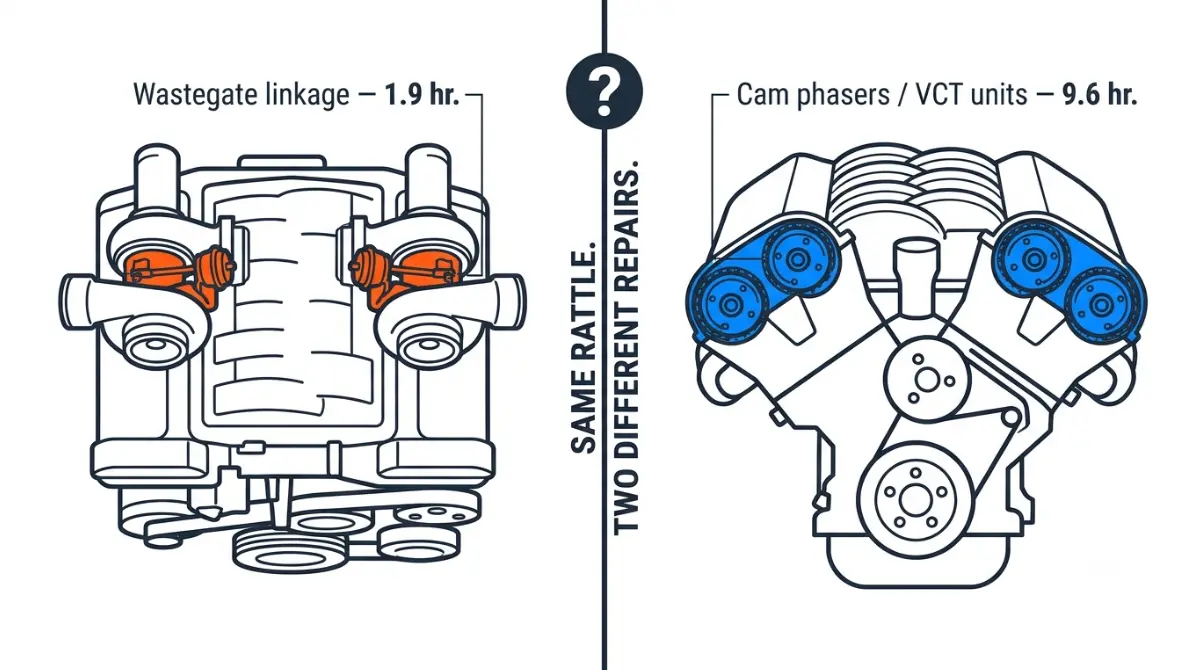
Table of Contents
Recall and bulletin status checked on November 16, 2026.
Two rattles, two places on the engine, two bills
On a 2017–2020 F-150 3.5L EcoBoost, Ford places the cam phaser rattle at the top front of the engine, lasting 2 to 5 seconds on the first start after the truck has sat 6 hours or more. Ford’s wastegate bulletin is looser and much smaller in reach, describing an engine-compartment rattle “under various operating conditions” on 2017 trucks only.
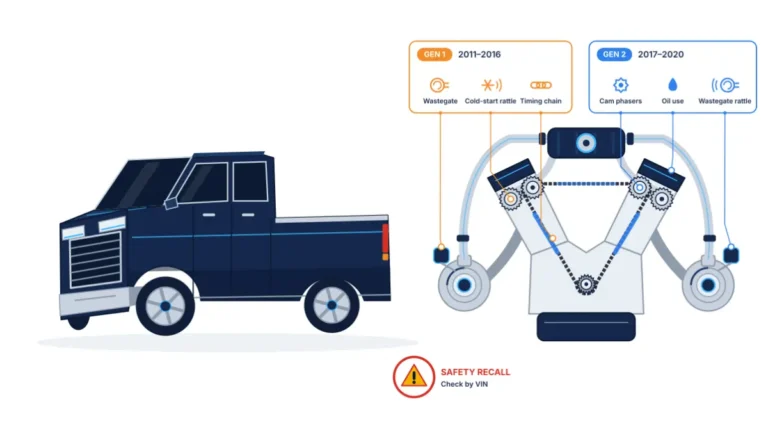
Cam phasers (Ford calls them VCT units) sit on the ends of the camshafts and shift valve timing. A wastegate is the flap in each turbocharger that bleeds off exhaust to limit boost, and the 3.5L has two of them.
The repairs sit far apart. Ford allows 1.9 labor hours to quiet both wastegate linkages and 9.6 hours to replace the four phasers on a non-Raptor F-150, so a wrong call in either direction gets expensive.
Safety note: The turbochargers and exhaust run hot on each side of the V6. Don’t reach into the engine bay with it running to chase the noise, and skip the hardware-store spring fixes passed around online, since none is a Ford procedure. If the rattle comes with a check engine light or lost power, have a qualified technician inspect the turbocharger and engine timing area before you keep driving.
What Ford’s bulletins say about each noise
TSB 20-2016 and TSB 23-2143 are the two Ford documents behind these noises, and they read very differently side by side.
| Detail | TSB 20-2016 (wastegate) | TSB 23-2143 (cam phasers) |
|---|---|---|
| Trucks | 2017 F-150, 3.5L only | 2017–2020 F-150, 3.5L; 2018–2020 Expedition and Navigator |
| Build-date limit | None given | Built on or before November 30, 2019 |
| Where the noise comes from | Engine compartment | Top front cover area |
| When it happens | Under various operating conditions | Initial start after a cold soak of 6 hours or more |
| How long it lasts | Not given | 2–5 seconds |
| Cause Ford names | Excess play in the turbocharger wastegate linkage | Worn VCT units |
| Ford’s repair | Spring washer kit HL3Z-9G488-C on both wastegate actuators | Replace all four VCT units |
| Ford labor time | 1.9 hours | 9.6 hours (Raptor 9.7) |
Source: Ford’s wastegate and phaser bulletins as filed with NHTSA, linked above.

Only the phaser bulletin ties its noise to a cold start and puts a time limit on it. A second symptom appears in that bulletin and nowhere in the wastegate one: the engine sometimes fails to restart during Auto Start-Stop, with or without trouble code P164C stored in the engine computer.
Is it the turbos or the front of the engine?
A rattle from high in the center at the front that dies away within about 5 seconds of startup matches Ford’s phaser description. A noise that seems to come from either side, where the two turbochargers sit, fits the wastegate bulletin’s looser wording better.
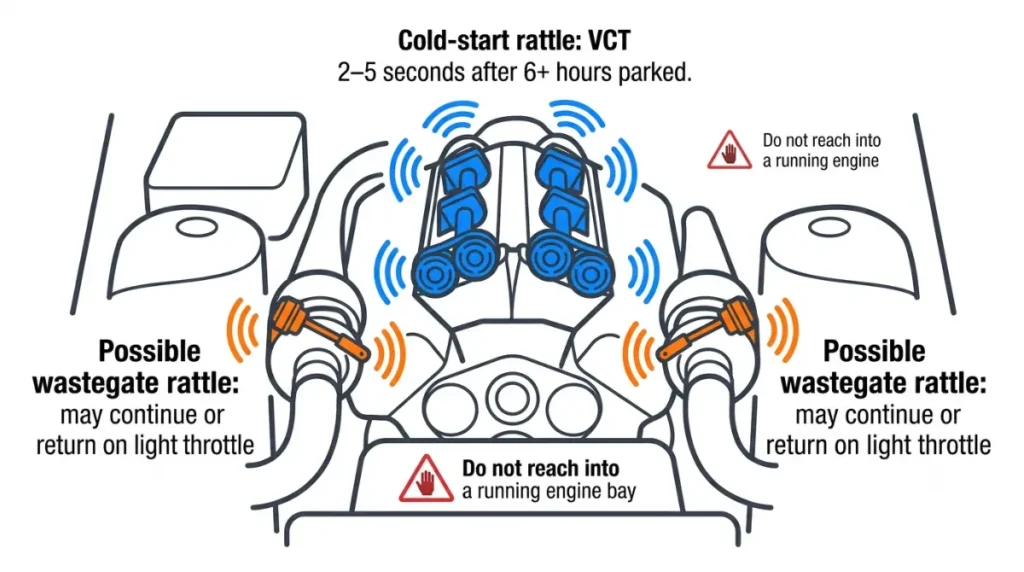
Owners who’ve had a wastegate rattle confirmed often describe it hanging on through the warm-up idle or coming back on light throttle. Neither pattern appears in Ford’s bulletin, so treat those reports as a hint for the technician rather than proof.
Because the phaser noise only shows up after 6 hours parked, a shop can only hear it on a truck that has sat overnight. Expect to leave it so the technician catches the morning start, and bring these questions:
- Did you hear it when the truck was started after sitting at least 6 hours, and where was it loudest?
- Which bulletin are you working from, and do my truck’s model year and build date fall inside it?
- Which trouble codes are stored, including P164C? Please print them before anything is cleared.
- If it’s the wastegate, did you check linkage play on both turbochargers, and is this the 1.9-hour spring kit repair or something larger?
- If it’s the phasers, is the quote limited to the VCT units on Ford’s parts list?
Answers to the first two tell you which of the two labor times further down applies to your truck.
2017 trucks are the only ones Ford’s wastegate bulletin names
One model year, 2017, and one engine, the 3.5L: that’s the entire reach of TSB 20-2016. It can’t support a wastegate repair on a 2018, 2019 or 2020 F-150, so a shop calling the noise on those trucks a wastegate rattle should be able to show you the linkage play it found.
Ford’s service site now marks 20-2016 as superseded or deactivated, and it marks 23-2143 the same way. Ask the dealer which current Ford document the repair order is written against.
Neither bulletin is a safety recall. Run your 17-character VIN through NHTSA’s recall search to see whether any open recall applies to your truck.
The phaser bulletin’s build-date cutoff matters as much as the model year. A 2020 F-150 built after November 30, 2019 sits outside 23-2143 even though the 2020 model year is listed. Build ranges are set out in how the two 3.5L generations split by year and build date.
A 7.7-hour labor gap between the two repairs
7.7 labor hours separate Ford’s two repairs, and every dollar of a shop’s hourly rate gets multiplied by that gap.
| Repair | Ford labor operation | Ford labor time | Labor per $100 of hourly rate |
|---|---|---|---|
| Wastegate spring kits, both turbos (2017 only) | 202016A | 1.9 hours | $190 |
| Phaser replacement, F-150 | 232143A | 9.6 hours | $960 |
| Phaser replacement, F-150 Raptor | 232143B | 9.7 hours | $970 |
Source: labor operations in TSB 20-2016 and TSB 23-2143. These are Ford’s warranty labor allowances; an independent shop may quote from its own book time.
Treat these numbers as a starting point, since hourly rates swing by region and between a dealer and an independent shop, and the figure that counts is the one on a signed estimate. At $150 an hour, for example, the wastegate job comes to about $285 in labor and the phaser repair on a standard F-150 to about $1,440, before parts and tax.
Parts widen the gap further. The wastegate repair needs two small spring washer kits. The phaser job calls for four VCT units and their bolts, both valve cover gaskets, a front crankshaft seal, a coolant pump gasket and O-ring, high-pressure fuel pump seals and bolts, and an oil filter, which shows how far into the engine the work goes. For the parts side in dollars, see what a phaser replacement costs with parts and labor.
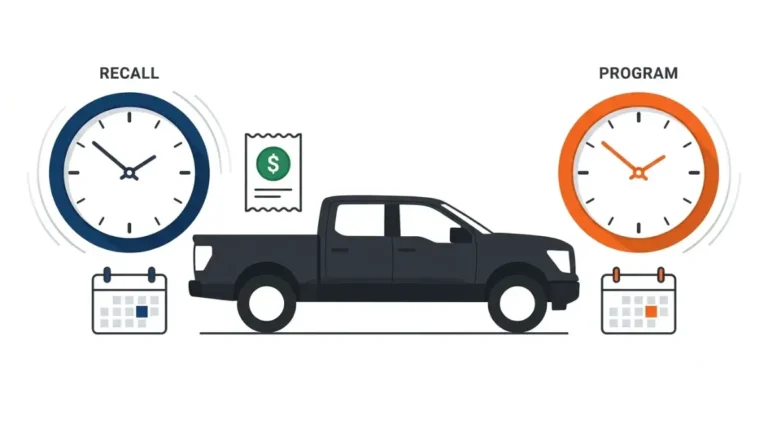
A bulletin is a repair instruction and doesn’t make the work free. The bulletins tie payment to a Ford warranty or extended service plan that still covers the failed part, which the dealer checks in Ford’s OASIS system. Ford’s prorated phaser program, 21N03, covered certain 2017–2020 3.5L F-150s built through the same November 2019 cutoff, paid less as mileage rose and nothing from 90,000 miles, and ended January 1, 2023. The details are in how Ford’s phaser programs ran and when they closed, and the wider picture is in which F-150 problems Ford still pays for by model year.
Before you approve: TSB 23-2143 tells technicians not to replace any VCT or engine timing parts beyond its parts list. A phaser quote that adds timing chains, guides or tensioners should come with written evidence of wear found on your engine.
When a newer EcoBoost rattle is not harmless
Lost boost is the risk on newer trucks. On a 2021–2025 F-150, Expedition or Navigator with the 3.5L, a turbocharger rattle together with code P0299 (underboost) can come from a wastegate actuator rod that has come disconnected (Ford SSM 54392). A truck with that pairing, especially one that feels down on power, should go to a shop soon.
The 2.7L has its own story. 2024 F-150s with the 2.7L EcoBoost built on or before October 4, 2024 have a separate Ford bulletin for a missing wave spring at the wastegate lever on both turbos.
Pay for the phaser job now, or wait?
If the noise matches Ford’s phaser description and the truck sets no codes, plan the repair rather than rushing it. Ford’s 21N03 program letter says a phaser that has become noisy does not affect the truck’s safety, performance or emissions, and the truck can stay in use while backordered parts arrive under TSB 23-2143.
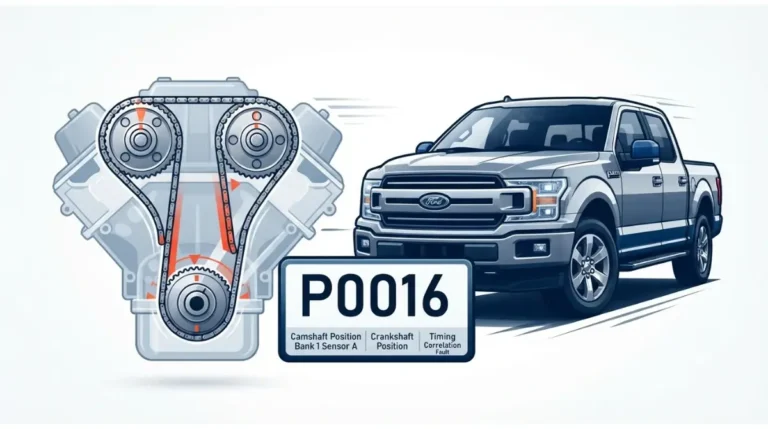
Book it sooner if the check engine light is on or a scan shows cam timing codes such as P0016 to P0019. A failed restart in Auto Start-Stop is another reason to move it up, since that fault appears alongside the noise in Ford’s phaser bulletin. On a 2017 truck where the shop confirms play in the wastegate linkage, approve the 1.9-hour spring kit repair and nothing larger.
Your next move is a cold-start diagnosis: leave the truck overnight, and approve nothing until the shop names the bulletin and where on the engine the noise comes from.
Found this helpful? See more of our guides on Google.
Want to see our guides first on Google?