
Why your 3.5 EcoBoost is burning oil, and what Ford documented
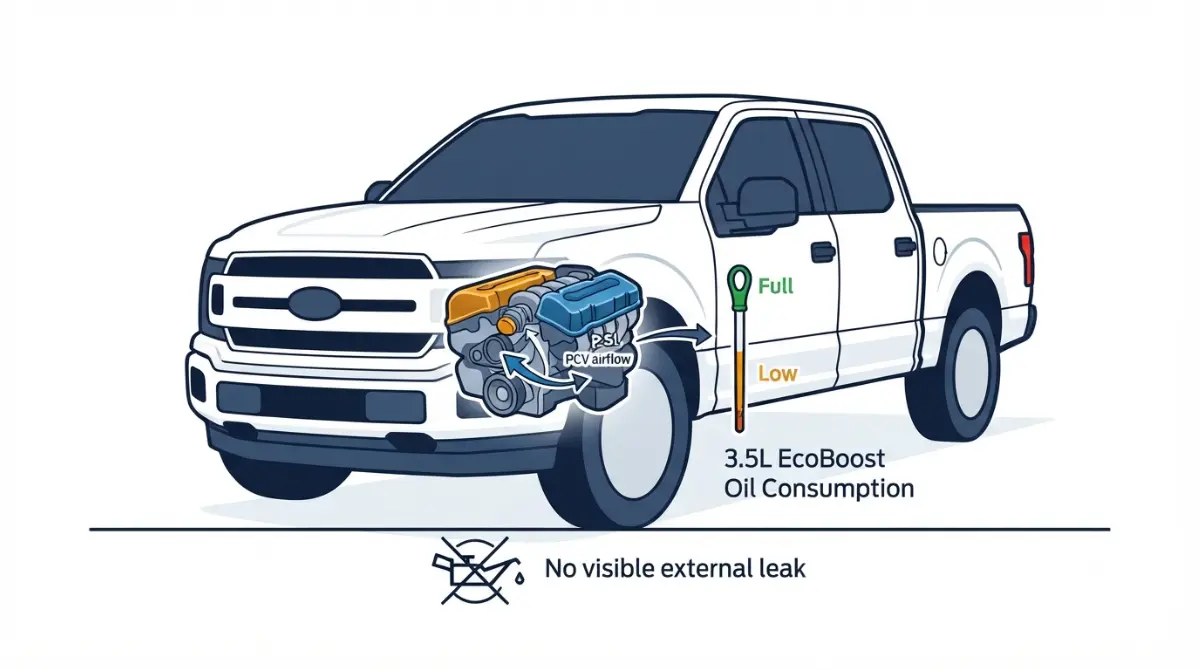
Table of Contents
Your 3.5 EcoBoost is burning oil and there’s no leak
Ford documented this one in writing.
The short answer
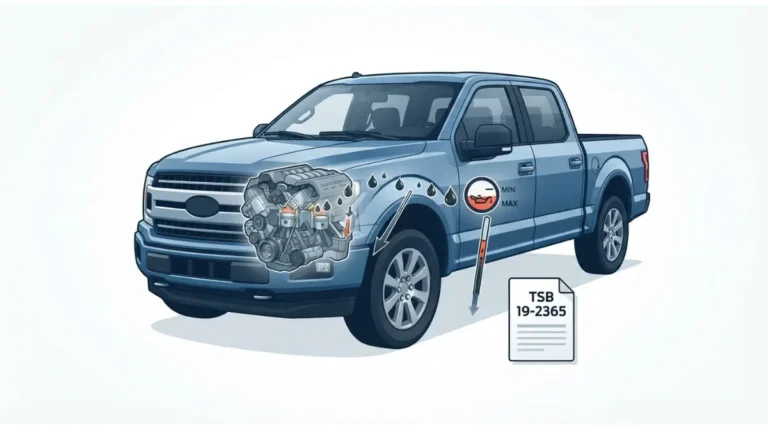
TSB 20-2132, issued 8 May 2020, attributes excessive oil consumption on the 3.5L EcoBoost to the positive crankcase ventilation system and tells dealers to replace both valve covers. It applies to 2017–2019 F-150s built on or before 1 April 2019.
Which situation you’re in
- Standard-output 3.5L, built before the cutoff — read straight through
- Raptor or 2019 Limited — a different bulletin covers you; jump to section three
- Under five years and 60,000 miles — coverage is section six
- Already holding a quote — section seven
If your symptom doesn’t match what’s below, the F-150 problems by model year index sorts the rest.
ℹ️ Safety Note: This article explains a documented condition and the coverage attached to it. It is not a repair procedure and not warranty advice. Coverage eligibility is determined by your VIN through a Ford dealer’s OASIS tool, and repair decisions should follow a qualified technician’s diagnosis.
What this looks like, and what it doesn’t
The bulletin condition has a specific shape, and one detail rules trucks out immediately.
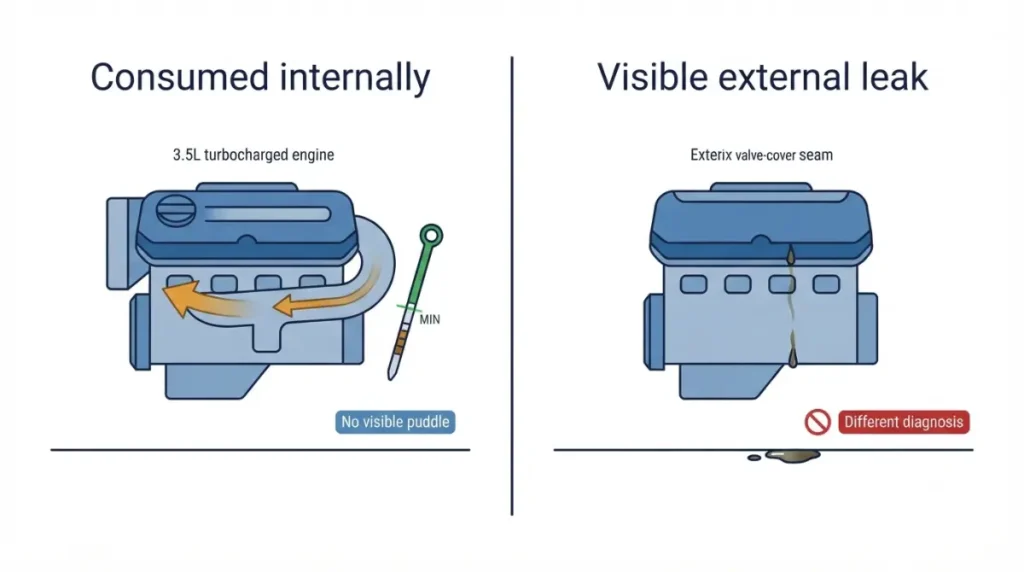
Oil disappearing with nothing on the driveway
Ford’s criteria require a customer concern of excessive consumption with no visible external leak. A valve cover seeping onto the block is a different repair, and a visible leak disqualifies the truck from this bulletin’s procedure entirely.
P0365 and P0369 may or may not appear
These are generic OBD-II camshaft position sensor circuit codes. Ford’s bulletin states the condition can occur with or without them, so a clean scan doesn’t rule you out — and the bulletin does not claim the codes cause the consumption.
What this isn’t
A cold-start rattle is a separate documented 3.5L complaint, covered in our write-up on the cold-start rattle owners mistake for other faults.
🔍 Why It Happens: The PCV system vents crankcase pressure back into the intake to be burned. On this engine the PCV function lives inside the valve cover itself, so when it stops regulating properly, engine oil gets pulled into the intake tract and burned along with the fuel — no leak, no puddle, just a falling dipstick.
Which trucks Ford’s bulletin actually covers
Build date decides this, not model year — and two trims are carved out.
| Model years | Engine | Built on or before | Bulletin | Applies to |
|---|---|---|---|---|
| 2017–2019 F-150 | 3.5L EcoBoost (standard output) | 1 April 2019 | TSB 20-2132 | All trims except 2018–2019 Raptor and 2019 Limited |
| 2018–2019 Expedition | 3.5L EcoBoost | 1 April 2019 | TSB 20-2132 | All |
| 2018–2020 F-150 / Navigator | 3.5L EcoBoost High-Output | 11 September 2020 | TSB 20-2423 | Raptor, Limited, Navigator |
Source: Ford TSB 20-2132 (NHTSA 10175884) and the separate high-output bulletin 20-2423 (NHTSA 10184643). Checked 18 September 2026.
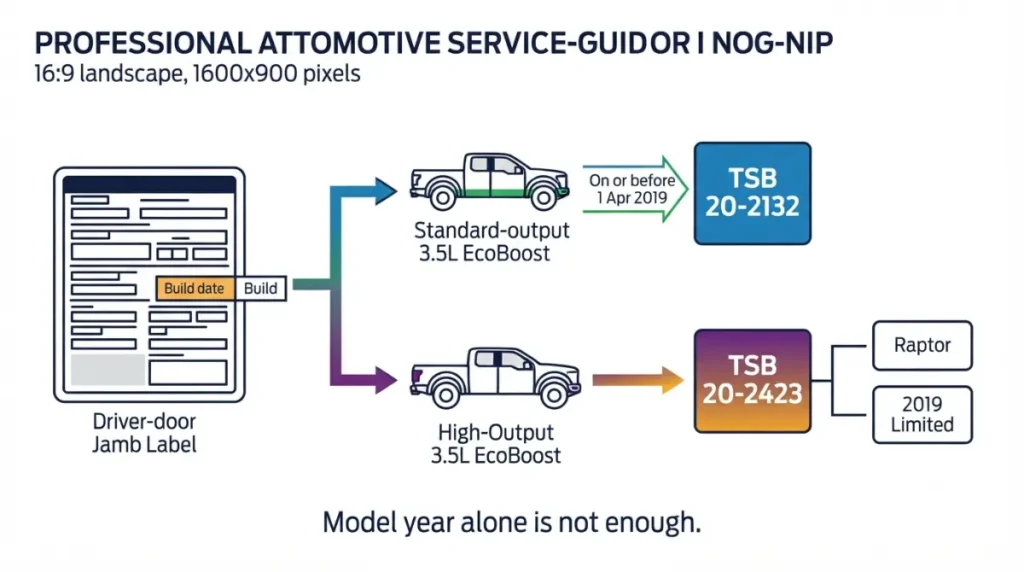
Finding your build date
It’s on the driver’s door-jamb label, printed as month and year of manufacture — not the model year on your registration.
Raptor and Limited go elsewhere
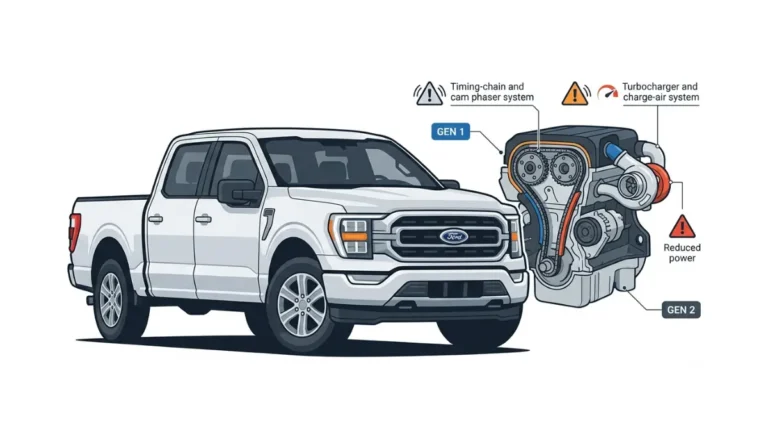
Those trucks run the high-output version of this engine, and 20-2423 adds a PCM reprogram before any cover replacement. Generation-level differences are mapped in our 3.5 EcoBoost problems by generation breakdown.
What Ford told dealers to do about it
The bulletin is short, specific, and worth taking to the service desk by number.
TSB 20-2132, and the bulletin it replaced
It supersedes TSB 19-2232 from July 2019, updating the vehicles affected. No superseding bulletin was found as of 18 September 2026.
Ford’s stated cause and fix
Ford attributes the condition to the positive crankcase ventilation system and directs replacement of both valve covers, listing left cover HL3Z-6582-E and right cover HL3Z-6582-C, with intake gaskets and a new high-pressure fuel pump to fuel rail tube. The causal part for warranty claiming is 6582.
📋 On the Record: Ford TSB 20-2132, issued 8 May 2020, supersedes TSB 19-2232 and covers 2017–2019 F-150 and 2018–2019 Expedition models with the 3.5L EcoBoost built on or before 1 April 2019, excluding the 2018–2019 Raptor and 2019 Limited. It attributes excessive oil consumption to the PCV system and directs replacement of both valve covers. This is a service bulletin, not a recall. Status checked 18 September 2026. Read Ford’s bulletin as filed with NHTSA.
The oil consumption test your dealer will run first
Qualifying isn’t automatic — Ford requires the dealer to measure the loss before authorising covers.
Ford’s threshold: one quart in 3,000 miles
The bulletin instructs the dealer to replace both covers when consumption meets or exceeds one quart in 4,800 km (3,000 miles) or less. Below that, Ford considers the engine to be operating normally.
Why they mark your dipstick
The procedure has the technician drain and refill the engine one quart short, mark the oil level indicator, add the final quart, and mark it again. Those two marks — not the factory markings — are the measurement used.
What you’re expected to record
Readings every 200 miles or weekly, on level ground, after a full 15-minute drain-back, with the mileage logged each time.
🛒 Our Pick: Ford’s parts list for this procedure specifies Motorcraft SAE 5W-30 and a Motorcraft oil filter, so starting the monitoring period on a correct, known fill matters.
Is any of this still covered in 2026?
For most owners reading this, the honest answer is no.
Powertrain warranty: five years or 60,000 miles
Ford’s powertrain warranty runs five years or 60,000 miles from the in-service date, whichever comes first, and lists valve covers among covered engine components. A 2019 truck delivered in 2019 passed the time limit in 2024 regardless of mileage.
There is no recall
No NHTSA recall or open investigation for this condition was identified as of 18 September 2026. A bulletin does not obligate Ford to pay or to notify you.
The emissions-warranty question worth asking
California’s emissions warranty rules treat the PCV system as a warranted part, with a longer term for high-cost parts. Whether Ford designated this valve cover as one is not publicly established — so ask, don’t assume.
✅ Do This: Have the dealer run your VIN through OASIS before you pay anything, and ask specifically whether TSB 20-2132 applies to your build date. In California and states following CARB rules, ask whether part 6582 is listed as an emissions warranted part for your model year. Check open campaigns yourself through NHTSA’s VIN recall lookup. Terms confirmed against Ford’s powertrain coverage page on 18 September 2026.
What the repair costs when you’re paying
Ford publishes the labour time, which lets you price this before anyone quotes you.
4.2 hours for both covers
TSB 20-2132 lists operation 202132B at 4.2 hours to replace both valve covers, plus 202132A at 0.8 hours for the inspection, oil change and dipstick marking. Multiply 4.2 by your shop’s posted hourly rate, then add parts: two cover assemblies, intake gaskets, the fuel pump tube, filter and oil.
Why gasket estimates come in low
Published valve cover gasket estimates price a different job. This bulletin replaces the cover assemblies and requires intake removal — closer to the cam phaser work priced in our F-150 cam phaser replacement cost breakdown.
💵 On these numbers: The 4.2 and 0.8 hour figures are Ford’s published warranty operation times, not estimates. What you pay depends on your shop’s posted rate, dealer versus independent, and local parts pricing and tax. Ask for a written quote that names both cover assemblies (part 6582) and confirms intake gaskets and the fuel pump tube are included.
3.5 EcoBoost oil consumption: quick answers
1. Is there a recall for 3.5 EcoBoost burning oil?
No recall was identified. Ford addressed the condition through TSB 20-2132, a dealer service bulletin rather than a recall campaign.
2. Which build date does the bulletin use?
TSB 20-2132 applies to 3.5L EcoBoost F-150s built on or before 1 April 2019, regardless of when the truck was sold.
3. Does the valve cover TSB cover the Raptor?
No. The 2018–2019 Raptor and 2019 Limited are excluded and fall under the separate high-output bulletin, TSB 20-2423.
4. How much oil loss counts as excessive?
Ford’s bulletin treats one quart consumed in 3,000 miles or less as the point at which both valve covers are replaced.
5. What does Ford say causes it?
The bulletin attributes the condition to the positive crankcase ventilation system and directs replacement of both engine valve covers.
6.Do I need a check-engine light for it to qualify?
No. Ford’s bulletin states the condition may occur with or without codes P0365 and P0369 present.
7. Is my truck still under warranty for this?
Ford’s powertrain warranty runs five years or 60,000 miles from the in-service date, so 2017–2019 trucks have passed the time limit. Ask the dealer to confirm your VIN through OASIS.
8. How long does the repair take?
Ford publishes 4.2 hours to replace both valve covers, plus 0.8 hours for the inspection and consumption-test setup.
9. Is this the same as a valve cover gasket job?
No. The bulletin replaces both cover assemblies plus intake gaskets, so gasket-only estimates understate the work involved.
10. Can I just keep topping up the oil?
Topping up manages the symptom only. The PCV concern Ford identified remains, and consumption continues until the covers are replaced.
What to do next
Find your build date on the door-jamb label and check it against 1 April 2019. Ask the dealer to open a consumption test against TSB 20-2132 and to run your VIN through OASIS in the same visit. Then get an itemised quote naming both cover assemblies before you authorise anything.
One Comment