Car burning oil? How much is normal for your engine

Oil burning limits by maker, from GM’s 1 quart per 2,000 miles to Kia’s under 1 per 1,000, converted into quarts you can add between oil changes.
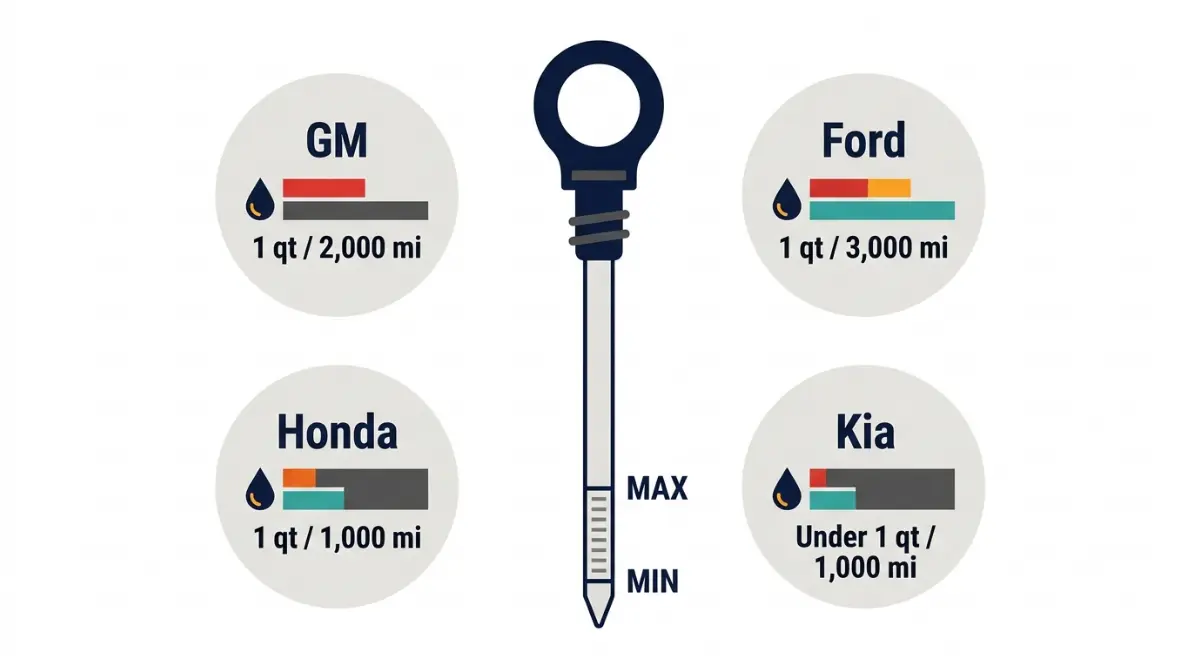
Table of Contents
Recall and bulletin status checked on October 27, 2026.
How much oil burning is normal?
Normal is whatever your engine’s maker put in writing, and those written lines sit far apart. GM accepts 1 quart every 2,000 miles on its cars and light trucks, Ford’s F-150 bulletins treat more than 1 quart in 3,000 miles as excessive, and Kia calls anything under a quart per 1,000 miles normal.
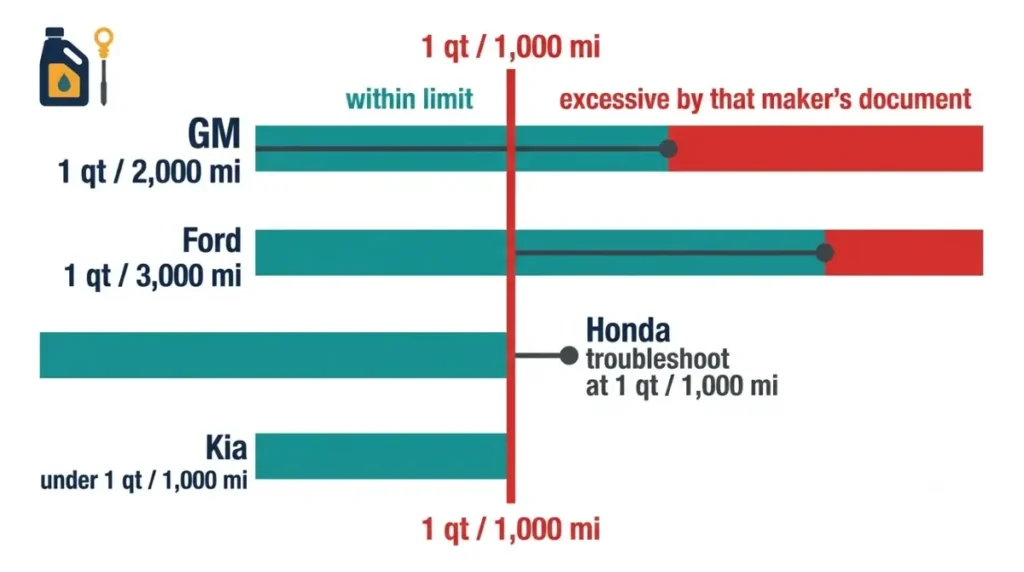
That puts a car burning oil at 1 quart every 1,000 miles past the GM and Ford lines and right at Kia’s limit. Honda’s own dealer test form sends that rate straight to troubleshooting.
If your rate sits under your maker’s line and holds steady from one oil change to the next, the maker treats it as normal use. Over the line, or climbing, it’s time for a formal test.
Safety note: Low engine oil can damage the engine, and oil burned in the cylinders can foul the catalytic converter and oxygen sensors. If the oil pressure light comes on or the dipstick reads below the add mark, add the oil grade your owner’s manual lists and have a qualified technician inspect the engine before you keep driving.
Each maker’s line, in quarts between oil changes
GM’s line applies to every 2025-and-earlier GM passenger car and gas light truck, while the Ford and Kia lines reach only the engines their bulletins list. GM attaches conditions to its 2,000-mile figure: personal use, under warranty, driven at legal speeds without hard driving, maintained on schedule and, for trucks, unloaded (GM bulletin 01-06-01-011Q). Under the same bulletin, a manual-transmission car driven hard at high rpm with frequent engine braking can use up to a quart every 500 miles with no repair needed.
The last two columns turn each line into what you’d see at the dipstick: the oil you could add between changes and still be inside it.
| Maker and document | Applies to | The line | Per 5,000 miles | Per 10,000 miles |
|---|---|---|---|---|
| GM bulletin 01-06-01-011Q | 2025 and earlier GM cars and gas light trucks, normal driving | Up to 1 qt per 2,000 mi accepted | 2.5 qt | 5 qt |
| GM bulletin 01-06-01-011Q | Same vehicles, manual transmission driven hard | Up to 1 qt per 500 mi | 10 qt | 20 qt |
| Ford TSB 19-2365 | 2018–2020 F-150, 5.0L | Over 1 qt in 3,000 mi is excessive | 1.7 qt | 3.3 qt |
| Ford TSB 20-2132 | Listed 2017–2019 F-150 and 2018–2019 Expedition, 3.5L EcoBoost | Over 1 qt in 3,000 mi is excessive | 1.7 qt | 3.3 qt |
| Honda job aid JA 03381 | Honda dealers | 1 qt or more per 1,000 mi: troubleshoot | 5 qt | 10 qt |
| Honda job aid JA 03381 | Honda, driven normally | 1 qt per 1,000–3,000 mi: regional assessment | 1.7–5 qt | 3.3–10 qt |
| Kia TSB ENG222 Rev 7 | Listed 2011–2024 Kia models, including Forte, Soul, Sportage, Optima, Sorento and Rio | Under 1 qt per 1,000 mi is normal | Under 5 qt | Under 10 qt |
Lines from GM bulletin 01-06-01-011Q, Ford TSBs 19-2365 and 20-2132, Honda job aid JA 03381 and Kia TSB ENG222 Rev 7, as filed with NHTSA. Quart columns are each line multiplied out over 5,000 and 10,000 miles.
If your car’s maker isn’t in the table, open the engine oil section of your owner’s manual. Some makers print a consumption figure there.
Ford’s own internal target is far tighter than its bulletins. In the 2018–2020 F-150 5.0L class action, Ford told the court that it “does not quantify expected oil consumption in the Owner’s Manual” and that its engineering criterion is 10,000 miles per quart, as CarComplaints reported from the court record. That target works out to half a quart per 5,000 miles, against the 1.7 quarts the bulletins allow before a repair.
Turn your dipstick into a miles-per-quart number
4,500 miles and 3 quarts of top-offs works out to 1,500 miles per quart. That’s past GM’s 2,000-mile line and comfortably inside Kia’s.
GM’s and Honda’s dealer test forms both use the same math, and it works at home:
- Start with the oil at the full mark, and write down the date and odometer reading.
- Each time you add oil, note the date, the odometer and how much went in.
- Divide the miles driven by the total quarts added to get miles per quart.
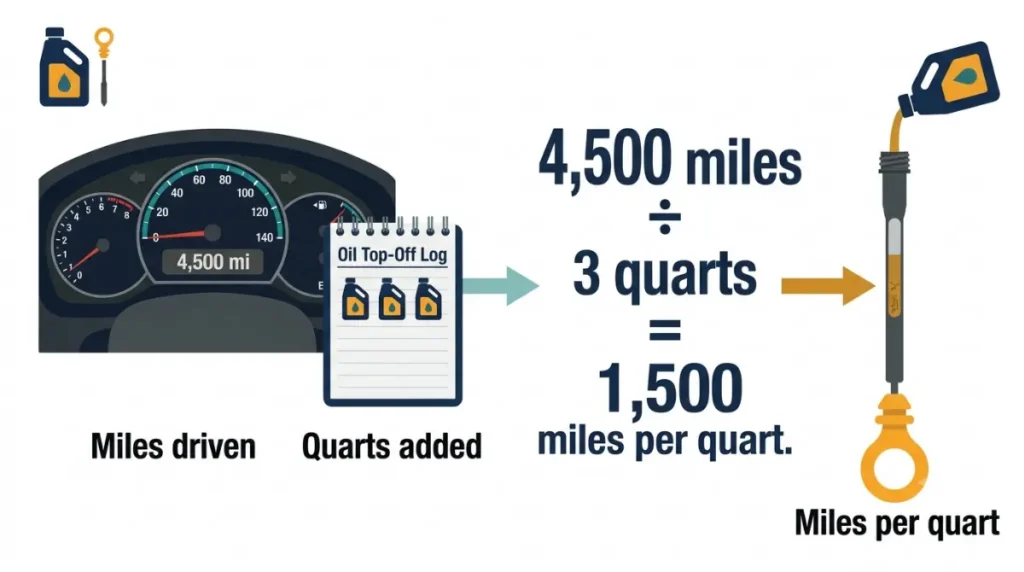
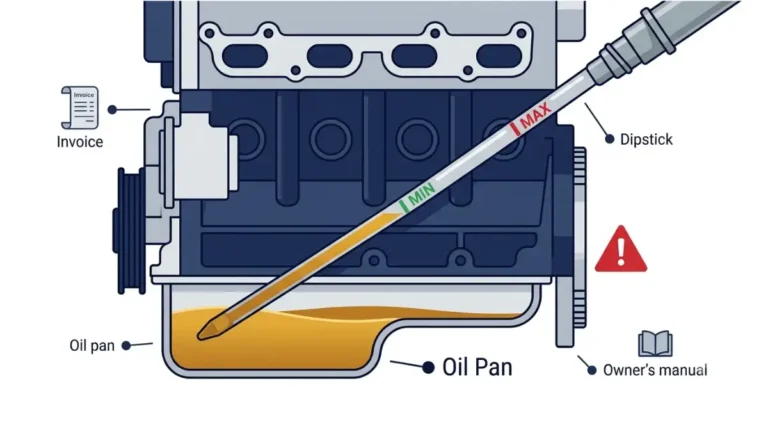
Read the dipstick on level ground after the wait your owner’s manual gives. GM’s bulletin wants at least 15 minutes after shutdown, while Honda’s test form uses 5 minutes with a hot engine, so a reading taken at the pump right after a drive can come up short.
A new engine skews the result. GM won’t test oil use before 4,000 miles unless the engine is using more than a quart per 1,000, and Ford’s 5.0L bulletin expects oil use to improve as the miles add up.
Short trips can hide burning for weeks. On drives under 5 miles, especially in cold weather, fuel and condensation stay in the oil and can push the dipstick above full. The next drive of 30 minutes or more boils them off, and the level seems to drop all at once.
Idling counts as work too. GM multiplies engine hours by 33 to estimate equivalent miles; if the result is higher than the odometer, the engine has done more than its mileage shows. On most GM models, engine hours sit in a settings menu of the driver information center.
Leak, fuel in the oil or a short fill
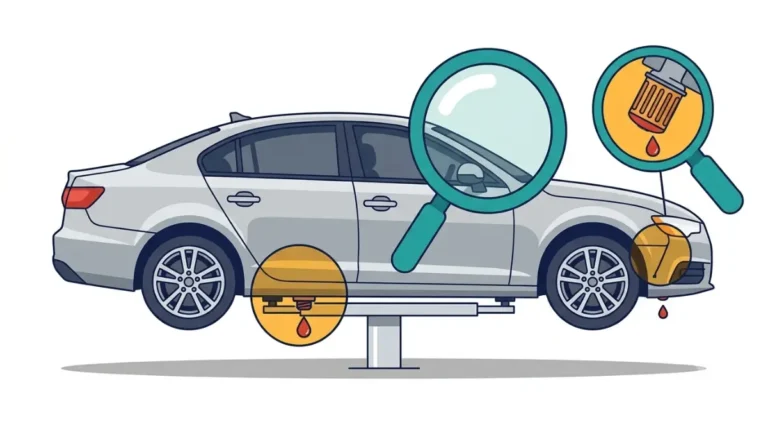
Oil spots on the driveway mean a leak, and no maker counts leaked oil as burned oil. GM’s test starts by ruling out external leaks, and Kia’s ENG222 requires any confirmed leak to be repaired before the test begins.
A level that climbs and smells of gasoline is a different problem: fuel getting into the oil. The model years and bulletins behind a rising oil level with a gas smell are covered separately.
A low reading right after an oil change usually points to the fill itself. GM’s bulletin has technicians confirm the right amount and grade went in before judging consumption, so compare the quart count on your invoice with the capacity in your manual.
2012–2013 Equinox and Terrain 2.4L show the cost of waiting
Burning oil can wear out emissions parts before any warning light comes on. GM admitted that for 2012–2013 Chevrolet Equinox and GMC Terrain models with the 2.4L engine certified to the EPA Bin 4 standard or the California Cleaner Federal Bin 4 option. In Special Coverage N192287100, it says oil use worse than 1 quart per 2,000 miles from piston ring wear could degrade the catalytic converters and oxygen sensors without turning on the check engine light.
That coverage replaced the converters and oxygen sensors at no charge for 10 years or 150,000 miles from the original in-service date, whichever came first. It applied only when an oil consumption test confirmed burning caused by ring wear, or when the rings had already been repaired for it.
The coverage has ended. A 2013 model first sold in 2013 passed its 10-year mark during 2023, and the deadline to claim reimbursement for repairs owners had already paid for was October 31, 2021. If yours went into service unusually late, a GM dealer can check the VIN.
The warning signs in GM’s letter to owners were frequent top-offs, an engine rattle or knock, and the oil pressure light.
Coverage note: On GM vehicles, repairs caused by running the engine below the dipstick’s minimum mark aren’t covered by the New Vehicle Warranty, and the damage can be severe (GM bulletin 01-06-01-011Q).
Running low, or on worn-out oil, leads to abnormal wear and sludge deposits (Kia TSB ENG222). Kia’s maintenance rule is a level check at every fuel stop.
Past the line: what to ask the service desk
Kia’s ENG222 repair is done as a field fix during the warranty period. After the warranty ends, a dealer needs approval from Kia’s regional service manager to do it. Ford’s 5.0L and 3.5L bulletins don’t change warranty limits either.
Kia won’t approve an engine replacement without oil maintenance records, so keep dated records that prove every oil change.
The warranty labor time gives a sense of scale. Kia allows 0.6 hour for a consumption test and 2.5 to 2.7 hours for combustion chamber cleaning. An engine replacement under the same TSB runs 5.3 to 12.3 hours depending on the model, and GM allows 0.5 hour for its own test. These are flat-rate hours the maker pays its dealers. Out of warranty, the bill depends on the labor rate in your area and on whether you use a dealer or an independent shop, and a written quote is the figure to trust.
At the counter, these five questions cover what the bulletins require:
- Is there a service bulletin or special coverage for my VIN and engine?
- Will you open a repair order and run the manufacturer’s oil consumption test?
- Which consumption limit will you measure against, and from which document?
- Have you checked for external leaks and a blocked PCV valve or hose?
- Will the report note the condition of the spark plugs and oxygen sensors?
The full dealer test, and what to do when the service advisor calls your rate normal, is in how to respond when a dealer says your oil use is normal.
Top it off and keep logging, or book the test
If your miles per quart stay under your maker’s line and hold steady, keep topping off with the oil grade in your manual and keep the log going.
Over the line, or getting worse with each change, book the manufacturer’s consumption test while the car is still under warranty, since the Kia and Ford fixes are done as warranty repairs. Out of warranty, the Equinox case is the reason to keep pushing: ring wear left alone can take the emissions parts with it.
Start the log at your next fill-up, with the oil at the full mark.