Right Severe Service Oil Change Test, Ford 2020, Toyota, Kia 2026
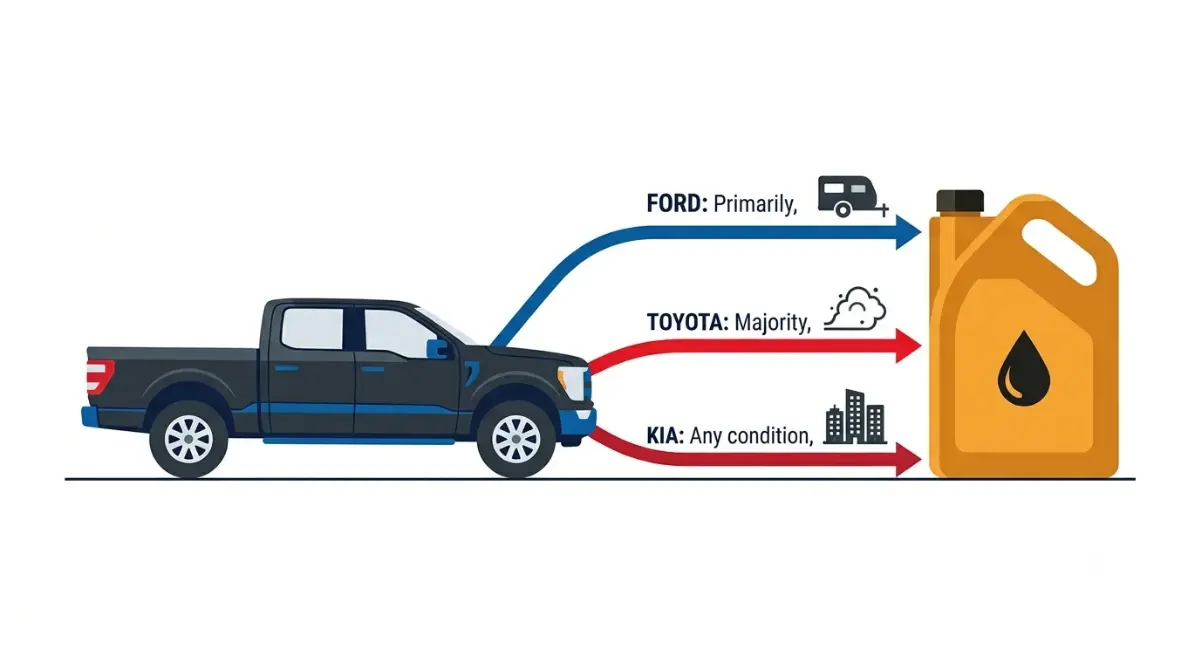
Table of Contents
Do you qualify for severe service oil changes?
The short answer
Your owner’s manual decides, and each maker sets a different bar. Ford’s 2020 F-150 manual says “primarily,” Toyota’s 2026 Tacoma guide says “majority of your driving,” and Kia’s 2026 manual says “if any” listed condition applies. Your model year may differ, so check your own copy.
Find your situation
- Holding a shop quote: see the trigger test and cost maths.
- Doing it yourself: use the interval table.
- Still under warranty: see the warranty section.
ℹ️ General information: Not legal advice; terms differ by automaker, model, model year and state.
What Ford, Toyota and Kia count as severe service
Severe service is the shorter oil change schedule your owner’s manual sets for demanding driving; your manual’s own list decides.
Ford F-150 (2020 manual)
Ford’s Special Operating Conditions chapter lists five gasoline conditions: trailer or car-top carrier, extensive idling or long low-speed driving, dusty or sandy roads, off-road use and exclusive E85.
Toyota Tacoma (MY2026)
Footnotes 6–10 name five conditions: dirt roads, towing or heavy loading, road salt, submersion and extensive idling. Each ties to specific services.
Kia (2026, SP2)
Kia’s Scheduled maintenance service chapter lists eleven conditions, A–K, including short trips under 5 miles, hills, towing and stop-and-go driving.
Primarily, majority or any: how much driving counts?
Check your own manual’s test: Ford says primarily, Toyota says the majority of your driving, and Kia says if any condition applies.
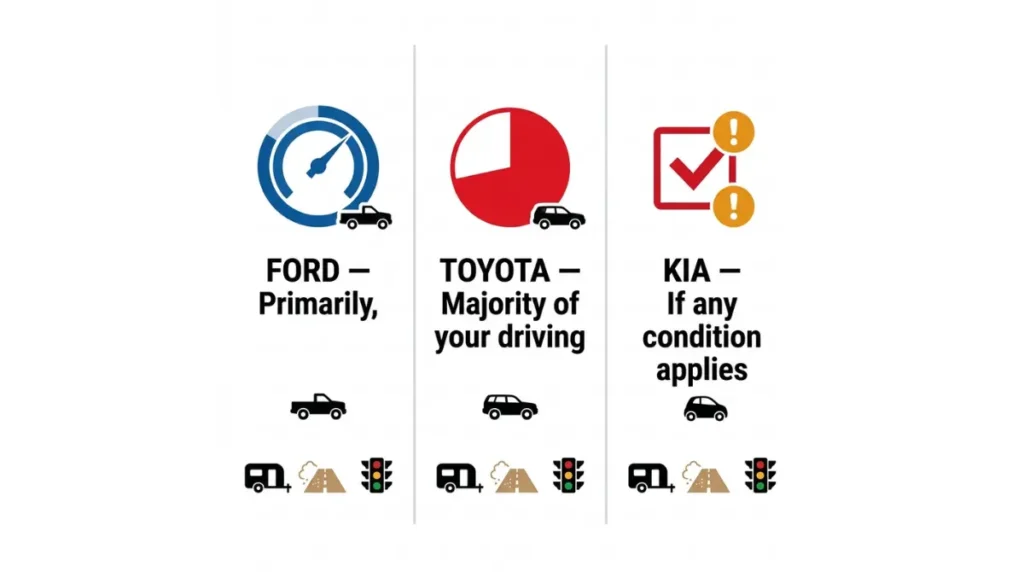
Ford: “primarily,” occasional use not required
Ford applies extra maintenance if you drive “primarily” in a listed condition. “Occasionally” is “not necessary.”
Toyota: “majority of your driving”
Toyota’s 2026 Tacoma guide (p.36) calls for special-condition services only when the “majority of your driving” fits.
Kia: “if any apply”
Kia’s bar is lowest: one listed condition triggers the severe schedule.
Where Ford’s oil monitor fits
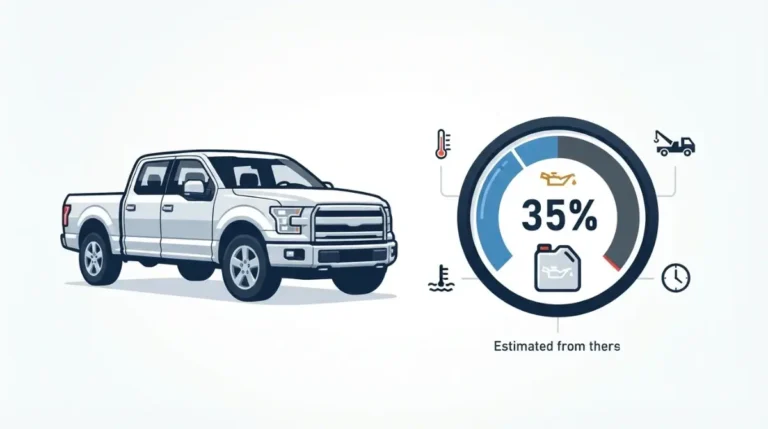
Ford’s monitor table is “a guideline only.” Other makers’ limits: how often to change oil.
Severe service oil change intervals, by document
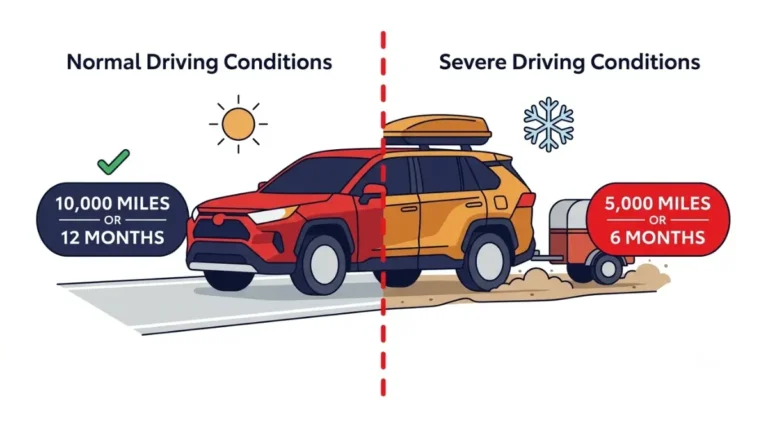
Where your manual sets a severe interval, it is 5,000 miles or six months — but Ford sets that only for dusty and off-road use.
| Document | Trigger | Oil and filter, severe | Applies to |
|---|---|---|---|
| Ford Special Operating Conditions | “primarily” | Dusty or off-road: 5,000 mi or six months. Towing, idling: per display | 2020 F-150, gasoline |
| Toyota guide, pp.39 and 46 | “majority of your driving” | 5,000 mi or six months (normal: 12 months or 10,000 mi) | MY2026 Tacoma |
| Kia scheduled maintenance | “if any” | 5,000 mi or 6 months (normal: 8,000 mi or 12 months) | 2026 SP2: 2.0 MPI all eleven conditions; G1.6 T-GDi three |
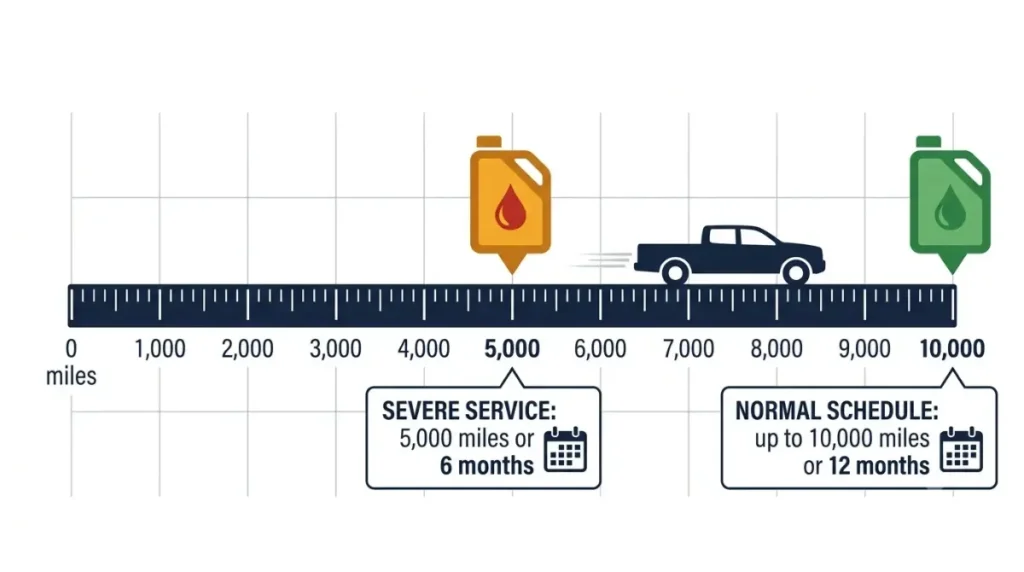
Ford: fixed for dust and off-road, display-led for towing and idling
Ford’s 5,000–7,500-mile severe band (moderate to heavy towing, extended idling) is a monitor guideline; see how Ford’s oil life monitor sets the F-150 oil change interval.
Toyota: 5,000 miles or six months
Chart footnote 4 ties it to mainly dirt or dusty roads; page 46 extends it to “any of the listed Special Operating Conditions.”
Kia: engine decides the list
The 2.0 MPI follows it for all eleven conditions; the G1.6 T-GDi for three.
What qualifying costs over 60,000 miles
Qualifying changes how many oil changes you need, not the price of one. At 12,000 miles a year, a 10,000-mile limit means 6 changes in 60,000 miles; a 5,000-mile limit means 12.
The maths: 12 changes versus 6
| F-150 source | Per change | What it includes | 6 extra changes |
|---|---|---|---|
| YourMechanic F-150 page, average | $142 | $37 parts + $105 labor; mechanic comes to you | $852 |
| YourMechanic, per-year estimates on the same page | $249.67–$313.63 | Not itemized; years listed 1993–2020 | $1,498–$1,882 |
| RepairPal F-150 page | $183–$212 | RepairPal Certified locations; inclusions not itemized | $1,098–$1,272 |
| DIY, parts only | $37 | YourMechanic’s parts share; oil grade changes it | $222 |
Who pays what: DIY parts versus shop labour
💵 What It Costs: Assumes 12,000 miles a year, changes at the mileage limit, F-150 only, read October 10, 2026. Typical ranges, not quotes: labour varies by region and shop type. YourMechanic does not explain why its average sits below its own estimates.
Test your own mileage in the Maintenance Interval Planner.
Severe service, your warranty and your records
Coverage wording turns on missed maintenance, so record the schedule you follow.
What the documents say about missed maintenance
Ford’s support page says skipped scheduled maintenance “will invalidate warranty coverage on parts affected by the lack of maintenance.” Toyota’s MY2026 Tacoma guide (p.34) excludes damage “caused by lack of proper maintenance.” None of the documents cited here says what happens if a qualifying owner follows the normal schedule.
Dealer extras versus required intervals
Toyota says dealer-recommended extras “are not required to maintain your warranty coverage.” The FTC’s auto warranty guide says a dealer cannot deny coverage just because someone else did routine maintenance; our oil change warranty rule guide covers proof.
Log which schedule you followed
✅ Do This: Our suggestion, not a maker requirement: record the date, mileage, which schedule you followed and why. Ford advises keeping receipts; for F-150 terms by year, see Ford powertrain warranty by year.
What the manuals warn if you skip severe service
The documented downside is oil-related engine damage, and the limits are specific.
What Toyota and Ford say about delay
Toyota (p.34) warns that late oil changes “can cause oil starvation and/or oil gelling,” which can mean repairs its warranty does not cover. Ford’s table says not to exceed “one year or 10,000 mi” between services. For the Smartstream G1.6 T-GDi, Kia says to follow the severe schedule if you do not use the recommended oil.
When extra services are not required
Ask which line in your manual any shorter interval follows; dealer extras are optional.
Severe service oil change questions, answered
1. What is a severe service oil change?
A severe service oil change follows the shorter schedule your manual sets for listed conditions like towing, dust, idling or short trips.
2. Does a severe service oil change mean every 3,000 miles?
Not by default. Severe service intervals in Toyota’s MY2026 Tacoma, Kia’s 2026 SP2 and Ford’s 2020 F-150 dust tables are 5,000 miles or six months.
3. How do I know if I qualify for severe service?
For severe service, match your driving to your manual’s list: Ford says primarily, Toyota the majority, Kia if any condition applies.
4. Does occasional towing count as severe service?
Not under Ford’s or Toyota’s wording, which require primarily or most driving. Kia applies severe service if any listed condition applies.
5. What does Ford’s oil monitor say about towing?
Ford’s 2020 F-150 manual puts moderate to heavy towing in a 5,000–7,500-mile severe band, a guideline only; follow the display.
6. What is the longest normal gap between oil changes?
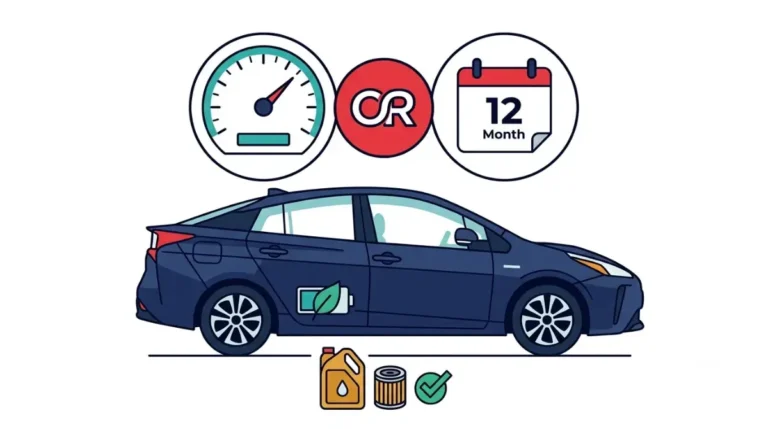
Ford’s 2020 F-150 manual says not to exceed one year or 10,000 miles; Toyota’s MY2026 Tacoma guide says 12 months or 10,000 miles.
7. Does a severe service oil change cost more?
A severe service schedule means more changes, not pricier ones: 12 per 60,000 miles at a 5,000-mile limit versus 6 at 10,000.
8. Does skipping the severe schedule void my warranty?
Skipping the severe service schedule does not void everything: Ford invalidates coverage on parts affected, and Toyota excludes damage from lack of proper maintenance. Read your own warranty booklet.
9. Where do I find my severe service schedule?
Your severe service schedule is in your manual’s maintenance chapter: Ford’s Special Operating Conditions, Kia’s Scheduled maintenance service, Toyota’s special conditions chart.
Check your manual’s severe service chapter first
Open your owner’s manual to its special operating conditions or severe usage chapter, tick every condition that fits, and apply your maker’s test: primarily, majority or any. Then run your yearly mileage through the Maintenance Interval Planner to see how many changes that schedule means.