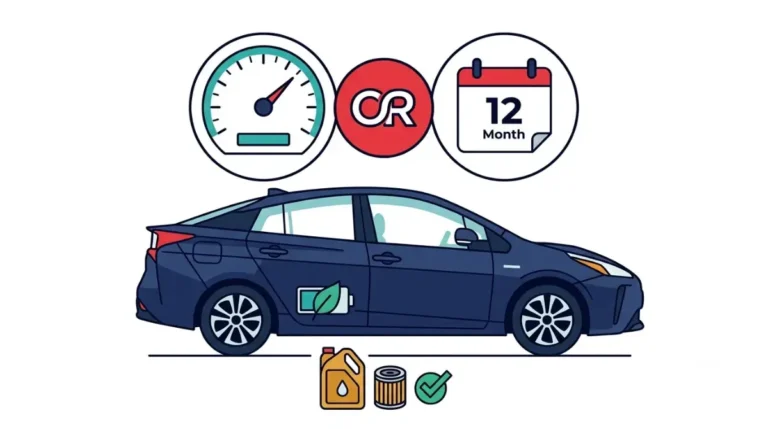
How Often to Change Oil by the Limits Your Maker Documents
Table of Contents
How often to change oil: what your maker actually says
Change your oil when your owner’s manual or oil-life monitor says to, and never let your maker’s time limit pass. Most cars no longer need a change every 3,000 miles, but some still do. Start here:
- Dashboard message: book the change; the monitor section below explains the percentages.
- 3,000-mile quote in hand: the next section shows when that is your maker’s number.
- Still under warranty: the warranty section covers the interval and the records.
- Barely drive: the calendar can matter more than mileage; see the maker table.
Find your number in the maintenance chapter of your owner’s manual or on your maker’s owner site.
ℹ️ Safety Note: Warranty terms are a money-and-legal matter that varies by maker and vehicle. This is general information, not legal advice; your warranty booklet and owner’s manual govern.
Is a 3,000-mile oil change still necessary?
For most cars the answer is no, but your manual makes the final call.
Why 3,000 miles became outdated
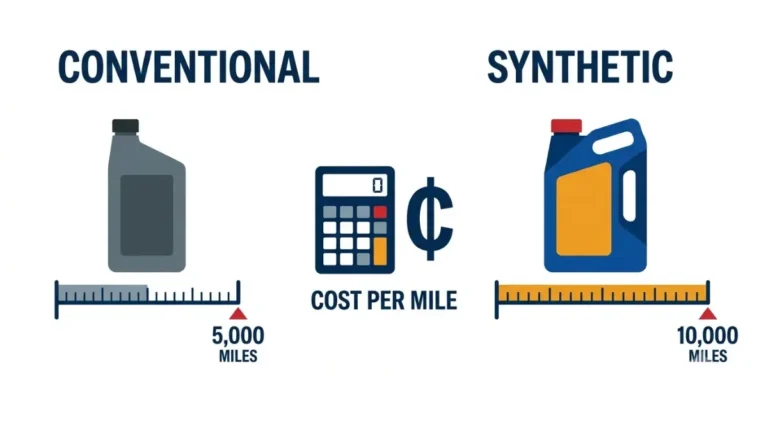
CalRecycle, California’s recycling agency, says the old 3,000-mile standard no longer applies to most cars, and that many can run 5,000 to 15,000 miles between changes. It adds that it makes no model-specific recommendation, so the manual decides.
When 3,000 is still your maker’s number
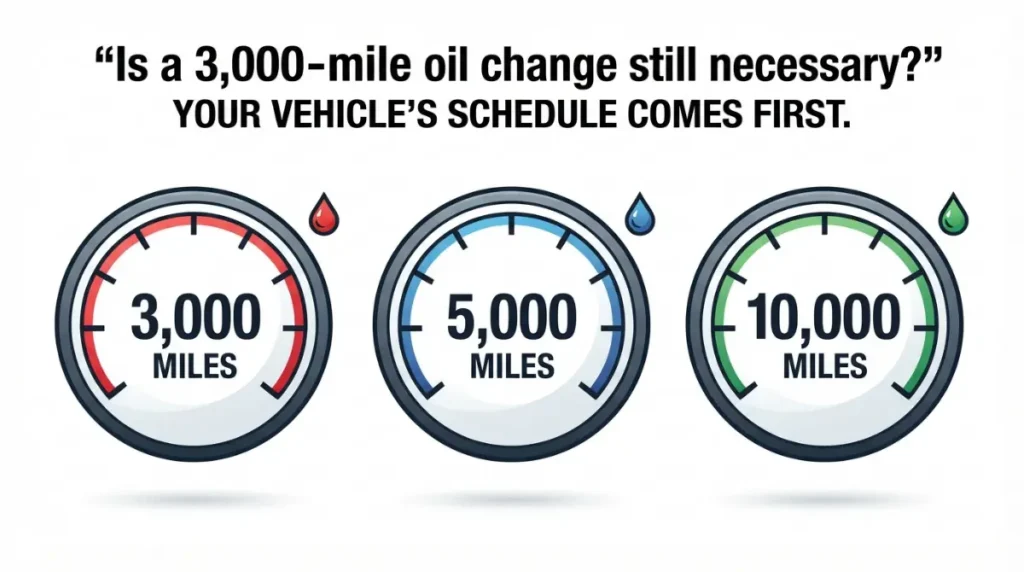
Chevrolet says many older models, including those built without or before its Oil Life Monitoring System, still require 3,000-mile changes.
📋 On the Record: Chevrolet’s oil-change page says its Engine Oil Life System, on most of today’s Chevrolets, has made the 3,000-mile change obsolete. It lists no model years. Status checked October 8, 2026.
Oil change intervals by maker: Chevrolet, Ford, Honda, Toyota
Each row below comes from the maker’s own page, scoped as far as that page allows.
What each maker says
| Maker | Oil change rule | Time limit | Applies to |
|---|---|---|---|
| Chevrolet (GM) | Within 600 miles of “Change Engine Oil Soon” | At least once a year | Most current Chevrolets; no years listed |
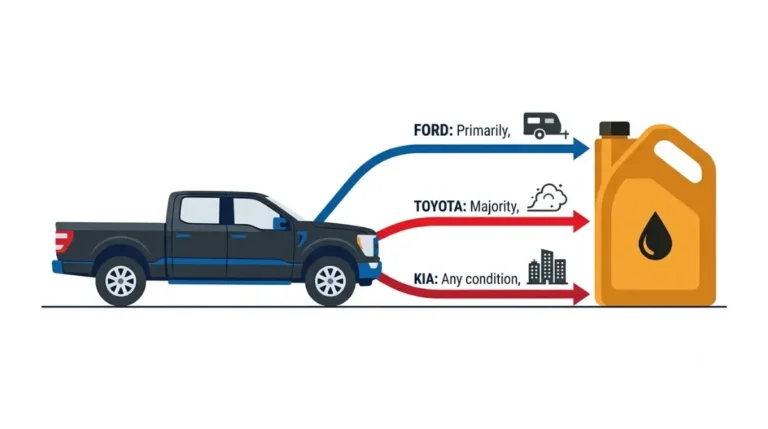
| Ford | Monitor message; reset after each change | None stated; time since service feeds the monitor | Monitor-equipped Fords; no years listed |
| Honda | “Due Soon” at 15–6% oil life | Yearly if no message in 12 months | U.S. manual page; model year not shown |
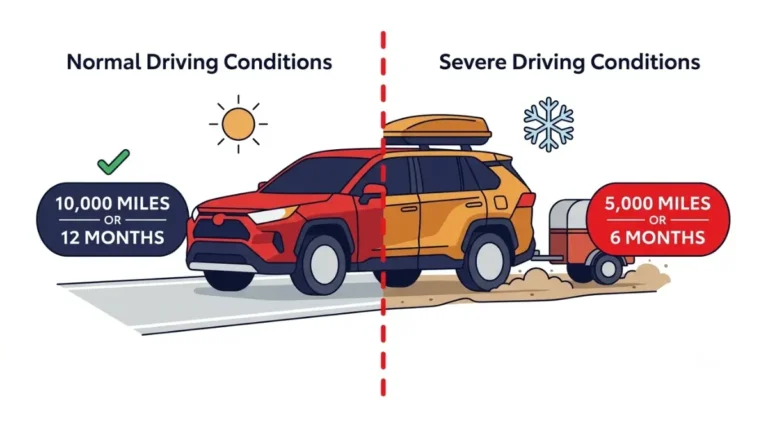
| Toyota | Oil and filter at 5,000 miles or six months | Six months | 2008 RAV4 guide only |
Why miles or months matters
Chevrolet and Honda both call for a yearly change even when no message appears, so low-mileage drivers hit the calendar first.
If your vehicle isn’t listed
Open the maintenance chapter of your manual. F-150 owners can start with our F-150 oil change interval guide for where Ford lists the normal and special schedules.
Severe driving and oil life monitors: which number wins?
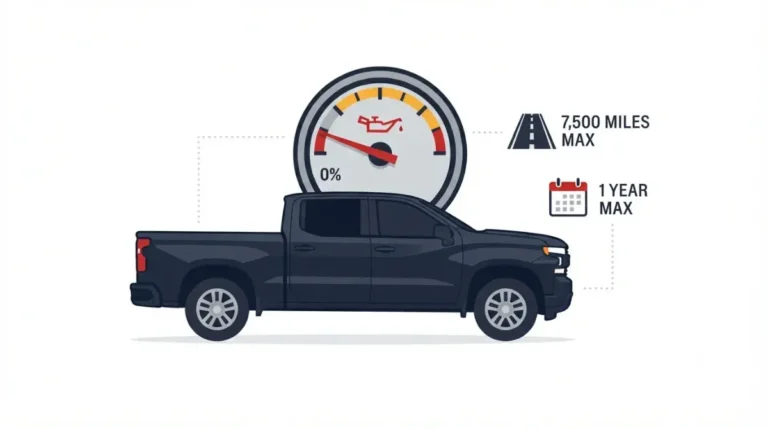
Follow whichever trigger arrives first: the monitor’s message or the maker’s time limit.
What counts as severe driving
Chevrolet’s system weighs speed, engine temperature, driving habits and climate; Honda’s weighs engine operating conditions, so how you drive moves your number. Toyota’s 2008 RAV4 guide and Ford’s F-150 manuals also print a separate Special Operating Conditions schedule.
What the monitor can’t see
Chevrolet says to check your oil level regularly even with its system. Ford and Honda both say to reset the monitor after each change, or it counts from the wrong starting point.
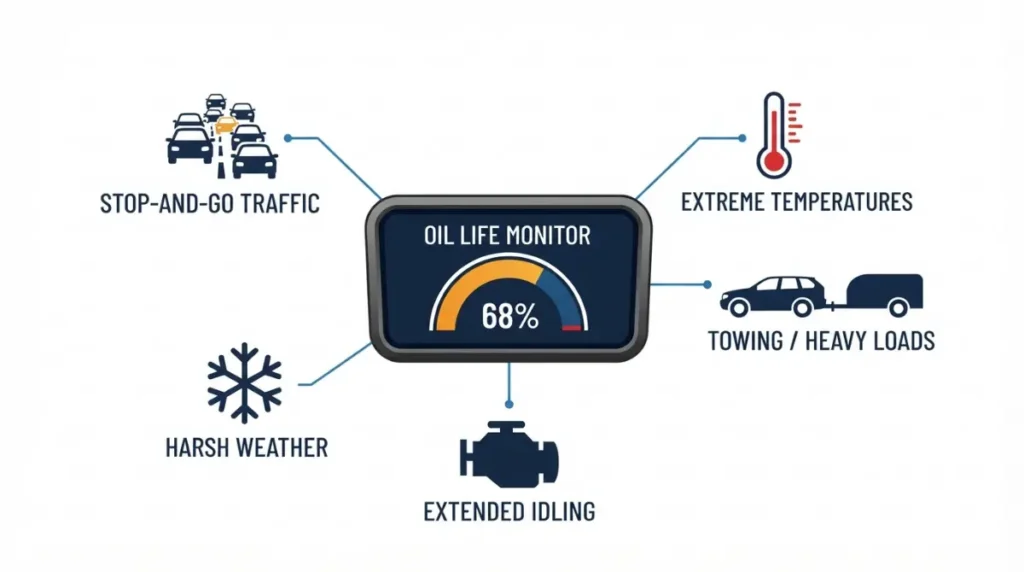
🔍 Why It Happens: The monitor estimates life from driving data, so it is not a level check.
Will skipping the maker interval cost you the warranty?
The shop you pick is protected; a skipped interval can put a claim at risk.
Who can do the work
The FTC’s consumer alert (July 2011 edition) says an independent mechanic, a retail chain shop or you can do routine maintenance without voiding the warranty. Our oil change warranty rule guide covers it in full.
What the records need to show
The same alert says to follow the maker’s recommended service schedule and keep every receipt, because a claim could be denied if it appears you did not maintain the vehicle. F-150 owners can also check Ford’s powertrain coverage by year.
✅ Do This: Read your warranty booklet’s maintenance section. If a claim is questioned, ask which service they say was missed, then escalate to the maker, your state attorney general or the FTC.
What your own oil change schedule costs per year
Yearly cost is changes per year times your shop’s quote, and the calendar sets a floor.
The per-year maths
Divide annual miles by your interval. At 12,000 miles a year, a 3,000-mile habit means 4 changes; if your manual listed 7,500 miles, it means 1.6. A driver who covers 5,000 miles a year still owes one change, because Chevrolet and Honda both set a yearly limit.
💵 What It Costs: Multiply changes per year by your own quote, and ask what it includes: oil, filter, labour, dealer or independent. Labour rates vary by region.
Records and level checks
File each receipt, as the FTC advises, and check your oil level between changes; Chevrolet says to do so even with a monitor. Run your numbers in our Maintenance Interval Planner.
What happens if you go past the interval?
Makers warn that neglected oil can damage an engine.
What the maker warns
GM’s customer letter says a lack of proper oil maintenance can damage the engine, but names no mileage where damage starts; treat it as a reason to follow your schedule.
When the monitor itself needed a fix
📋 On the Record: GM Customer Satisfaction Program 12312 offered to reprogram the oil-life monitor on 2.4L 2010–2011 Buick LaCrosse, 2011–2012 Buick Regal, and 2010–2012 Chevrolet Equinox and GMC Terrain, so it would in most cases call for more frequent changes. It was free until February 28, 2015, and has expired (checked October 8, 2026).
If you own one, ask a GM dealer what applies to your VIN.
Oil change questions, answered
1. How often should I change my oil?
How often to change oil comes from your owner’s manual or oil-life monitor, plus the maker’s time limit; GM requires at least yearly.
2. Is a 3,000-mile oil change necessary?
A 3,000-mile oil change is outdated for most cars, but Chevrolet says many older models still require it.
3. How often should I change oil in an F-150?
Oil change timing on an F-150 follows your model year’s manual, which has separate normal and special operating conditions schedules.
4. How often should I change oil if I rarely drive?
If you rarely drive, change oil on the calendar: Chevrolet and Honda both call for a yearly change.
5. Does the oil life monitor replace the time limit?
No. The monitor estimates oil life, and makers like GM still require a change at least once a year.
6. What counts as severe driving for oil changes?
Severe-driving rules sit in your manual: Toyota and Ford list special operating conditions; Chevrolet and Honda monitors factor in how you drive.
7. Is it bad to change oil too early?
Changing oil earlier than your maker says costs more per year: divide annual miles by the interval, then multiply by your quote.
8. Does an independent oil change void my warranty?
An independent shop’s oil change does not void your warranty, per the FTC; follow the maker’s schedule and keep receipts. Check your warranty booklet.
9. What records should I keep for oil changes?
Keep every oil change receipt, whoever does the work; the FTC advises keeping all service records.
10. What happens if I go past the oil change interval?
GM’s oil-monitor program letter warns that poor oil maintenance can damage the engine, but names no mileage.
Your next step
Open your owner’s manual, find your maker’s number and its time limit, and set your schedule from those, not from a shop’s sticker. If a shop quotes 3,000 miles, ask where your manual says so. Reset the monitor after every change and keep every receipt. Then run your yearly numbers in our Maintenance Interval Planner before agreeing to a shorter interval.