Exact Cost Per Mile of a Synthetic vs Conventional Oil Change
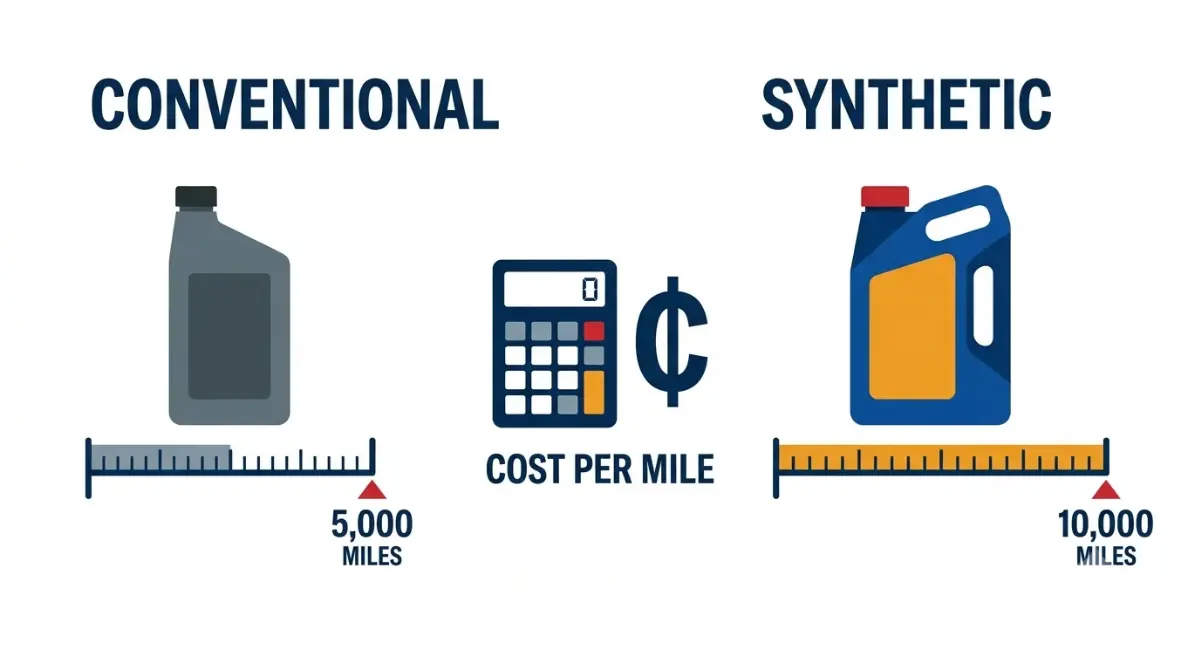
Table of Contents
Is synthetic oil cheaper per mile than conventional?
The one-line answer
Synthetic oil is cheaper per mile only if it lasts longer than its price premium over conventional (owners often say regular oil). The synthetic vs conventional oil change cost test is one division: price, over miles before the next change.
Find your situation
- Holding a quote: the break-even maths below converts it to cents per mile.
- Doing it yourself: the worksheet near the end needs only your manual and a receipt.
- Under warranty: any shop or DIY change is allowed if the specification matches; see the oil change warranty rule.
- Towing or idling: the last section covers the interval limit.
ℹ️ Safety Note: This is general information, not legal advice. Check your own booklet and manual before choosing an oil.
What Ford’s manual says about oil type and interval
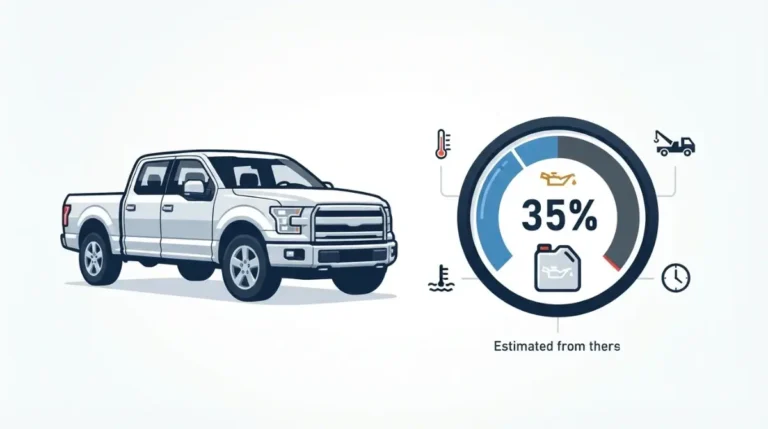
Ford’s 2020 F-150 manual sets the oil change interval by how the truck is used and caps it at one year or 10,000 miles; its Normal schedule page names no oil type.
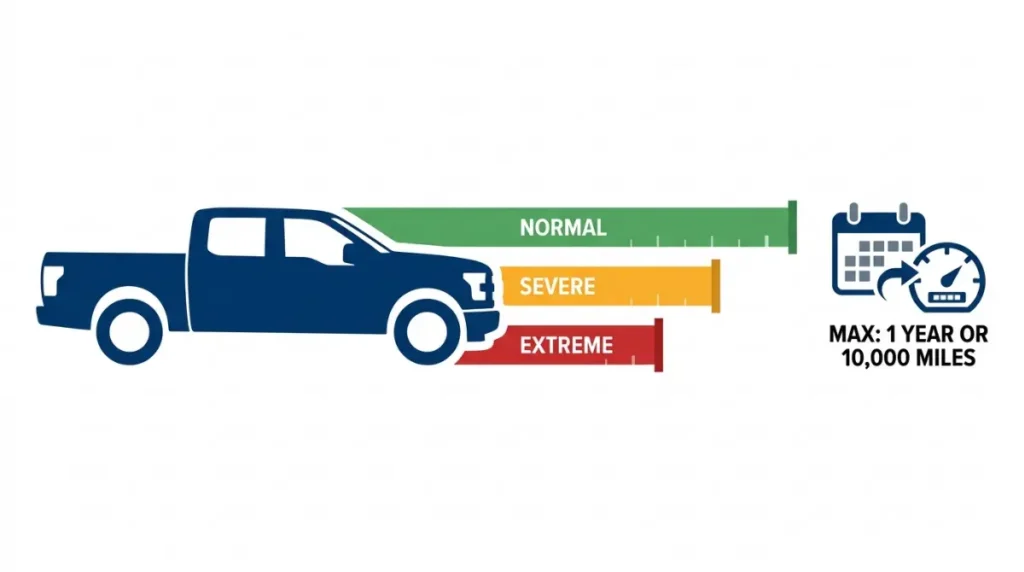
The 2020 F-150 interval bands
📋 On the Record: The 2020 F-150 Owner’s Manual, Scheduled Maintenance (Normal), lets the oil-life monitor set the interval; guideline bands are 7,500–10,000 miles (normal), 5,000–7,500 (severe) and 3,000–5,000 (extreme). A footnote says not to exceed one year or 10,000 miles. Retrieved October 10, 2026.
What the Normal schedule page names
The retrieved text names no oil type, so it cannot say whether synthetic earns a longer interval. Our Ford’s F-150 oil change interval guide covers the schedules; we did not read the Special Operating Conditions page, so check it, and your own year’s manual.
Motorcraft blend and full synthetic share one Ford spec
Motorcraft lists Ford specification WSS-M2C961-A1 on both its 5W-30 synthetic blend and 5W-30 full synthetic pages, with no engines, years or intervals.
What a synthetic vs conventional oil change costs
Oil change prices vary by region, shop and oil; each figure below states what it includes.
Price per change: what each figure includes
| Source | Figure | Includes | Applies to | Oil type stated? |
|---|---|---|---|---|
| Bankrate (Oct 16, 2024) | $66 average | Not itemised; 2024 Yelp data | Generic U.S. | No |
| YourMechanic | $142 | $37 parts + $105 labour; mobile | F-150, 2011–2020 engines | No |
| RepairPal | $183–$212 | Oil, filter, gasket, leak check, light reset | F-150, years not stated | No |
No source splits conventional from synthetic, so we cannot give a like-for-like pair and will not invent one.
💵 On these numbers: Costs shown are typical ranges, not quotes. Labour rates vary by region and between dealer and independent shops, and parts pricing moves.
Parts versus labour: where DIY saves
Only YourMechanic itemises: $37 parts and $105 labour. DIY removes the labour charge, not the parts or your need for proof records.
Cost per mile: the break-even maths
Divide the total price of one oil change by the miles you drive before the next one.
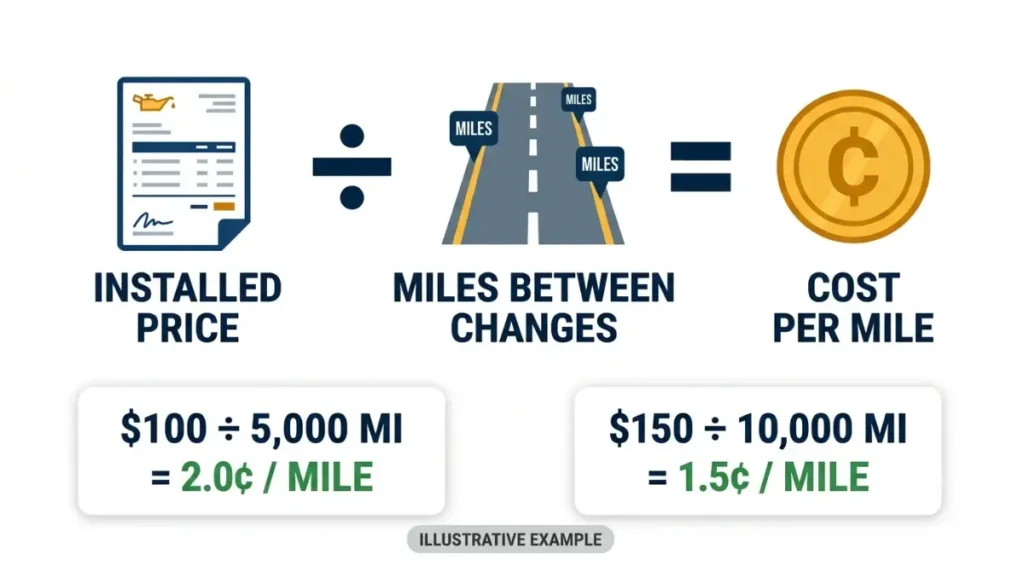
The formula and a worked example
Cost per mile = installed price ÷ miles between changes. With illustrative inputs, not quotes: $100 over 5,000 miles is 2.0 cents per mile; $150 over 10,000 miles is 1.5 cents.
How long synthetic must last to break even
- Divide synthetic price by conventional price: $90 ÷ $60 = 1.5.
- Multiply by the conventional interval: 1.5 × 5,000 = 7,500 miles.
Synthetic must last that far to match conventional; the table shows each break-even interval.
| Synthetic ÷ conventional price | Conventional every 3,000 mi | Every 5,000 mi | Every 7,500 mi |
|---|---|---|---|
| 1.25× | 3,750 | 6,250 | 9,375 |
| 1.5× | 4,500 | 7,500 | 11,250 † |
| 1.75× | 5,250 | 8,750 | 13,125 † |
| 2× | 6,000 | 10,000 | 15,000 † |
† Past the 2020 F-150 manual’s 10,000-mile cap.
When the manual’s cap ends the comparison
A longer interval only helps if the maker allows it. Bankrate’s “sometimes up to 12,000 miles” for synthetic is its claim, not a maker limit.
The cheapest oil is the one that meets your spec
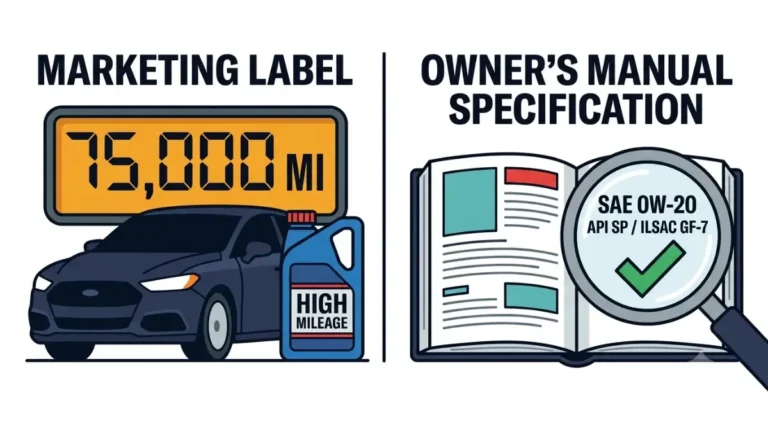
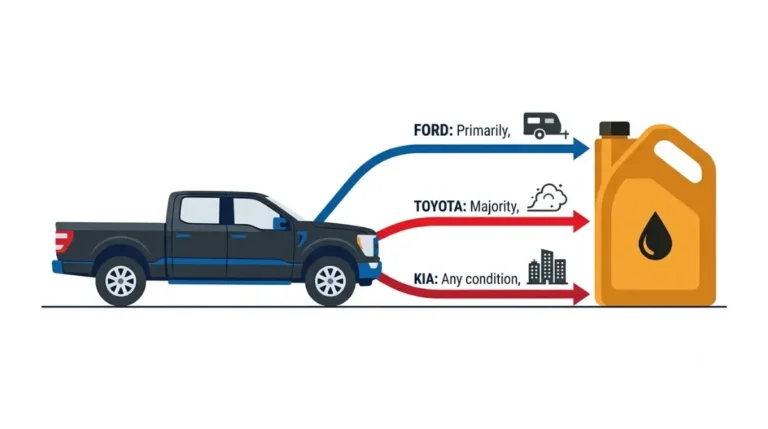
Use oil that meets the specification in your owner’s manual; Ford, Toyota and Chevrolet warranty booklets exclude damage from improper fluids.
Only compare oils that meet your specification
In its 2026 Warranty Guide, Ford requires “Ford engineering specifications” (p.3) and excludes improper fluids (p.16). Toyota’s MY2026 Tacoma guide excludes fluids not in the owner’s manual (p.14); Chevrolet’s MY2026 booklet excludes failing to use or maintain proper fluids (p.10). A cheaper oil without the required specification is not a like-for-like price.
Any shop or DIY is allowed, with proof
Federal law bars tying coverage to a brand or dealer, but a maker may deny a claim it can show the work caused. Keep dated receipts or a DIY log.
✅ Do This: Ask any shop to print the viscosity grade, specification and filter part number on the invoice. This is not legal advice.
Work out your own cost per mile in three steps
Three inputs give you a number you can defend.
Step 1: get the quote in writing
Ask for the full installed price, with the specification printed on it.
Step 2: take the interval from your manual
Use your manual’s interval or monitor, plus its time limit. Chevrolet’s current models and one Honda manual page call for a change at least yearly (see each maker’s oil change limits).
Step 3: divide and compare
Divide each quote by its interval: an illustrative $90 over 7,500 miles is 1.2 cents per mile. Then run your yearly miles through the Maintenance Interval Planner the Oil Change Cost-per-Mile Worksheet keeps the results together.
Stretching the interval to save money has a limit
Savings from fewer changes stop at the maker’s cap.
Ford’s cap on the 2020 F-150
The 2020 F-150 manual’s footnote says not to exceed one year or 10,000 miles. As a labelled example only, Toyota’s MY2026 Tacoma guide gives 12 months or 10,000 miles (p.39, footnote 4).
Why the monitor sets the date
🔍 Why It Happens: Ford’s monitor sets the interval from how the truck is used, so your date follows your driving, not only the odometer.
For towing or idling, read the Special Operating Conditions page in your own manual. See what each maker’s oil life percentage counts.
Frequently asked questions
1. How do you calculate oil change cost per mile?
Divide installed price by miles until the next change; $100 over 5,000 miles is 2 cents per mile.
2. Is synthetic oil cheaper per mile than conventional oil?
Only if it lasts long enough: synthetic must last at least its price ratio times conventional’s interval.
3. How do you find the break-even interval for synthetic oil?
Multiply conventional’s interval by the price ratio: $90 against $60 is 1.5, so 7,500 miles beats a 5,000-mile conventional change.
4. Does the oil type set the oil change interval?
Ford’s 2020 F-150 manual gives interval bands by driving use and says not to exceed one year or 10,000 miles.
5. Can the cheapest oil cost me my coverage?
Match the specification in your owner’s manual; Ford, Toyota and Chevrolet warranty booklets exclude damage from improper fluids.
6. Are Motorcraft blend and full synthetic the same specification?
Motorcraft lists WSS-M2C961-A1 for both its 5W-30 synthetic blend and full synthetic; check the specification your manual names.
7. Does an independent shop or DIY oil change void the warranty?
No. Federal rules bar tying coverage to brand-name service; keep proof and use the specification your manual requires.
8. What does an oil change typically cost?
Bankrate cites a $66 U.S. average (Yelp, 2024, type unspecified); YourMechanic lists $142 for an F-150, mobile service, $37 parts.
9. How much does a DIY oil change save?
YourMechanic’s $142 F-150 figure is $37 parts plus $105 labour, so DIY removes the labour charge but still needs proof records.
10. How long can synthetic oil go between changes?
Follow your manual or monitor and the maker’s time cap; Chevrolet and Honda call for a change at least yearly.
Your next step: divide, then check your manual
Take your shop’s quote and your manual’s interval, divide one by the other, and compare the two oils on cost per mile. Then run your yearly miles through the Maintenance Interval Planner to check the time cap. Confirm the oil meets the specification your manual names, and keep dated receipts or a DIY log.