Is your 2018–2020 F-150 5.0 Coyote burning oil? Ford’s answer

A June 2017 Ford test of the 5.0 Coyote returned 3,782 miles per quart, against Ford’s own 10,000 minimum, as shown in the 2026 court ruling.
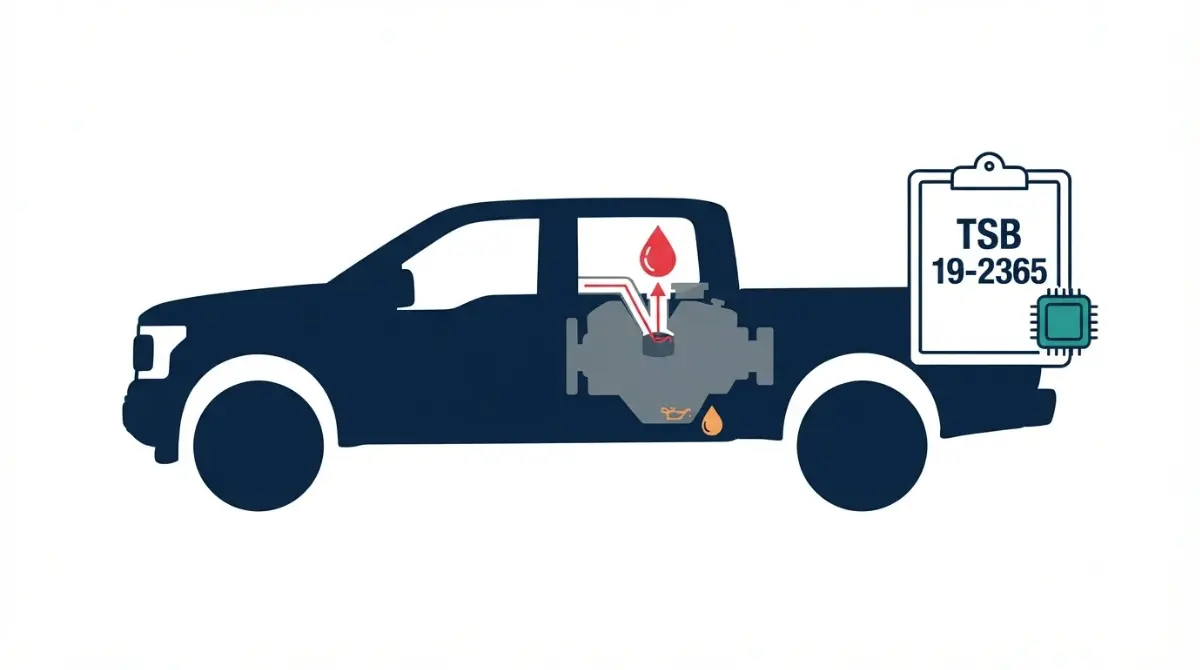
Table of Contents
Recall and bulletin status checked on November 17, 2026.
Ford traced it to deceleration, and the fix is software
Ford’s answer for a 2018–2020 F-150 with the 5.0L that burns oil is TSB 19-2365: a powertrain control module (PCM) software update plus an oil and filter change. Trucks built on or before October 4, 2019 also get a new dipstick.
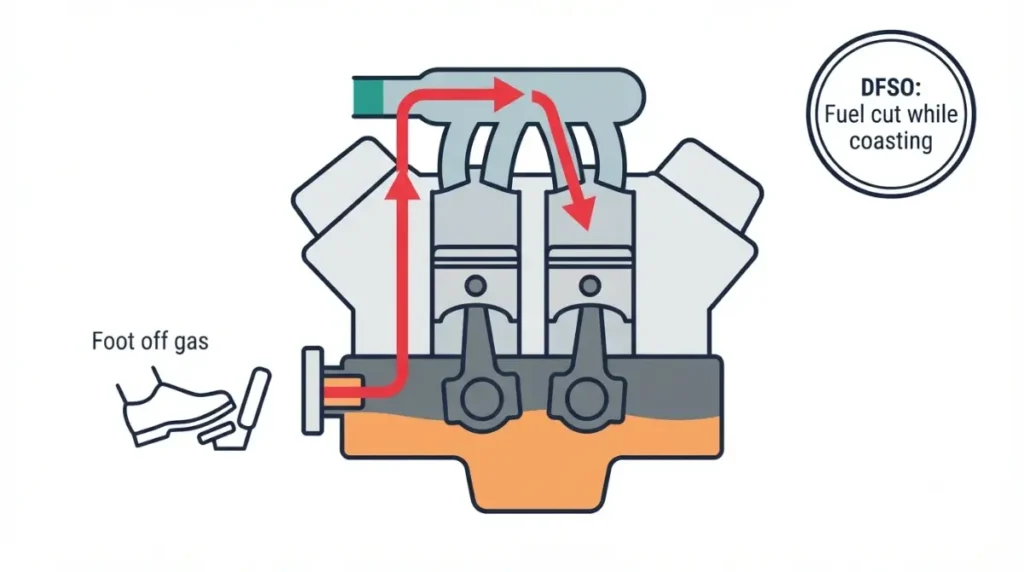
The bulletin, issued December 5, 2019, traces the oil loss to “high intake manifold vacuum during some deceleration fuel shut off (DFSO) events.” DFSO is the engine cutting fuel while you coast with your foot off the gas. In those moments, vacuum draws oil into the combustion chamber from the crankcase, the valve guides and the PCV system. The new calibration lowers that vacuum during some of those events.
It’s a service bulletin rather than a recall. On most of these trucks today, the 0.9 labor hours Ford allows for the job are paid by the owner.
Safety note: A 5.0 that uses oil between changes can run low, and low oil is an engine lubrication problem. In the court record of the 5.0 oil lawsuit, an owner testified that his truck lost power at about 60 mph while very low on oil (opinion and order). If the oil pressure warning comes on or the dipstick reads below its lower mark, stop driving the truck and have a qualified technician check the engine before it goes back on the road.
More than a quart in 3,000 miles, with no leaks
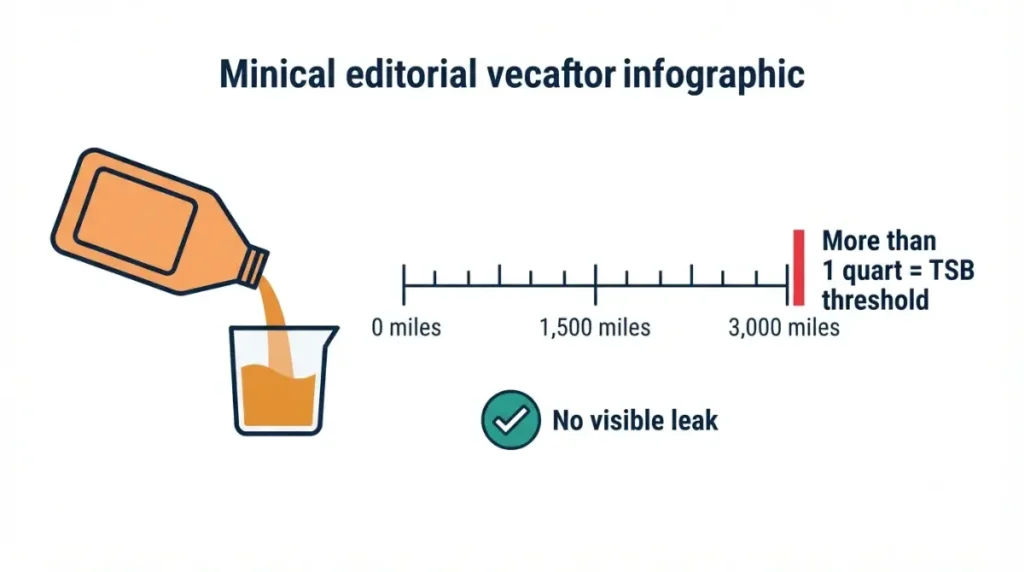
A quart low at the oil change, a dry driveway and no oil weeping from the engine: that’s the pattern this bulletin was written for. Ford’s line is more than 1 quart in 3,000 miles with no visible leaks. If the technician finds a leak, 19-2365 doesn’t apply, and the leak is repaired as a separate job.
Mileage matters too. Oil use is normally higher during the first 10,000 miles and generally improves after that, per the same bulletin, so a truck still under that mark is inside Ford’s break-in window.
The new dipstick, part JL3Z-6750-E, shows a wider normal operating range of 2 quarts.
Some owners hear at the service desk that a quart every 1,000 miles is normal for a 5.0. Neither 19-2133 nor 19-2365 uses that figure. Both draw the line at 1 quart per 3,000 miles. If that’s the answer you’re getting, read what to do when a dealer calls your oil use normal before the next visit.
Write down the odometer reading at each oil change and every quart you add between changes. Those two numbers turn “it uses oil” into a rate a dealer can hold against the bulletin.
Why does the 5.0 pull oil when you lift off the gas?
Ford’s bulletin says the oil gets in on deceleration, through manifold vacuum. Ford’s own development records, as they appear in the court record, point at the piston rings.
In Lyman v. Ford Motor Company, Judge Gershwin A. Drain of the Eastern District of Michigan laid out those records in his July 22, 2026 opinion. Since 2012, Ford has required its vehicles to reach at least 10,000 miles per quart (MPQ), a standard it calls “Trustmark.” A June 2016 report found the 5.0 did “not fully meet” that requirement and traced the cause to piston ring tension, which Ford raised from 28.7 N to 39.2 N. By October 2016, the engine was confirmed at 10,000 MPQ.
Fuel economy reports later that year tied a shortfall to the higher ring tension. In June 2017, after production began, a test on the US06 lab cycle returned 3,782 MPQ, and Ford still approved a lower ring-tension design. That 2017 result is about 38% of Ford’s own minimum.
| Miles per quart | What the number is | Where it comes from |
|---|---|---|
| 10,000 | Ford’s internal minimum for average retail customers, required since 2012 | Court opinion, Lyman v. Ford |
| 3,782 | June 2017 Ford test of the 5.0 on the US06 cycle, after production began | Court opinion, Lyman v. Ford |
| 3,000 | Use worse than this with no visible leaks puts a truck under the bulletin | TSB 19-2365 |
Sources: opinion and order, Lyman v. Ford, E.D. Mich.; Ford TSB 19-2365.
The ruling leaves the defect question to a jury. On whether the bulletin fixed the problem, the judge wrote that “there is evidence in the record suggesting that it did not remedy the defect,” and he didn’t decide the point.
For an owner, the practical point is narrower. 19-2365 remains the current 5.0 oil bulletin for all three model years. If your truck stays above the bulletin’s line after the reflash, the next step is an engine diagnosis under whatever coverage the truck still has.
2018, 2019 and 2020: which trucks the bulletin covers
Ford’s first two 5.0 oil bulletins covered 2018 trucks only. The 2019 model year was added in November 2019, and 2020 trucks joined when 19-2365 replaced that interim bulletin in December.
| Bulletin | Issued | Model years | What the dealer did |
|---|---|---|---|
| 19-2058 | Early 2019 | 2018 | First version, replaced by 19-2133 with a new procedure and parts list |
| 19-2133 | May 10, 2019 | 2018 | New PCV valve, a dipstick-marked consumption test, and a long block replacement if the truck used 1 quart or more within 3,000 miles |
| 19-2338 | November 2019 | 2018–2019 | Interim version, replaced by 19-2365 |
| 19-2365 | December 5, 2019 | 2018–2020 | PCM reflash with an oil change, new dipstick where needed; no consumption test and no engine replacement step |
Sources: Ford TSB 19-2133; Ford TSB 19-2365.
19-2133 was the only version with a pass/fail consumption test and a long-block swap for trucks that failed it. The current bulletin drops both. On a 2018–2020 truck today, an engine replacement comes through a dealer’s diagnosis and whatever warranty the truck still has, with the repair coded to causal part 6006, the engine.
The 2021-and-later F-150 5.0 and the Mustang GT aren’t listed on 19-2365. A 3.5L EcoBoost truck has its own bulletin, covered in the 3.5 EcoBoost oil-burning valve cover fix. Other faults on these model years are listed in F-150 problems and what Ford covers, by year.
Not a recall, and the warranty clock has mostly run out
Because 19-2365 is a bulletin, Ford pays for it only while the truck is inside a warranty or Ford Protect plan that covers the engine. The bulletin itself doesn’t change any coverage limit.
On these trucks, Ford’s powertrain warranty lasts 5 years or 60,000 miles from the Warranty Start Date, whichever occurs first. It covers engine parts that fail from a defect in factory materials or workmanship. That 5-year term is still open only on a truck whose Warranty Start Date falls after November 17, 2021, and only if the odometer is under 60,000. The details are in how Ford’s powertrain warranty works on an F-150.
No safety recall covers 5.0 oil consumption on 2018–2020 F-150s. NHTSA’s recall search shows open safety recalls by VIN, and a service bulletin like 19-2365 won’t appear there. The split decides who pays, which is laid out in TSB versus recall on an F-150: who pays.
The class action over these trucks is still open, with no settlement. The July 22, 2026 ruling in Lyman threw out the federal Magnuson-Moss claim and the express warranty claims. It let consumer-protection or fraudulent-concealment claims from owners in California, Illinois, Ohio, Pennsylvania, Virginia and Washington go forward. A second suit, Bryan v. Ford Motor Company, was filed in the same Michigan federal court in August 2025. Neither case has a claim form or a payout today, so there’s no reason to hold off on a reflash or a repair while they run.
What a dealer checks, and what to ask
Bring the numbers with you: the odometer reading at your last oil change and every quart added since.
Under 19-2365, the technician checks for leaks, drains the oil, fits a new filter, fills to the MAX mark and reprograms the PCM, swapping the dipstick on older builds. The update also resets the transmission’s adaptive shift strategy, and shifts can feel firmer than normal for several days, per the bulletin.
At the service desk, these six questions cover it:
- Does my VIN’s service history show labor operation 192365A, the 19-2365 calibration?
- Was my truck built early enough to need the new dipstick, JL3Z-6750-E, and was it installed?
- Did the leak inspection find anything?
- Will you measure oil use from a marked full level after the reflash and give me the readings in writing?
- In OASIS, is causal part 6006 still inside my powertrain warranty or my Ford Protect plan?
- If you recommend an engine, what are the part number, the book time and your hourly rate?
A repair order showing operation 192365A is your proof the calibration was done.
Cost of the reflash vs a replacement long block
0.9 labor hours is Ford’s book time for the whole 19-2365 visit, from the leak check to the PCM update. An engine is a much bigger job. TSB 19-2133 gave dealers 11.8 hours to replace the long block in a 2018 4×2 and 12.3 hours in a 4×4, and both times include removing the cab.
| Job | Ford book time | Parts | What you pay |
|---|---|---|---|
| 19-2365 visit (reflash, oil change, dipstick) | 0.9 hours | Motorcraft 5W-20, filter AA5Z-6714-A, dipstick JL3Z-6750-E where needed | 0.9 × the shop’s hourly rate, plus parts |
| Long block, 2018 4×2 | 11.8 hours, cab off | Long block JL3Z-6006-A, $7,998.67 list | 11.8 × the hourly rate, plus the engine and core charge |
| Long block, 2018 4×4 | 12.3 hours, cab off | Same long block | 12.3 × the hourly rate, plus the engine and core charge |
Sources: TSB 19-2365; TSB 19-2133; JL3Z-6006-A listing.
Hourly rates differ by region and by shop, so the hours and part prices above are building blocks, and the quote you sign is the price that counts.
FordPartsGiant, an online Ford parts dealer, lists the JL3Z-6006-A long block at $6,684.69 against the $7,998.67 list price, plus a $1,800 core charge. It shows HL3Z-6006-DARM as the replacement part number and lists the part as unavailable, so check which number your quote carries.
Labor is where the shop’s rate shows. Every $10 of hourly rate adds $118 to the 4×2 engine job and $123 to the 4×4, against $9 for the reflash. Ford published those engine hours for 2018 trucks, so a 2019 or 2020 quote should list its own book time.
Before you approve an engine: confirm the truck already has the 19-2365 calibration and that oil use was measured after it. The engine job runs 11.8 to 12.3 labor hours plus a long block listed at $7,998.67.
Reflash first, then decide between an engine and a sale
A truck without operation 192365A on its record gets the reflash before anything else.
If the reflash is done and the truck still uses more than the bulletin allows while it’s inside the powertrain term or a Ford Protect extended service plan, push for the engine claim with your measured readings in hand.
Outside coverage, the math is the engine quote against the truck’s value. When a long block and roughly 12 hours of labor come close to what the truck would bring on a sale, selling it is the better call, and the oil use goes on the disclosure along with your readings. A truck that uses some oil but stays under the bulletin’s line doesn’t need an engine; Ford’s own test in 19-2133 called that operating normally. Keep checking the level the way the owner’s manual describes.
Start with the service history on your VIN and look for 192365A.
Found this helpful? See more of our guides on Google.
Want to see our guides first on Google?