F-150 recall remedy not yet available? What to do while you wait

A remedy-not-yet-available letter is the first of two. Ford’s 2015–2017 F-150 downshift fix came 86 days after filing; the 2021 park fix is due Q2 2027.

Table of Contents
Recall and bulletin status checked on November 4, 2026.
A Ford recall letter that says the fix isn’t ready means the recall is official, but dealers don’t have the parts or software to fix your truck yet. A second letter follows once they do, and until it arrives, the precautions printed in the first one are your instructions.
What “remedy not yet available” means on a Ford notice
The status means Ford has filed a safety recall with NHTSA and your VIN is in it, but the repair isn’t ready to ship. Federal notice rules give Ford 60 days from that filing to mail owners whether or not a fix exists. So many F-150 owners get two letters: an interim notice naming the defect and its warning signs, then a remedy notice telling you to book the dealer.

The same status shows up online. Enter your 17-character VIN in NHTSA’s recall lookup, and an affected truck reads “Recall Incomplete, remedy not yet available” beside the campaign. Ford’s campaign number (26S48, for example) and NHTSA’s number (26V402) point to the same recall, and the dealer can work from either one.
None of this changes the price: the recall repair is free at any Ford dealer.
Safety note: The open F-150 campaigns below involve the transmission park system and the rear axle hub bolts. If your truck shows the warning sign your letter describes, such as the wrench light or a click from a rear wheel, have a Ford dealer inspect it before you drive it normally again.
How long have Ford’s F-150 fixes taken to arrive?
86 days passed between Ford’s filing of the 2015–2017 downshift recall and the launch of its fix. That campaign hit its own estimate. The 2021 park-system fix isn’t expected until the second quarter of 2027, 9 to 12 months after its filing.
| Recall | Trucks covered | Filed with NHTSA | Ford’s estimate for the fix | Where it stands |
|---|---|---|---|---|
| 26S28 / 26V237 | 2015–2017 F-150, 6-speed automatic, built Mar 12, 2014–Aug 18, 2017 | Apr 14, 2026 | July 2026 | Fix launched Jul 9, 2026 |
| 25S82 / 25V512 | 2023–2025 F-150, Trailer Tow Max Duty with 9.75-in heavy-duty axle, built Jan 2, 2023–May 21, 2025 | Aug 8, 2025 | Q4 2025 | Phased campaign; check your VIN |
| 26S48 / 26V402 | 2021 F-150, built Jan 8, 2020–Oct 8, 2021 (Dearborn) or Feb 12, 2020–Sep 28, 2021 (Kansas City) | Jun 24, 2026 | Q2 2027 | Open, no fix yet |
Sources: NHTSA’s 26V237 recall acknowledgment, Ford’s 25S82 owner letter, Ford’s 26S48 recall FAQ, and each recall’s NHTSA filing for scope and dates.

The estimate in an interim letter is Ford’s forecast. Federal rules ask only that the second letter follow within a reasonable period once the remedy exists, so a quarter printed on the first letter can slide. The 25S82 letter told Max Duty owners parts were anticipated in Q4 2025, and the campaign runs in phases.
That recall’s scope and the trouble codes that matter later are in how the 2015–2017 F-150 downshift recall fix works. Every other open campaign by model year sits in F-150 problems by year, with what Ford still pays for.
2021 and 2023–2025 F-150s: driving while you wait
“Ford has not issued instructions to stop driving your vehicle under this safety recall,” reads the 25S82 letter mailed to 2023–2025 Max Duty owners. Unless your own letter carries a stop-driving or park-outside instruction, the truck stays in service, with the precaution followed exactly.
On a 2021 F-150 covered by 26S48, that precaution is simple: set the electronic parking brake every time you park. The defect lets the park pawl, the pin that locks the transmission in Park, engage while the truck is moving. Damage left behind can stop the transmission from holding the truck in Park, and without the parking brake set it can roll. A wrench light on the instrument panel or a parking brake that applies itself is the cue to book the dealer that week, and the 2021 F-150 park pawl recall details which trucks are in it.
The axle campaign gives a different warning. As a hub bolt loosens, owners may hear a clicking noise from a rear wheel. A broken bolt can wear the axle hub splines, and damaged splines can let the truck roll in Park without the parking brake applied, or lose drive power. If you hear that click, stop towing and have it seen the same day.
Without a symptom, both groups of trucks can keep working while the fix is finished.
Questions for the service desk before the fix ships
A wrench light, a rear-wheel click or a parking brake that sets itself turns a long wait into a dealer visit. Go in with these:
- Does your system show my VIN in this campaign, and is the remedy flagged as available?
- Has Ford authorized any inspection or interim repair for trucks that show the symptom?
- Can you order the parts against my VIN now so the truck is in line when they ship?
- Is a loaner or rental authorized for this campaign?
- Will you note today’s visit and mileage on the repair order?
No federal rule requires a loaner while a recall waits for parts, so question 4 deserves a straight answer from the service advisor. The repair order from question 5 is dated proof of your visit.
The 60-day clock starts at your first visit after the fix date
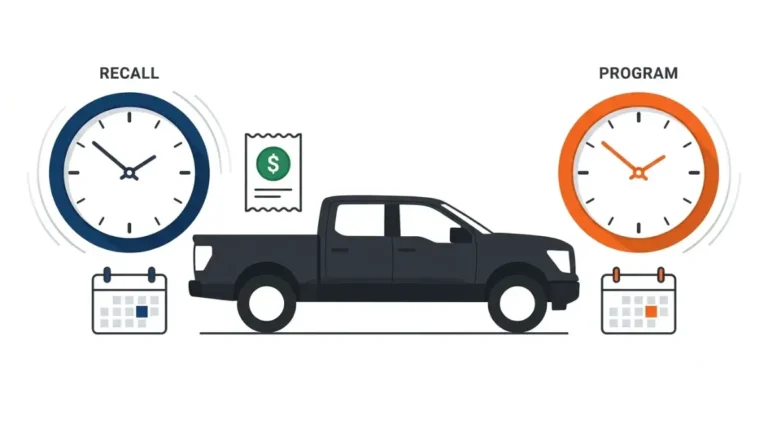
Visit the dealer before the repair date in your remedy notice and federal law doesn’t count it as presenting the truck. Once that date has passed, the visit counts.
If Ford hasn’t repaired the truck adequately within 60 days of that first visit, 49 U.S.C. 30120 treats the delay as prima facie evidence (presumed unless Ford shows otherwise) that it failed to repair the truck in time. The Department of Transportation can extend the 60 days by order for good cause. When the repair isn’t done adequately in a reasonable time, the statute says the manufacturer must replace the vehicle with an equivalent one or refund the price, less a reasonable allowance for depreciation.
Your recall letter lists NHTSA’s Vehicle Safety Hotline, 1-888-327-4236, for owners who believe Ford can’t fix the defect free of charge or promptly enough.
2023–2025 Max Duty trucks with a remedy letter but no parts
Trucks with the Trailer Tow Max Duty package built from Jan 2, 2023 to May 21, 2025 were notified in phases. Some owners report their remedy notice arriving while their dealer still had no parts. That is where the 60-day rule starts to matter.
A remedy letter sets the earliest repair date, so a visit after it counts as presenting the truck, even when the dealer can only order parts that day. Make sure that first visit is written up with the date and mileage. If one dealer has nothing on the shelf, call another Ford dealer. Both axle campaigns, 23S65 for earlier trucks and 25S82 for these, are laid out in the F-150 rear axle hub bolt recall.
Wait it out, press the dealer or complain to NHTSA
Waiting won’t cost you the repair. Ford safety recalls don’t expire, and the federal free-remedy duty covers vehicles first sold within 15 calendar years before the recall notice. That takes in every F-150 in the table above.
So wait if your letter has no stop-driving or park-outside instruction and the truck shows no symptom, and follow its precaution every time you park or tow. Press the dealer the day a symptom appears. Call NHTSA once the repair date in your remedy notice has passed and 60 days have gone by since your first visit without a fix.
The one thing to do today: run your VIN through NHTSA’s lookup and match the campaign number on screen to the one on your letter.
Other questions F-150 owners ask
Will Ford give me a loaner while I wait?
Federal recall law doesn’t require one. Ask the dealer whether Ford has authorized a loaner or rental for your specific campaign before you leave the truck.
Can I pay a shop now and get the money back?
Possibly, for a repair you paid for before Ford’s notice. Federal law requires every recall program to include a reimbursement plan for owners who paid for the remedy in a set window before notification, and Ford offers a possible refund when an issue you paid to fix is later tied to a recall. A repair paid for after the notice falls outside that rule, so get Ford’s answer in writing before spending money, and see how Ford recall reimbursement works for F-150 owners.
Found this helpful? See more of our guides on Google.
Want to see our guides first on Google?