Use Any Shop Under the Oil Change Warranty Rule With Right Proof
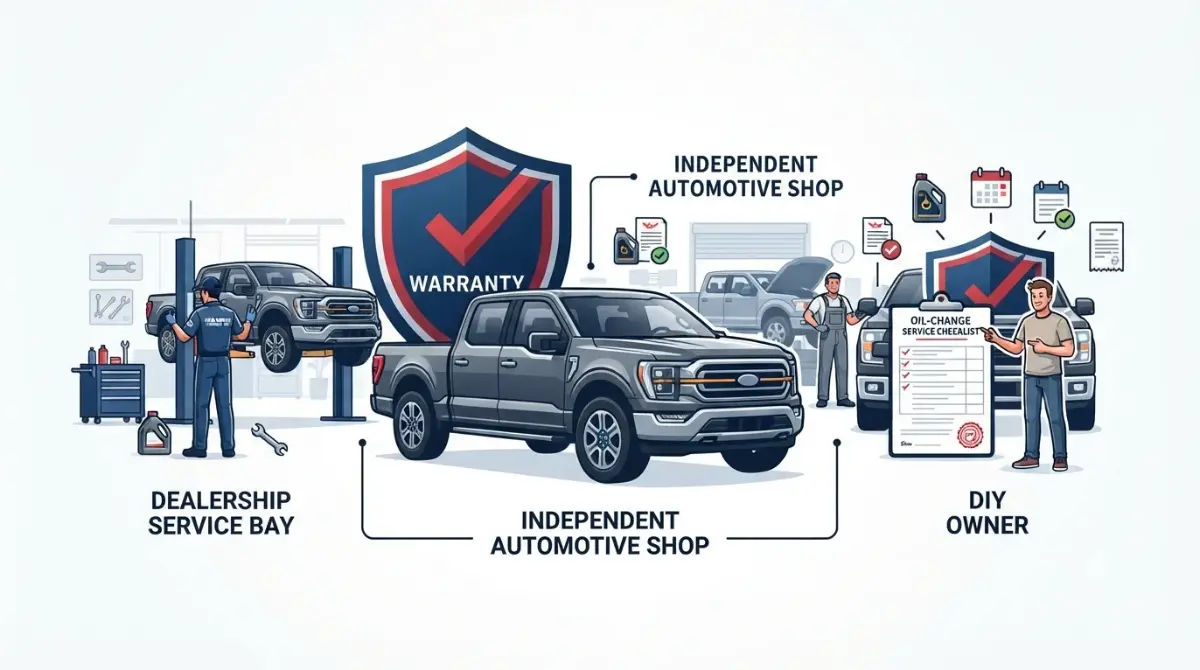
Table of Contents
Can I skip the dealer for oil changes and keep my warranty?
The short answer, with three conditions
No. Federal rules bar a carmaker from voiding your warranty only because you or an independent shop did routine maintenance. A carmaker can still deny a claim if it shows improper or missed maintenance caused the damage, so use the right specification, stay on schedule, and keep proof.
The rule comes from the Magnuson-Moss Warranty Act, 16 CFR 700.10 and FTC guidance. One exception: maintenance the automaker provides free under the warranty can be tied to its dealers.
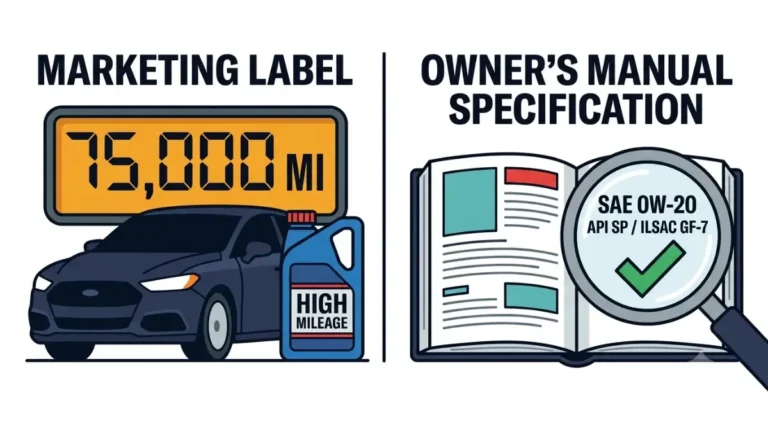
- Right specification: the grade and specification in your owner’s manual.
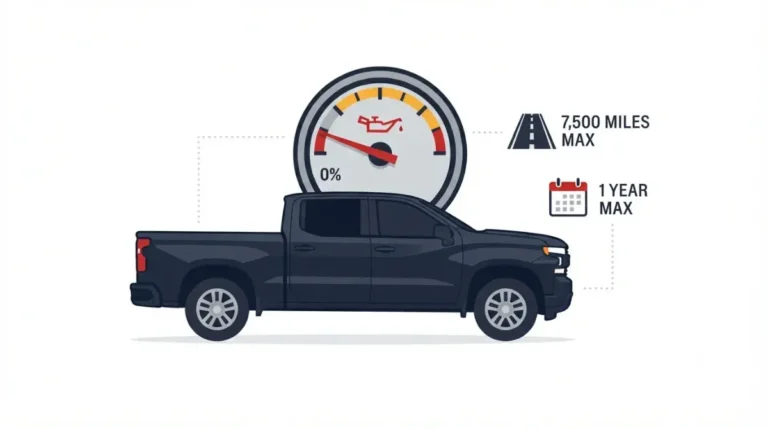
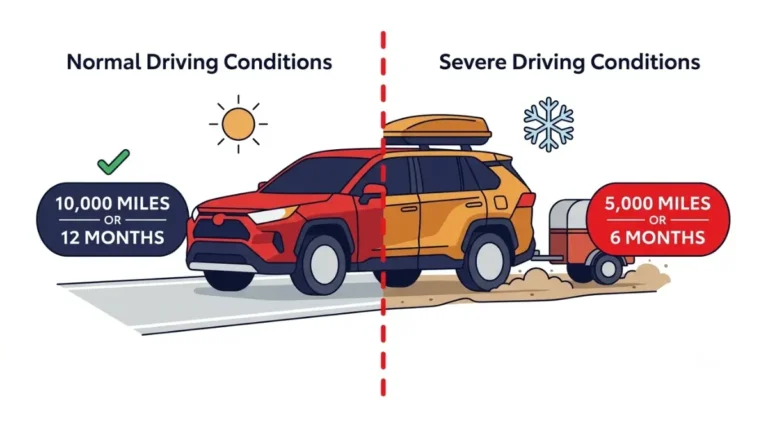
- On schedule: your maintenance schedule’s interval.
- Proof: date, mileage and what was used.
Find your situation
- DIYer with a new truck under warranty: start with the specification and proof-log sections.
- Quick-lube or independent-shop customer: your shop is allowed; see what to ask for on the invoice.
- Dealer-pressured owner: read the booklet comparison, the contracts section and the denial steps.
- Questioned or denied claim: read when a carmaker can deny a claim, then the denial steps.
- Extended-plan or service-contract holder: that paper is not your warranty; see the contracts section.
- Ford F-150 owner: Ford’s exact wording is in the booklet comparison.
How this guide was checked
Every legal and booklet statement traces to a document we opened on October 8, 2026.
ℹ️ Safety Note: This guide is general information about warranty documents, not legal advice, and terms differ by automaker, model, model year and state. A DIY oil change involves lifting the vehicle and handling hot fluid; this guide gives no procedure, so follow your owner’s manual or use a shop.
What the federal oil change warranty rule actually says
The law: no brand or dealer tie-ins to your warranty
The Magnuson-Moss Warranty Act is the federal law governing written warranties on consumer products, including new vehicles. Its anti-tying provision, 15 U.S.C. 2302(c), bars a warrantor from conditioning coverage on a branded part or service, unless the maker provides that part or service free of charge under the warranty.
The document chain, from statute to your glovebox:
- Statute: 15 U.S.C. 2302(c) bars tying a warranty to branded parts or service.
- Regulation: 16 CFR 700.10 prohibits dealer-only wording for paid maintenance, and lets the maker deny where it can demonstrate cause.
- FTC guidance: the FTC’s consumer guide to auto warranties and service contracts says a dealer cannot deny coverage for routine maintenance done by someone else, and to keep records.
- FTC enforcement: the MINI consent order, October 2015.
The regulation, 16 CFR 700.10, in plain English
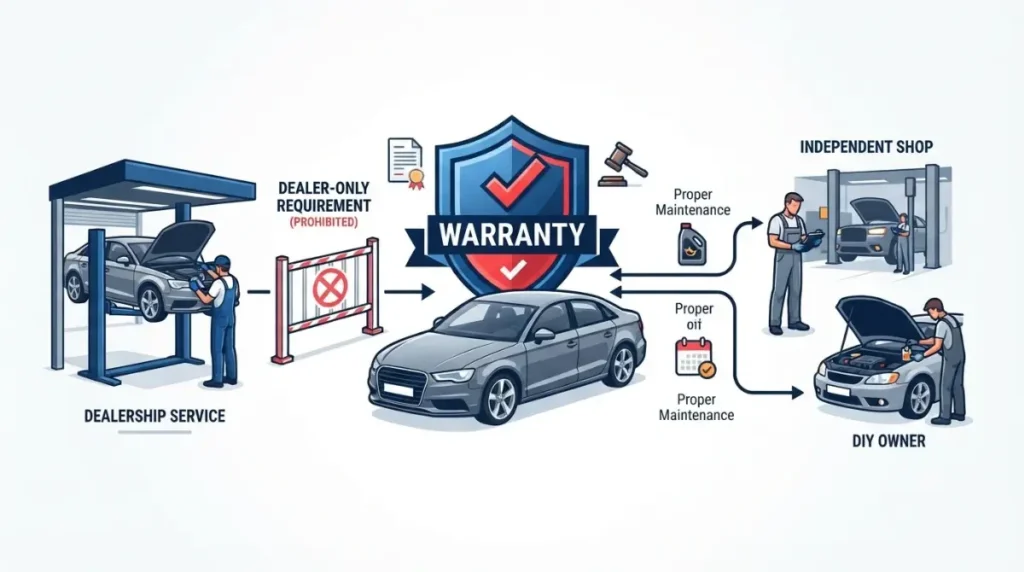
The FTC’s rule, 16 CFR 700.10, prohibits wording such as “void if serviced by anyone but an authorized dealer” for non-warranty service and maintenance. It also preserves a warrantor’s right to deny liability where it can demonstrate that unauthorized articles or service caused the damage. The eCFR text is current to October 1, 2026, with no change since the 2015 amendment (80 FR 42721); we checked it October 8, 2026.
What the FTC has said and done: the 2015 MINI order
In October 2015 the FTC issued its final consent order against BMW of North America over MINI warranty practices, without modification (File No. 1323150). Per the FTC’s 2015 MINI order letters, it bars warranty tying and bars claiming maintenance must happen at a MINI dealer. We found no later automaker-specific order in the sources we reviewed.
Warranty repairs versus paid maintenance
The rule covers maintenance you pay for. Repairs under the warranty itself go to an authorized dealer, per the Ford MY2026 (p.10), Chevrolet MY2026 (p.23) and Toyota MY2026 Tacoma (p.32) booklets.
Does the oil brand or filter brand matter for my warranty?
A carmaker may require a specification, but not a logo.
Brand requirements versus specification requirements
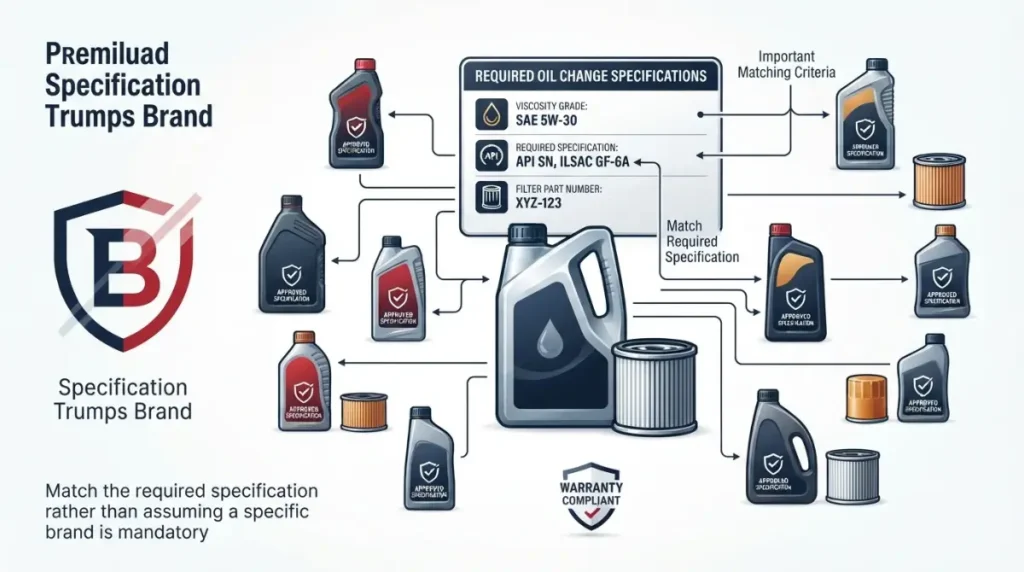
Not by itself. An aftermarket oil filter alone does not void coverage, and the carmaker must prove the part caused the damage, according to the FTC’s consumer guide. Match the oil and filter specification in your owner’s manual, not a brand name.
Wording such as “use only authorized replacement parts” is the kind of tie-in the regulation prohibits when the work is not free.
What “use the fluids in your owner’s manual” really requires
Automakers can write a specification into the warranty. Ford’s MY2026 guide requires materials that meet “Ford engineering specifications” (p.3), excludes improper fluids (p.16) and recommends genuine parts (p.3).
Toyota’s MY2026 Tacoma guide excludes fluids “other than those specified in the Owner’s Manual” (p.14). Chevrolet’s MY2026 booklet excludes failure to “use or maintain proper fluids” (p.10). We did not retrieve any oil-licensing requirement, so we make no claim about one; check your own manual.
Aftermarket filters: allowed unless shown to cause the damage
Toyota’s guide says its warranty does not depend on a brand of replacement parts (p.31).
✅ Do This: Ask any shop to write the exact viscosity grade, the oil specification and the filter part number on the invoice.
When a carmaker can legally deny your engine claim
The carmaker has to connect the damage to the maintenance
Not for using an independent shop alone. A carmaker can deny only when it can demonstrate that the shop’s work, the wrong fluid or a missed service caused the engine failure, per 16 CFR 700.10 and the FTC’s consumer guide.
Missed intervals and wrong fluids: the denials that hold up
Ford’s MY2026 guide says skipped maintenance “will invalidate warranty coverage on parts affected by the lack of maintenance” (p.3). Chevrolet’s MY2026 booklet excludes damage from missed intervals or improper fluids (p.10), and Toyota’s MY2026 Tacoma guide excludes damage from lack of or improper maintenance (p.34).
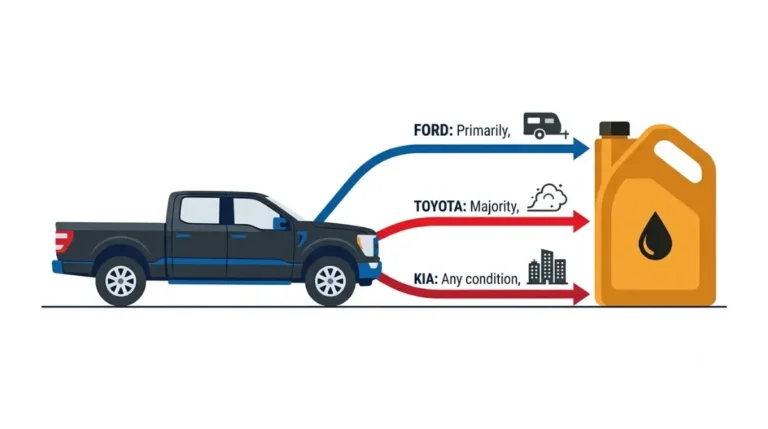
Intervals differ by maker. As one labeled example, Toyota’s MY2026 Tacoma guide says to replace oil and filter after 12 months or over 10,000 miles, whichever comes first (p.39, footnote 4). For Ford trucks, see how Ford’s oil life monitor sets the F-150 oil change interval, or use the Maintenance Interval Planner.
Why a missing receipt still causes trouble in practice
The law puts the burden on the carmaker, but a thin paper trail makes a denial easy to issue and harder to fight. CBS News and KDKA reported a Pennsylvania 2019 Kia Optima engine failure at 80,000 miles, inside 10-year/100,000-mile powertrain coverage.
The owner had 14 oil-change records; the denial cited receipts missing the VIN and odometer reading, and it was reversed after KDKA inquired. That is one reported case, not a pattern.
What late or skipped oil changes can cost you
🔍 Why It Happens: Toyota’s guide warns that failing to replace oil and filter regularly can cause oil starvation or gelling, and that the resulting repairs are not covered (p.34).
What Ford, GM, Toyota and Kia say in their own warranty books
Four automakers, side by side
| Automaker and document | Records | Who may do paid maintenance | Fluids and parts | Denial language |
|---|---|---|---|---|
| Ford: MY2026 Warranty Guide | Keep receipts with the vehicle (p.3); copies recommended (p.6) | Dealer or Quality Care Service Center “can perform” it (p.3); no dealer requirement in pages read. Emissions maintenance: any shop or individual with equivalent or certified parts (pp.55-56) | Must meet “Ford engineering specifications” (p.3); improper fluids excluded (p.16) | Skipped maintenance invalidates coverage on affected parts (p.3) |
| Chevrolet: MY2026 Limited Warranty booklet | Retain receipts (p.13). Emissions section: no denial solely for absent records (p.24) | Any qualified outlet; warranty repairs at an authorized dealer (p.23, emissions section) | Failure to “use or maintain proper fluids” excluded (p.10) | Missed intervals excluded (p.10); may deny if missed maintenance caused a part to fail (p.24) |
| Toyota: MY2026 Tacoma Warranty and Maintenance Guide | Keep detailed records; no denial solely for missing records (pp.30, 34) | “You or any automotive service provider you choose” (p.34) | Fluids outside the Owner’s Manual excluded (p.14); not dependent on a brand of parts (p.31) | Lack of or improper maintenance not covered (p.34) |
| Kia: 2024 owner’s manual (excerpt) | Owner keeps records; they establish compliance | Professional workshop; Kia recommends an authorized dealer | Not retrieved | Repairs from improper or missing maintenance not covered |
Sources: Ford 2026 Model Year Warranty Guide (October 2025 printing); Chevrolet 2026 booklet (read through a third-party copy); Toyota 2026 Tacoma guide (25-TCS-19156); Kia 2024 manual excerpt. Checked October 8, 2026. Each row applies only to the document named. Kia row.
📋 On the Record: Ford’s 2026 guide says it cannot deny solely for lack of receipts only in its California emissions statement (p.36), not its general maintenance text (pp.2-3). Status checked October 8, 2026.
What the differences mean in practice
Toyota is explicit on both records and providers in its general text. Ford’s and Chevrolet’s “no denial solely for missing receipts” lines sit in emissions statements, so their general text leans on “keep receipts.” Kia puts the burden on the owner. In the excerpts we reviewed, none of the four requires dealer service for paid maintenance.
How to find the booklet for your exact model year
Use the guide for your model year, from your glovebox or the automaker’s owner website, and read its maintenance and owner-responsibility pages.
How to prove your oil changes if a claim is questioned
The proof log: what every oil change record should show
Toyota’s guide says records should include the date, the mileage and a description of the service or parts (pp.30, 34). Our standard has seven fields:
- Date.
- Odometer reading.
- VIN.
- Oil specification, viscosity and quantity.
- Filter part number.
- Who did the work: the shop name, or “owner.”
- The purchase receipts and any shop invoice.
The Throttle Times proof-log standard, built from the documents cited here; not a manufacturer requirement.
DIY: parts receipts are not a record of the work
Receipts for oil and a filter prove you bought them, not the date, the mileage or the work. Write the log entry the day you do the job and, as our own suggestion, photograph the odometer. If you are unsure how to do the work safely, a shop is an acceptable choice.
Shop or quick-lube: what to ask on the invoice
Ask the shop to print the VIN, odometer reading, oil specification and quantity, and filter part number; missing VIN and odometer were the stated reason in the Kia case.
Where to keep it, and passing it to the next owner
Keep the log with the vehicle, as Ford (p.3) says of receipts, plus a digital copy. Toyota (p.34) and Chevrolet (p.13) say to pass records to the next owner. If you top up oil between changes on a 5.0L F-150, see our guide to Ford’s bulletin on 5.0L Coyote oil consumption.
✅ Do This: Download the Oil Change Proof Log, a printable and spreadsheet template with these seven fields.
Free oil changes, dealer plans and extended warranties
Five kinds of paper people call “my warranty”
Sometimes. The law lets an automaker tie maintenance to its dealers only when it provides that maintenance free under the warranty. Prepaid plans, dealer programs and service contracts are separate agreements, so read their maintenance clauses.
| Paper | What governs maintenance |
|---|---|
| New-vehicle limited warranty (came with the vehicle) | Anti-tying rule applies to paid maintenance; free items may be tied. Read the booklet |
| Manufacturer-backed service contract, such as Ford Protect (bought separately) | The contract’s own terms |
| Dealer “lifetime powertrain” or similar program | Its written terms; we retrieved no dealer-program document |
| Third-party administrator contract (bought separately) | The contract’s own terms; the FTC notes some require the selling dealer |
| Complimentary or prepaid maintenance | Free work can be tied to the dealer; prepaid plans are contracts |
Sources: FTC consumer guide; Ford MY2026 guide (p.58). Ads on this page are not endorsements of any plan.
Free maintenance: the exception the law allows
The statute and regulation except work provided without charge under the warranty. In Ford’s MY2026 guide, wheel alignments and tire balancing are free for 12 months or 12,000 miles (pp.18-19), while oil changes and filters are maintenance, not covered (p.18).
Dealer “lifetime powertrain” plans and extended service contracts
The FTC says a service contract is “not a warranty as defined by federal law” because you buy it separately. Some require the maker’s recommended maintenance or service at the selling dealer. We do not state whether anti-tying reaches dealer programs or service contracts.
For Ford trucks, see Ford’s F-150 powertrain warranty by year and Ford Protect extended service plans for the F-150.
How to tell which contract you are holding
Toyota’s guide says that “When maintenance and repairs are paid for by you,” you or any provider may do them (p.19).
✅ Do This: Ask whether your oil changes are provided free or paid for, and ask for the contract’s maintenance conditions in writing. Check open campaigns by VIN with the Recall & VIN Lookup Helper.
What to do if the dealer denies your warranty claim
- Ask for the denial and its reason in writing, including which clause and which maintenance they say caused the failure.
- Assemble your proof log, receipts and the booklet pages.
- Contact the manufacturer’s customer care, using the number printed in your booklet.
- Use the dispute program named in your booklet.
- Report to the FTC and your state attorney general.
- Consider a consumer-protection attorney.
First: get the denial and the evidence in writing
A written denial names the maintenance the carmaker blames, and the carmaker has to demonstrate cause.
Escalate: manufacturer customer care and the dispute program in your booklet
Ford’s guide describes BBB AUTO LINE as free mediation then arbitration, not binding on you, usually decided within forty days (pp.59-60), and requires it before Magnuson-Moss remedies (p.8). Chevrolet’s booklet says BBB AUTO LINE may be required before court action (pp.26-27).
Toyota’s Dispute Settlement Program, run by the National Center for Dispute Settlement, is free and required before a Magnuson-Moss court action (pp.5, 10, 16). Your state may differ.
Report it: the FTC and your state attorney general
The FTC’s consumer guide says to report problems to your state attorney general and the FTC. If a bulletin or recall also applies, see who pays when a bulletin, recall or program applies.
When to talk to a consumer-protection attorney
The FTC’s business guidance says the Act lets a consumer who wins recover costs and reasonable attorneys’ fees. The Repair Cost Estimator sizes the exposure, and the Fix-or-Sell Calculator weighs an out-of-warranty fix.
Oil change warranty questions, answered
1. Does changing my own oil void my warranty?
No. Federal rules bar automakers from voiding coverage simply because you did routine maintenance, though they can deny damage they show you caused.
2. Do I have to get oil changes at the dealership to keep my warranty?
No, not for maintenance you pay for. The exception is maintenance the automaker provides free under the warranty.
3. Can a dealer deny my claim because I used a quick-lube or independent shop?
Not for that reason alone. The carmaker must show the shop’s work, wrong fluid, or missed service caused the failure.
4. Do I need to keep receipts for a DIY oil change?
Yes. Toyota’s MY2026 Tacoma guide says it won’t deny a claim solely for missing records, but Ford, GM and Kia booklets say keep receipts.
5. What if I lost my oil change records?
Toyota’s MY2026 Tacoma guide won’t deny a claim solely for missing records; Ford and GM say so for emissions coverage. Missed maintenance still isn’t covered.
6. Does using a non-dealer oil filter or oil brand void my warranty?
Not by itself. Automakers must show the part or fluid caused the damage, and you should match the specification in your owner’s manual.
7. Do free dealer oil changes or “lifetime powertrain” plans change the rule?
Free maintenance can be tied to the dealer. Dealer plans and extended service contracts are separate agreements, so read their maintenance clauses.
8. What should I do if my dealer refuses a claim after a DIY oil change?
Ask for the denial and its evidence in writing, then use your booklet’s dispute program, and consider an FTC complaint or attorney.
Your next step before the next oil change
Start your proof log today
You need a record of the specification, the date and the mileage, not a dealer’s permission. Next, read Ford’s F-150 powertrain warranty by year and how Ford’s oil life monitor sets the F-150 oil change interval.